
Introduction
If you work in industrial procurement or engineering, you’ve almost certainly seen specifications like DIN 933, ISO 4017, or ASTM A325 on drawings, RFQs, or purchase orders.
At first glance these look like simple product numbers. In reality, they define critical technical requirements—including bolt geometry, thread standards, material properties, and testing methods.
Misunderstanding these standards is a common sourcing mistake. For example:
- ordering DIN bolts for a project requiring ASTM structural bolts
- assuming ISO and DIN fasteners are identical
- ignoring strength grades specified separately from dimensional standards
These mistakes can lead to installation issues, inspection failures, or compliance problems in construction and infrastructure projects.
This guide explains how to correctly read DIN, ISO, and ASTM fastener standards, how they differ, and how experienced buyers interpret them when sourcing industrial fasteners globally.
Main Content
What a Fastener Standard Actually Defines
A fastener standard is not just a naming system. It defines the technical rules that manufacturers must follow.
Depending on the standard, this may include:
- Head dimensions
- Thread type and pitch
- Thread length
- Tolerance limits
- Material composition
- Mechanical properties (tensile strength, yield strength)
- Heat treatment requirements
- Surface coating requirements
- Testing procedures
For example:
ISO 4017 defines the dimensions of a fully threaded hex bolt, but it does not define the strength grade.
The bolt strength must be specified separately, such as:
- ISO 4017 Grade 8.8
- ISO 4017 Grade 10.9
This distinction is critical during procurement because a bolt standard alone rarely defines the complete product specification.
The Three Major Fastener Standard Systems
In global supply chains, most fasteners reference one of three organizations.
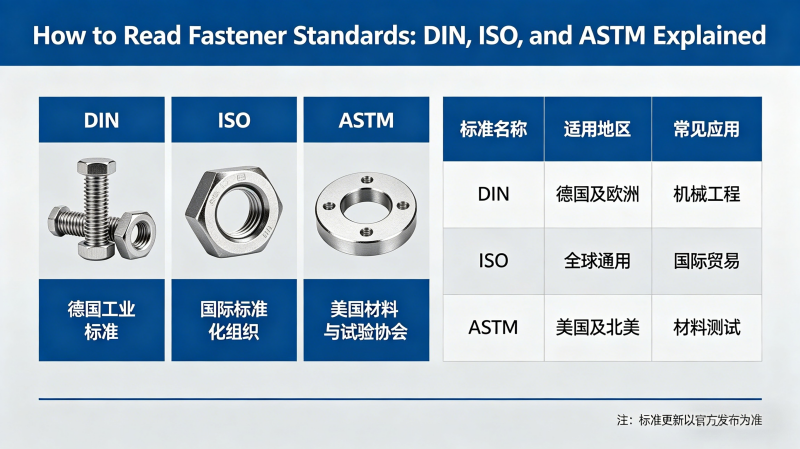
DIN – German Industrial Standards
DIN (Deutsches Institut für Normung) originated in Germany and historically shaped the European fastener industry.
Many classic fastener specifications were defined under DIN.
Typical examples include:
| DIN Standard | Description |
|---|---|
| DIN 933 | Hex bolt, fully threaded |
| DIN 931 | Hex bolt, partially threaded |
| DIN 912 | Socket head cap screw |
| DIN 125 | Flat washer |
Even though many DIN standards have been replaced by ISO equivalents, DIN numbers remain widely used in machinery drawings and spare-parts documentation.
Industries still using DIN frequently include:
- mechanical equipment manufacturing
- European automotive suppliers
- industrial machinery spare parts
In practice, many engineers still refer to bolts simply as “DIN933 bolts”, even if the supplier manufactures them according to ISO.
ISO – International Fastener Standards
ISO (International Organization for Standardization) created standards to harmonize specifications globally.
Most modern international projects now reference ISO rather than DIN.
Examples:
| ISO Standard | Equivalent DIN |
|---|---|
| ISO 4017 | DIN 933 |
| ISO 4014 | DIN 931 |
| ISO 4762 | DIN 912 |
However, “equivalent” does not mean identical.
For instance, engineers sometimes notice small dimensional differences such as:
- slightly different head heights
- minor tolerance adjustments
- updated thread length rules
These differences usually do not affect installation but can matter in precision assemblies or when clearance is tight.
ASTM – Material and Structural Performance Standards
ASTM standards are widely used in North American construction and energy industries.
Unlike DIN and ISO, ASTM standards usually focus on material properties rather than bolt geometry.
Typical ASTM fastener standards include:
| ASTM Standard | Application |
|---|---|
| ASTM A325 | Structural steel bolts |
| ASTM A490 | High-strength structural bolts |
| ASTM A193 B7 | High-temperature alloy steel bolts |
| ASTM A307 | General carbon steel bolts |
For example:
A structural bolt specification may read:
ASTM A325 Type 1, 3/4″ diameter
This tells us:
- bolt material and strength class
- heat treatment requirements
- testing requirements
But it does not define head geometry, which typically follows ASME or ANSI dimensional standards.
This is why ASTM specifications often appear alongside other standards in engineering documents.
Why a Single Bolt Can Reference Multiple Standards
In many industrial projects, a bolt specification combines several standards.
A typical specification might look like this:
ISO 4017 – M12 – Grade 10.9 – Zinc Plated
This includes:
- ISO 4017 → bolt dimensions
- M12 → nominal diameter
- Grade 10.9 → strength class
- Zinc plating → corrosion protection
In American infrastructure projects, the structure might look different:
ASTM A325 – 3/4″ – Hot-dip galvanized
Here:
- ASTM defines material strength
- ASME standards define dimensions
- coating specification defines corrosion protection
Understanding this layered specification is essential for accurate procurement.
DIN vs ISO vs ASTM: Key Differences Buyers Should Understand
1. Metric vs Imperial Systems
DIN and ISO standards are primarily metric.
Common metric sizes:
- M6
- M8
- M10
- M12
- M16
ASTM fasteners commonly use imperial sizes:
- 1/2″
- 5/8″
- 3/4″
- 1″
Ordering the wrong thread system is one of the most frequent sourcing errors.
2. Dimensional vs Material Focus
Another key difference is the purpose of the standard.
| Standard | Main Focus |
|---|---|
| DIN | Product geometry |
| ISO | Global dimensional standard |
| ASTM | Material and performance |
Because of this, ISO and ASTM are often used together rather than as alternatives.
3. Application Environment
Different industries rely on different standards.
Typical patterns include:
Europe industrial equipment
→ DIN / ISO
Global machinery exports
→ ISO
US construction and infrastructure
→ ASTM
Oil and gas projects
→ ASTM + API specifications
Understanding this context helps buyers quickly identify whether a specification makes sense for a project.
A Practical Example: Reading a Real Fastener Specification
Consider the following RFQ specification:
Hex Bolt – ISO 4017 – M16 × 80 – Grade 10.9 – Black Oxide
Breaking this down:
ISO 4017
→ bolt type (fully threaded hex bolt)
M16
→ bolt diameter
80
→ bolt length
Grade 10.9
→ high tensile strength (~1040 MPa tensile strength)
Black oxide
→ light corrosion protection, mainly for indoor equipment
From an engineering perspective, this tells us the bolt is likely intended for machinery or equipment assembly rather than structural steel.
Common Mistakes Buyers Make When Reading Fastener Standards
Assuming DIN and ISO Are Always Identical
Although many DIN standards were converted to ISO, they are not always dimensionally identical.
For most industrial assemblies this is acceptable, but high-precision equipment may require strict compliance.
Ignoring Strength Grades
Ordering:
ISO 4017 bolts
without specifying the grade could result in receiving:
- Grade 4.8
- Grade 8.8
- Grade 10.9
These bolts have completely different load capacities.
Mixing Structural and Non-Structural Bolts
A frequent mistake in construction sourcing is substituting ISO bolts for ASTM structural bolts.
Structural bolts such as ASTM A325 have:
- controlled mechanical properties
- specific heat treatment requirements
- defined inspection standards
Using general-purpose bolts instead may violate structural codes.
Procurement Checklist for Fastener Standards
Experienced buyers typically confirm the following before placing orders:
- Standard system (DIN / ISO / ASTM)
- Diameter and thread type
- Length specification method
- Strength grade or material class
- Surface treatment
- Certification requirements
When sourcing internationally, it is also important to verify whether the supplier understands cross-standard equivalence, since incorrect substitutions are common in global procurement.
You can learn more about our manufacturing capabilities on our About Us page:
https://xzfastener.com/home/about-us/
Or explore our full product range here:
https://xzfastener.com/home/products/
If your project requires non-standard fasteners or special specifications, our engineering team can also support custom production:
https://xzfastener.com/home/customized-service/
For technical questions about fastener standards or specifications, feel free to contact our team:
https://xzfastener.com/home/contact-us/
Key Takeaways
- DIN, ISO, and ASTM fastener standards serve different purposes and are not always interchangeable.
- DIN and ISO mainly define dimensions, while ASTM focuses on material and mechanical performance.
- Many bolt specifications combine multiple standards in a single description.
- Strength grade is often separate from the dimensional standard and must be specified clearly.
- Buyers should always confirm standard, thread system, material grade, and coating before ordering.
FAQ
Are DIN and ISO fasteners interchangeable?
In many cases yes, because many DIN standards were converted to ISO. However, small dimensional differences may exist, and critical engineering applications should always follow the exact specified standard.
Why do some bolts include both ISO and ASTM standards?
ISO often defines the geometry of the bolt, while ASTM defines the material and strength properties. Both may apply to the same fastener.
Are ASTM bolts stronger than ISO bolts?
Not necessarily. ASTM standards define specific mechanical requirements for certain applications, but ISO bolts can achieve similar strength levels through grades such as 10.9 or 12.9.
What is the most common fastener standard in international trade?
ISO standards are the most widely used globally because they provide harmonized specifications suitable for multinational supply chains.
How do engineers verify equivalent fastener standards?
Engineers usually consult cross-reference tables, engineering handbooks, or confirm equivalence with experienced manufacturers familiar with multiple standard systems.
Conclusion
Reading fastener standards correctly is a fundamental skill in industrial procurement. Codes like DIN 933, ISO 4017, or ASTM A325 are not product names—they represent complete engineering specifications that determine whether a fastener will perform safely in its intended application.
For machinery and equipment manufacturing, ISO standards are the most common reference. In European legacy designs, DIN standards still appear frequently, while ASTM standards dominate structural and infrastructure projects in North America.
For buyers working in international supply chains, the key is not simply recognizing these standards but understanding what each one actually defines—dimensions, materials, or performance requirements.
When specifications are unclear or involve cross-standard equivalents, consulting experienced fastener manufacturers can help ensure the correct product is selected before production begins.
 English
  Español
  Français
  Español de México
  العربية
  Deutsch
  Русский
  Tiếng Việt
  Bahasa Indonesia
  Italiano
  简体中文
简体中文