
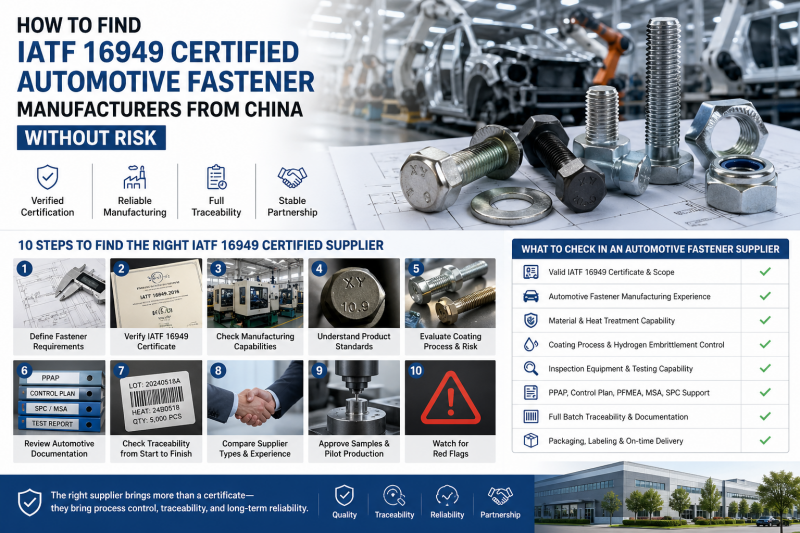
Introduction
Finding an IATF 16949 certified automotive fastener manufacturer from China is not difficult. The difficult part is knowing whether the supplier is truly suitable for your automotive project.
Many buyers only ask, “Do you have IATF 16949?” and then compare prices. This is risky. For automotive fasteners, the real question should be:
Does this factory have the correct certification scope, stable process control, material traceability, heat treatment capability, coating risk control, and documentation ability required for automotive supply?
This article explains how to verify Chinese automotive fastener manufacturers step by step, how to judge whether their IATF 16949 certification is meaningful for your project, and what practical checks can reduce sourcing risk before you place an order.
Main Content
Why IATF 16949 Matters for Automotive Fasteners
IATF 16949 is a quality management system standard for the automotive industry. It is based on ISO 9001 but adds automotive-specific requirements, including stronger focus on defect prevention, process control, traceability, customer-specific requirements, and continuous improvement.
For fastener buyers, this matters because automotive fasteners are rarely judged only by appearance or basic dimensions. A bolt, nut, stud, washer, or special cold-formed part used in an automotive assembly may need to meet requirements for:
- mechanical strength;
- material traceability;
- dimensional consistency;
- thread accuracy;
- heat treatment stability;
- coating performance;
- torque-tension behavior;
- batch identification;
- PPAP documentation;
- long-term production repeatability.
AIAG describes IATF 16949:2016 as a standard defining automotive quality management system requirements when used together with customer-specific requirements. That means the certificate itself is only one part of supplier qualification, not the whole answer.
IATF 16949 Certificate Does Not Mean Every Fastener Is Approved
This is one of the most common misunderstandings.
An IATF 16949 certificate proves that the organization has been certified for a defined quality management system scope. It does not automatically prove that every bolt, nut, washer, or custom part produced by the supplier is approved for your application.
For example, a factory may have IATF 16949 for general metal parts, but your project may require:
- class 10.9 or 12.9 high-strength bolts;
- zinc flake coating;
- special friction coefficient;
- safety-related assembly use;
- PPAP Level 3 submission;
- OEM-specific packaging labels;
- 100% sorting for critical dimensions;
- controlled heat treatment and coating suppliers.
If the factory cannot support these requirements, the certificate alone does not protect your project.
A good buyer should check three things together:
- Is the certificate valid?
- Does the certificate scope match automotive fastener manufacturing?
- Can the factory prove process capability for this exact part?
IATF 16949 vs ISO 9001 for Fastener Buyers
Not every fastener order needs IATF 16949. The right standard depends on the application.
| Item | ISO 9001 Supplier | IATF 16949 Supplier |
|---|---|---|
| Best for | General industrial fasteners, construction, machinery, distribution | Automotive OEM, Tier 1, Tier 2, EV, safety-related fasteners |
| Focus | General quality management | Automotive process control and defect prevention |
| Documentation | Basic inspection and quality records | PPAP, control plan, PFMEA, MSA, SPC if required |
| Traceability | May vary by supplier | Usually stronger batch and process traceability |
| Cost level | Usually lower | Usually higher due to quality system and documentation |
| Suitable for safety-critical automotive parts | Not always | More suitable, but still needs project verification |
ISO 9001 may be enough for standard DIN 933 bolts used in general machinery. But if the same bolt is used in an automotive bracket with customer approval requirements, IATF 16949 becomes much more important.
What Types of Automotive Fasteners Usually Require More Control?
Not all automotive fasteners carry the same risk. A plastic trim screw and a suspension bolt should not be treated the same.
Higher-Risk Automotive Fasteners
These usually require stricter supplier qualification:
- suspension bolts;
- wheel bolts and wheel nuts;
- seat belt fasteners;
- steering system fasteners;
- brake system fasteners;
- engine and transmission fasteners;
- battery pack fasteners for EVs;
- chassis structural bolts;
- high-strength flange bolts;
- special shoulder bolts;
- welded studs;
- safety-related custom fasteners.
Lower-Risk Automotive Fasteners
These may still need quality control, but may not always need full automotive approval:
- non-critical clips;
- trim screws;
- light-duty brackets;
- aftermarket maintenance fasteners;
- general replacement bolts;
- non-structural washers.
The key point is simple: the more safety-related the application, the less you should rely only on price and certificate images.
Step 1: Define the Fastener Requirement Before Searching Suppliers
Before searching for IATF 16949 certified manufacturers in China, prepare a proper technical inquiry. If your request is vague, suppliers will quote based on assumptions, and the lowest price may come from the wrong process.
Your inquiry should include:
- product name;
- drawing or standard;
- size;
- thread type;
- tolerance;
- material;
- property class;
- surface treatment;
- annual quantity;
- batch quantity;
- application;
- required documents;
- PPAP level if applicable;
- packaging and labeling requirements;
- target OEM or customer-specific requirement if relevant.
For example, “M10 bolt” is not enough.
A better inquiry is:
Hex flange bolt, M10 × 1.25 × 45, class 10.9, zinc flake coating, automotive chassis bracket use, annual demand 300,000 pcs, PPAP Level 3 required, packed by lot number with material heat traceability.
This level of detail immediately filters out suppliers that only trade standard fasteners.
If your project involves non-standard fasteners, special head markings, customized dimensions, or drawing-based production, it is better to start with an engineering review through a customized fastener service instead of asking for a quick price only.
Step 2: Verify the IATF 16949 Certificate Correctly
When a supplier sends an IATF 16949 certificate, do not stop at the logo. Check the details.
Check the Company Name
The company name on the certificate should match the actual manufacturer. If the seller is a trading company, ask clearly:
“Is this certificate from your own factory or your partner factory?”
There is nothing wrong with working with a trading company, but for automotive projects you must know the certified production source.
Check the Factory Address
The certificate must cover the actual production site. Some suppliers show a valid certificate from one factory but produce your order in another workshop. That creates traceability and approval risk.
Check the Scope
The scope should relate to the product you are buying. For automotive fasteners, look for wording related to manufacturing of fasteners, cold-formed parts, machined metal parts, threaded parts, or automotive components.
If the scope only mentions unrelated products, ask for clarification.
Check the Certification Body
IATF-recognized certification bodies are authorized to conduct IATF 16949 certification activity. Buyers can check recognized certification bodies through IATF Global Oversight resources.
Check Certificate Validity
Use the official IATF certificate validity check channel where possible. Do not rely only on a screenshot or cropped certificate image. The IATF Customer Portal provides certificate validity checking for IATF 16949 certificates.
Step 3: Check Whether the Factory Really Makes Automotive Fasteners
A supplier can be certified but still not strong in your specific fastener type. Automotive fastener manufacturing requires process control, not only final inspection.
Ask about the factory’s real production process:
| Process | Why It Matters |
|---|---|
| Cold heading | Controls head shape, grain flow, material utilization, and mass production consistency |
| Thread rolling | Affects thread strength, assembly fit, and fatigue performance |
| Heat treatment | Determines hardness, tensile strength, proof load, and toughness |
| Surface treatment | Affects corrosion resistance, torque behavior, appearance, and hydrogen embrittlement risk |
| Sorting and inspection | Reduces mixed parts, missing threads, wrong dimensions, and surface defects |
| Batch traceability | Allows problem batches to be isolated quickly |
If the supplier cannot explain these processes clearly, the risk is high even if the price looks attractive.
Step 4: Understand the Fastener Standards Behind the Quote
Automotive fastener buyers often focus on IATF 16949 but ignore product standards. That is a mistake.
For carbon steel and alloy steel bolts, screws, and studs, ISO 898-1 specifies mechanical and physical properties under defined test conditions. For nuts, ISO 898-2 covers mechanical and physical properties of nuts made from non-alloy or alloy steel.
This matters because property class is not just a mark on the head.
For example:
| Property Class | Practical Meaning | Common Risk if Poorly Controlled |
|---|---|---|
| 8.8 | Medium-high strength, widely used in machinery and automotive brackets | Wrong material or unstable heat treatment may reduce proof load |
| 10.9 | Higher strength, common in automotive structural applications | More sensitive to heat treatment and coating risks |
| 12.9 | Very high strength, often used where high clamping force is needed | Higher risk if plating, baking, and application conditions are not controlled |
For property classes such as 10.9 and 12.9, buyers should pay close attention to heat treatment records, hardness range, decarburization control, surface defects, and coating process.
Step 5: Pay Attention to Coating Risk, Not Only Salt Spray Hours
Many buyers ask only one question about coating:
“How many hours salt spray?”
This is not enough.
Automotive fastener coating should be selected based on:
- corrosion resistance;
- assembly friction coefficient;
- mating material;
- operating temperature;
- risk of hydrogen embrittlement;
- thread fit after coating;
- appearance requirement;
- customer specification.
Zinc Plating
Zinc plating is common and cost-effective, but for high-strength fasteners it requires careful control because electroplating can create hydrogen embrittlement risk. ISO 4042 covers electroplated coating systems for fasteners and includes requirements and recommendations to reduce hydrogen embrittlement risk.
Zinc Flake Coating
Zinc flake coating is often used for automotive fasteners because it is non-electrolytically applied and can offer strong corrosion protection depending on the system. ISO 10683 specifies requirements for non-electrolytically applied zinc flake coating systems for steel fasteners, including bolts, screws, studs, nuts, washers, pins, and clips.
Phosphate
Phosphate is often used where controlled friction, oil retention, or indoor corrosion resistance is needed. It is not automatically equivalent to zinc flake or zinc plating.
Practical Coating Advice
If the part is class 10.9 or 12.9 and used in a safety-related automotive assembly, do not choose coating only by price. Ask the supplier:
- Is the coating done in-house or outsourced?
- Can you provide coating thickness records?
- Can you control friction coefficient if required?
- Is baking required after electroplating?
- Can you provide salt spray test reports?
- Can you ensure thread go/no-go inspection after coating?
Step 6: Ask for Real Automotive Documentation
For automotive sourcing, documents are not “extra paperwork.” They are part of risk control.
Depending on the project, a qualified supplier should be able to provide:
- material certificate;
- chemical composition report;
- mechanical test report;
- hardness test report;
- dimensional inspection report;
- thread gauge inspection record;
- heat treatment report;
- coating thickness report;
- salt spray report if required;
- process flow chart;
- control plan;
- PFMEA;
- MSA report;
- SPC data for critical dimensions;
- PPAP package if required.
AIAG describes PPAP as the industry standard used to define the production part approval process and to help ensure design record and specification requirements are consistently met by the supplier’s manufacturing process.
For small aftermarket orders, you may not need a full PPAP package. For OEM or Tier projects, you should discuss PPAP requirements before sampling, not after production.
Step 7: Check Traceability from Steel Wire to Final Carton
Traceability is one of the biggest differences between ordinary fastener supply and automotive fastener supply.
For an automotive bolt, the supplier should ideally be able to trace:
- steel wire supplier;
- steel grade;
- heat number;
- incoming inspection;
- cold heading batch;
- thread rolling batch;
- heat treatment batch;
- coating batch;
- final inspection record;
- packing label;
- shipment lot.
This matters because if a defect appears later, you need to isolate the affected lot quickly. Without traceability, one small problem can become a full shipment rejection.
A practical question to ask the supplier:
“If we find one defective bolt after delivery, can you trace which heat number, production date, heat treatment batch, and coating batch it came from?”
If the answer is unclear, the supplier may not be ready for automotive supply.
Step 8: Compare Supplier Types Before Choosing
Not all Chinese suppliers are the same. Understanding supplier type helps you avoid wrong expectations.
| Supplier Type | Suitable For | Main Advantage | Main Risk |
|---|---|---|---|
| IATF 16949 certified fastener factory | Automotive serial production, custom fasteners, Tier projects | Better process control and documents | Higher MOQ and higher cost |
| ISO 9001 fastener factory | General industrial fasteners, standard parts | More flexible and cost-effective | May not support PPAP or automotive traceability |
| Trading company | Mixed products, small orders, export coordination | Convenient communication and sourcing | Actual manufacturer may be unclear |
| Coating or heat treatment subcontractor | Specialized process support | Technical process capability | Needs supplier control and documentation |
For automotive fasteners, a trading company can still be useful, especially for export coordination and mixed orders. But the actual production factory must be visible and qualified.
You can also review a supplier’s company background, export experience, and product focus through an About Us page before starting technical discussion.
Step 9: Do Not Skip Sample Approval and Pilot Production
For custom automotive fasteners, avoid going directly from quotation to mass production.
A safer process is:
- drawing review;
- feasibility confirmation;
- tooling discussion if needed;
- sample production;
- dimensional inspection;
- mechanical testing;
- coating verification;
- customer approval;
- PPAP submission if required;
- pilot production;
- mass production.
For new suppliers, a pilot order is especially important. It helps verify not only product quality, but also communication, lead time, packaging, document accuracy, and problem-solving ability.
Step 10: Watch for These Red Flags
Be careful if a supplier shows any of these signs:
The Supplier Only Sends a Certificate Image
A serious supplier should provide a complete certificate PDF with company name, address, scope, certificate number, validity, and certification body.
The Certificate Scope Is Too Vague
If the certificate does not clearly relate to automotive parts or fastener manufacturing, ask for more information.
The Price Is Much Lower Than Other IATF Suppliers
For automotive fasteners, a very low price may mean:
- wrong material;
- no proper heat treatment control;
- coating shortcut;
- missing inspection;
- subcontracted production;
- no PPAP support;
- poor traceability.
The Supplier Cannot Explain Heat Treatment
For class 8.8, 10.9, and 12.9 fasteners, heat treatment is not a minor detail. If the supplier cannot explain whether heat treatment is in-house or outsourced, be careful.
The Supplier Says “No Problem” to Every Requirement
A reliable manufacturer will confirm details, ask technical questions, and sometimes say certain requirements need testing or customer confirmation. A supplier that agrees to everything immediately may not understand the project.
The Supplier Does Not Ask About Application
Automotive fastener selection depends on application. A good supplier should ask where the part will be used, whether it is safety-related, what coating is required, and whether PPAP is needed.
Practical Sourcing Checklist
Before confirming an automotive fastener supplier from China, use this checklist.
| Check Point | What to Ask | Good Sign |
|---|---|---|
| Certificate | Can you provide full IATF 16949 certificate PDF? | Clear certificate with valid scope |
| Factory site | Is this the actual production site? | Address matches production location |
| Product scope | Have you produced similar automotive fasteners? | Similar drawings or project experience |
| Material | Can you provide heat number traceability? | Material certificate by batch |
| Heat treatment | In-house or outsourced? Any records? | Batch records and hardness reports |
| Coating | Which coating standard or customer spec? | Coating thickness and test reports |
| Inspection | What equipment do you use? | Thread gauges, hardness tester, tensile test support |
| PPAP | Can you support PPAP if required? | Understands control plan, PFMEA, MSA, SPC |
| Packaging | Can you label by lot number? | Clear batch labels and carton marks |
| Delivery | What is sample and production lead time? | Realistic schedule, not vague promise |
If you are still at the product selection stage, you can first check available fastener categories on the All Products page and then prepare a more accurate inquiry.
How to Choose the Right Supplier Based on Your Situation
Choose an IATF 16949 Certified Factory If:
- the part is used in OEM or Tier supply chain;
- PPAP is required;
- the fastener is safety-related;
- annual demand is stable;
- customer-specific requirements apply;
- traceability is mandatory;
- coating and heat treatment risks are high.
Choose an ISO 9001 Factory If:
- the part is used in general machinery;
- there is no automotive approval requirement;
- the order is small or one-time;
- basic material and inspection reports are enough;
- price flexibility is more important than PPAP.
Choose a Trading Company If:
- you need mixed fastener products;
- order quantity is not large;
- export coordination is important;
- the trader can disclose and manage the real factory;
- automotive approval is not highly complex.
Choose a Custom Fastener Manufacturer If:
- the product is drawing-based;
- the head shape, thread, shoulder, or coating is special;
- tooling is needed;
- the part requires trial production;
- your customer needs sample approval before mass production.
For automotive custom parts, do not judge only by unit price. Tooling accuracy, process stability, inspection capability, and engineering communication often decide whether the project succeeds.
Key Takeaways
- IATF 16949 certification is important, but it is not enough. Buyers must verify certificate validity, scope, factory address, and certification body.
- Automotive fastener risk usually comes from process control, not appearance. Heat treatment, coating, thread accuracy, material traceability, and batch control matter more than a clean surface.
- High-strength fasteners need special attention. For class 10.9 and 12.9 parts, coating and hydrogen embrittlement risk must be reviewed carefully.
- PPAP capability should be discussed before sampling. If your customer requires PPAP, confirm documents, control plan, PFMEA, MSA, and SPC capability early.
- The lowest price is not always the safest choice. For automotive projects, supplier reliability, traceability, and documentation often save more cost than a small unit price difference.
FAQ
1. Is IATF 16949 required for all automotive fasteners?
No. It depends on the customer, application, and risk level. OEM, Tier 1, Tier 2, safety-related, and long-term serial production projects often require IATF 16949 or equivalent automotive quality control. For low-risk aftermarket or general replacement fasteners, ISO 9001 with proper inspection documents may be acceptable.
2. How can I verify if a Chinese supplier’s IATF 16949 certificate is real?
Ask for the full certificate PDF and check the company name, address, scope, certificate number, certification body, and validity. The production site on the certificate should match the actual factory making your parts. You can also use the official IATF certificate validity check resources where available.
3. What documents should I request for automotive fasteners?
For basic automotive orders, request material certificate, dimensional report, hardness report, coating report, and batch traceability. For OEM or Tier projects, you may also need PPAP, control plan, process flow, PFMEA, MSA, SPC data, and customer-specific documentation.
4. Can a trading company supply IATF 16949 automotive fasteners?
Yes, but the actual manufacturer must be clear. The certificate should belong to the real production factory, not just a partner used for marketing. For safety-related or PPAP projects, direct factory visibility is strongly recommended.
5. What is the biggest risk when buying automotive fasteners from China?
The biggest risk is not usually fake appearance. It is uncontrolled process variation: wrong material, unstable heat treatment, improper coating, missing traceability, weak inspection, or documents that do not match the production batch.
Conclusion
Finding an IATF 16949 certified automotive fastener manufacturer from China should not be treated as a simple supplier search. For automotive fasteners, the real sourcing work is supplier verification.
A safe decision should be based on certificate validity, manufacturing scope, process control, material traceability, heat treatment capability, coating risk management, PPAP support, and commercial reliability.
If your project is a standard, low-risk fastener order, an experienced ISO 9001 supplier may be enough. If your project involves automotive OEM, Tier supply, EV parts, high-strength bolts, safety-related assemblies, or PPAP requirements, choose an IATF 16949 certified manufacturer with proven fastener production experience and strong documentation control.
Before placing an order, prepare a clear technical inquiry, verify the certificate, request sample approval, confirm required documents, and start with a pilot batch when possible.
For project discussion, technical review, or quotation support, you can contact the team through Contact Us.
 English
  Español
  Français
  Español de México
  العربية
  Deutsch
  Русский
  Tiếng Việt
  Bahasa Indonesia
  Italiano
  简体中文
简体中文