
Introduction
When selecting fasteners for construction, infrastructure, or outdoor equipment, corrosion protection is often the deciding factor. Two of the most common surface treatments are hot-dip galvanizing and zinc plating. At first glance, both appear to provide similar protection because they use zinc coatings. In reality, they perform very differently in terms of coating thickness, durability, installation compatibility, and cost.
Choosing the wrong finish can lead to premature rust, seized threads, or unnecessary project costs. This guide explains the real differences between hot-dip galvanized and zinc plated fasteners, where each option works best, and how engineers, contractors, and buyers should evaluate them before purchasing.
What Are Zinc Coated Fasteners?
Zinc coatings are widely used to protect carbon steel fasteners from corrosion. Zinc acts as a sacrificial layer, meaning it corrodes first and protects the underlying steel from rust.
The two most common industrial processes are:
- Hot-Dip Galvanizing (HDG)
- Electroplated Zinc (Zinc Plating)
Although both involve zinc, the coating process, thickness, and durability are very different.
What Are Hot-Dip Galvanized Fasteners?
Hot-dip galvanizing involves immersing steel fasteners in molten zinc at approximately 450°C (842°F). The zinc reacts with the steel surface to form a thick, metallurgically bonded coating.
Key Characteristics
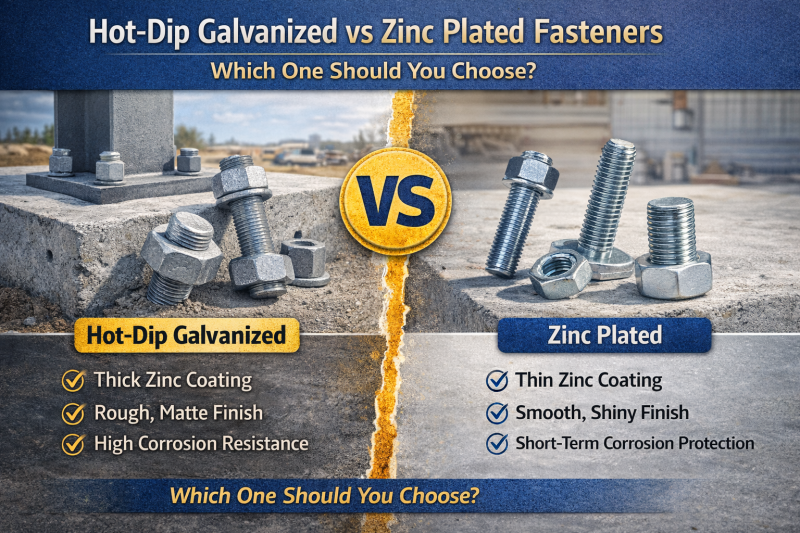
Coating thickness
Typically 40–80 microns, sometimes thicker depending on the standard and fastener size.
Surface appearance
- Matte gray
- Slightly rough texture
- Thicker coating that may slightly affect thread fit
Corrosion resistance
Because of the thick zinc layer, hot-dip galvanized fasteners can provide long-term corrosion protection, especially in outdoor environments.
Typical Applications
Hot-dip galvanized fasteners are commonly used in:
- Structural steel construction
- Bridges and highway infrastructure
- Utility poles and transmission towers
- Solar mounting systems
- Outdoor steel structures
In these applications, fasteners may remain exposed to rain, humidity, and temperature changes for decades.
What Are Zinc Plated Fasteners?
Zinc plating (also called electroplating) deposits a thin zinc layer onto the fastener using an electrical process.
Key Characteristics
Coating thickness
Typically 5–12 microns, much thinner than hot-dip galvanizing.
Surface appearance
- Smooth finish
- Bright or blue-white color
- More precise thread dimensions
Corrosion resistance
Zinc plated fasteners provide short-term corrosion protection, especially in indoor or controlled environments.
Typical Applications
Zinc plated fasteners are often used in:
- Machinery assembly
- Automotive components
- Electrical equipment
- Indoor metal structures
- Consumer products
They are suitable when appearance, thread precision, and lower cost are priorities.
Key Differences Between Hot-Dip Galvanized and Zinc Plated Fasteners
1. Coating Thickness
One of the most important differences is coating thickness.
| Coating Type | Typical Thickness |
|---|---|
| Zinc Plated | 5–12 μm |
| Hot-Dip Galvanized | 40–80 μm |
This difference significantly affects corrosion resistance and service life.
2. Corrosion Resistance
Hot-dip galvanizing offers much longer corrosion protection because of its thicker coating.
General comparison:
- Zinc plated: suitable for indoor environments
- Hot-dip galvanized: suitable for outdoor and harsh environments
In coastal areas, industrial environments, or infrastructure projects, zinc plating usually cannot provide sufficient long-term protection.
3. Surface Finish and Appearance
Zinc plated fasteners typically have a bright, smooth appearance, which is preferred in visible assemblies or consumer-facing products.
Hot-dip galvanized fasteners have a matte, industrial appearance, which is usually acceptable in structural applications but less suitable for aesthetic components.
4. Thread Fit and Tolerance
Because hot-dip galvanizing adds a thick coating, it can affect thread dimensions.
Common industry practice includes:
- Using oversized tapped nuts for hot-dip galvanized bolts
- Following standards such as ASTM A153 or ASTM F2329
Zinc plated fasteners maintain tighter tolerances and usually fit standard nuts without adjustment.
5. Cost Differences
Zinc plating is generally less expensive due to:
- Lower material usage
- Faster processing
- Simpler equipment
Hot-dip galvanizing costs more but provides longer service life, which often makes it more economical in long-term outdoor projects.
When to Choose Hot-Dip Galvanized Fasteners
Hot-dip galvanized fasteners are usually the better choice when:
- The structure will be installed outdoors
- Long service life is required (10–30+ years)
- Exposure includes rain, humidity, or temperature cycling
- The project involves infrastructure, construction, or utility systems
Typical examples include:
- Solar mounting structures
- Highway guardrails
- Steel towers
- Agricultural buildings
In these cases, the thicker zinc layer significantly slows corrosion.
When Zinc Plated Fasteners Are the Better Option
Zinc plated fasteners are often more suitable when:
- The environment is indoor or dry
- Appearance is important
- Tight thread tolerance is required
- The application is machinery or equipment assembly
- Cost control is important for high-volume components
Typical examples include:
- Equipment housings
- Electrical cabinets
- Automotive assemblies
- Mechanical devices
Using hot-dip galvanizing in these applications may create unnecessary cost and assembly difficulties.
Common Mistakes Buyers Make
Assuming All Zinc Coatings Are the Same
Many buyers assume “zinc coated” means the same level of protection. In reality, coating thickness varies dramatically.
Using Zinc Plated Fasteners Outdoors
Zinc plated fasteners can begin showing corrosion within a relatively short time when exposed to rain or humidity.
Ignoring Thread Compatibility
Hot-dip galvanized bolts often require compatible nuts designed for galvanized coatings.
Choosing Based Only on Price
The lowest initial cost does not always result in the lowest lifecycle cost. Replacing corroded fasteners can be far more expensive than selecting the correct coating initially.
Key Takeaways
- Hot-dip galvanized fasteners have much thicker zinc coatings and provide significantly better corrosion protection.
- Zinc plated fasteners are thinner, smoother, and better suited for indoor or controlled environments.
- Outdoor structures, infrastructure, and long-life installations typically require hot-dip galvanizing.
- Zinc plating is often preferred for machinery, equipment assembly, and applications requiring precise threads.
- The right choice depends primarily on environmental exposure, service life requirements, and thread tolerance needs.
FAQ
Are hot-dip galvanized fasteners stronger than zinc plated fasteners?
The coating itself does not increase the mechanical strength of the fastener. However, hot-dip galvanizing provides better corrosion protection, which helps maintain structural integrity over time.
Can zinc plated fasteners be used outdoors?
They can be used outdoors temporarily, but they generally do not provide long-term corrosion resistance in outdoor environments.
Do hot-dip galvanized bolts require special nuts?
Yes. Because the coating is thicker, galvanized bolts are usually paired with oversized or galvanized nuts to ensure proper thread engagement.
Why do galvanized fasteners look rougher than zinc plated ones?
Hot-dip galvanizing forms a thicker zinc layer through a chemical reaction with steel, creating a matte and slightly textured surface.
Is stainless steel better than galvanized fasteners?
In highly corrosive environments (such as marine conditions), stainless steel may offer better corrosion resistance. However, it is usually more expensive and not always necessary for standard outdoor structures.
Conclusion
Hot-dip galvanized and zinc plated fasteners both rely on zinc for corrosion protection, but they serve very different purposes. Hot-dip galvanizing provides a thick, durable coating designed for long-term outdoor exposure, while zinc plating offers a thin, precise finish suitable for indoor assemblies and mechanical equipment.
For construction, infrastructure, solar mounting systems, or other outdoor steel structures, hot-dip galvanized fasteners are typically the safer and more durable choice. For machinery, indoor equipment, and applications requiring smooth appearance and tight thread tolerances, zinc plated fasteners are usually more practical.
Before making a purchasing decision, buyers should evaluate three key factors: environmental exposure, required service life, and thread compatibility. Taking these into account helps ensure the fasteners will perform reliably throughout the lifecycle of the project.
 English
  Español
  Français
  Español de México
  العربية
  Deutsch
  Русский
  Tiếng Việt
  Bahasa Indonesia
  Italiano
  简体中文
简体中文