
Introduction
If you’ve ever purchased stainless steel fasteners, you’ve almost certainly encountered the terms “A2” and “A4”. These are the two most common grades used in industrial fasteners, but they are not interchangeable. Choosing the wrong grade can lead to premature corrosion, structural failure, and unnecessary costs.
This guide will explain exactly what A2 and A4 stainless steel are, how they differ in composition and performance, where each should (and should not) be used, and provide a clear decision framework to help you make the right choice for your specific project.
Main Content
What Are A2 and A4 Stainless Steel Fasteners?
A2 and A4 are designations defined by the ISO 3506 standard for corrosion-resistant stainless steel fasteners. They correspond to the widely recognized American Iron and Steel Institute (AISI) grades 304 and 316 respectively.
These are both austenitic stainless steels, which means they have a face-centered cubic crystal structure that provides excellent formability, weldability, and corrosion resistance. They are non-magnetic in their annealed condition, though they can become slightly magnetic after cold working.
- A2 (AISI 304): The most commonly used stainless steel grade worldwide. It accounts for approximately 70% of all stainless steel fastener production.
- A4 (AISI 316): A higher-alloyed grade specifically formulated for improved corrosion resistance, particularly in chloride-containing environments.
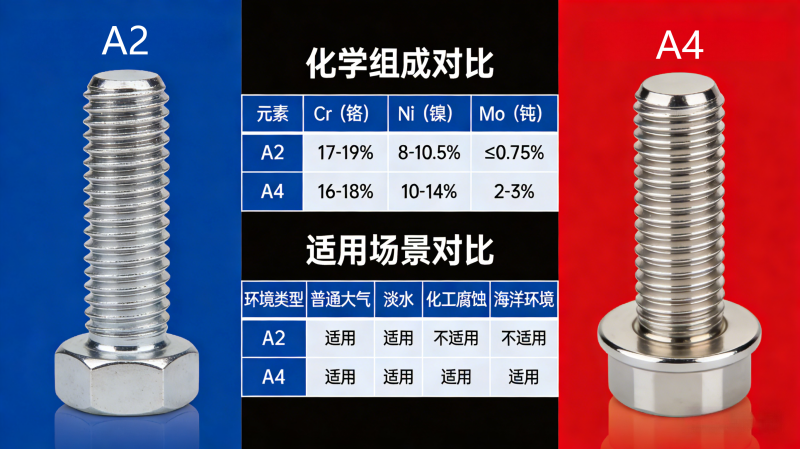
A2 vs A4: Core Chemical Composition Differences
The primary difference between A2 and A4 lies in their chemical composition, specifically the addition of molybdenum in A4.
表格
| Element | A2 (304) Stainless Steel | A4 (316) Stainless Steel |
|---|---|---|
| Chromium | 18.0-20.0% | 16.0-18.5% |
| Nickel | 8.0-10.5% | 10.0-14.0% |
| Molybdenum | ≤ 0.75% | 2.0-3.0% |
| Carbon | ≤ 0.08% | ≤ 0.08% |
| Manganese | ≤ 2.0% | ≤ 2.0% |
| Silicon | ≤ 1.0% | ≤ 1.0% |
| Phosphorus | ≤ 0.045% | ≤ 0.045% |
| Sulfur | ≤ 0.03% | ≤ 0.03% |
The 2-3% molybdenum content in A4 is the game-changer. It significantly enhances resistance to pitting and crevice corrosion caused by chlorides, which is why A4 is often referred to as “marine grade” stainless steel.
A2 vs A4: Key Performance Characteristics
While both grades offer good corrosion resistance compared to carbon steel, their performance differs significantly in specific environments.
Corrosion Resistance
- A2: Provides excellent resistance to atmospheric corrosion, fresh water, most organic acids, and mild alkaline solutions. However, it will corrode in environments with high chloride concentrations (such as seawater, de-icing salts, and many industrial chemicals).
- A4: Offers superior resistance to chloride-induced pitting and crevice corrosion. It can withstand prolonged exposure to seawater, brackish water, and many industrial chemicals that would quickly degrade A2.
Mechanical Properties
At room temperature, A2 and A4 have nearly identical mechanical properties when produced to the same strength class (typically class 70 or 80 for bolts and screws).
- Tensile strength: 700-800 N/mm² (class 70-80)
- Yield strength: 450-640 N/mm² (class 70-80)
- Hardness: 200-250 HV
However, A4 retains its strength better at elevated temperatures (up to approximately 870°C vs 815°C for A2) and has slightly better toughness at sub-zero temperatures.
Cost
A4 fasteners are typically 30-50% more expensive than equivalent A2 fasteners. This price difference is due to the higher nickel and molybdenum content, as well as more complex manufacturing processes.
Availability
A2 fasteners are available in virtually every size, thread type, and head style imaginable. A4 fasteners are widely available but may have more limited options in very large sizes or specialized head styles.
A2 Stainless Steel Fasteners: Ideal Applications and Limitations
A2 is the workhorse of stainless steel fasteners. It is the best choice for most general-purpose applications where extreme corrosion resistance is not required.
Best Applications for A2 Fasteners
- Indoor construction and furniture assembly
- Outdoor applications in rural or suburban areas with low pollution
- Food processing equipment (non-saline environments)
- Kitchen appliances and fixtures
- Automotive components (excluding underbody parts exposed to road salt)
- HVAC systems
- General industrial machinery
Where A2 Should NOT Be Used
- Coastal or marine environments within 5 km of the ocean
- Areas where de-icing salts are regularly used
- Chemical processing plants handling chlorides or acids
- Swimming pool equipment and structures
- Wastewater treatment facilities
- Any application where fasteners will be buried in soil containing chlorides
A4 Stainless Steel Fasteners: Ideal Applications and Limitations
A4 is the premium choice for applications where corrosion resistance is critical. While more expensive, it can prevent costly failures and reduce maintenance requirements in harsh environments.
Best Applications for A4 Fasteners
- Marine and offshore equipment
- Coastal construction and infrastructure
- Bridges and roadways in areas using de-icing salts
- Swimming pool structures and equipment
- Chemical processing plants
- Wastewater treatment facilities
- Food processing equipment handling brines or salty foods
- Medical devices and surgical instruments
- Outdoor equipment in industrial or polluted areas
Where A4 Should NOT Be Used
- General-purpose indoor applications (overkill and unnecessary expense)
- Applications requiring high strength at temperatures above 870°C
- Environments with strong reducing acids (such as hydrochloric acid at high concentrations)
- Applications where galvanic corrosion with dissimilar metals is a significant concern (A4 is slightly more noble than A2)
How to Choose Between A2 and A4: 7 Critical Decision Factors
Use this step-by-step framework to make the right choice for your project:
1. Evaluate the Corrosive Environment
This is the single most important factor. Ask yourself:
- Will the fasteners be exposed to saltwater, brackish water, or de-icing salts?
- Will they come into contact with industrial chemicals or cleaning agents?
- What is the humidity and temperature range?
- Will the fasteners be subject to crevice conditions where moisture can be trapped?
If the answer to any of these questions is yes, A4 is almost certainly the better choice.
2. Consider the Project Lifespan
For temporary structures or projects with a lifespan of less than 5 years, A2 may be sufficient even in moderately corrosive environments. For permanent structures or equipment expected to last 10+ years, A4 is often the more economical choice when considering total lifecycle costs.
3. Assess the Structural Importance
If fastener failure could result in personal injury, significant property damage, or costly downtime, always err on the side of caution and choose A4 in borderline cases.
4. Calculate Total Cost of Ownership
While A4 fasteners have a higher upfront cost, they can save money in the long run by:
- Eliminating the need for frequent replacement
- Reducing maintenance costs
- Preventing costly downtime due to fastener failure
- Avoiding structural damage caused by corroded fasteners
5. Check Regulatory and Industry Requirements
Certain industries have specific requirements for fastener materials. For example:
- Marine industry often mandates A4 stainless steel
- Food and pharmaceutical industries may require specific grades
- Building codes in coastal areas may specify A4 for structural fasteners
6. Evaluate Availability and Lead Times
For urgent projects, check the availability of A4 fasteners in the required sizes and styles. In some cases, A2 may be the only option that can be delivered quickly.
7. Consider Galvanic Compatibility
Ensure that the fastener material is compatible with the materials being joined. Both A2 and A4 are compatible with each other and with most other stainless steels. However, they can cause galvanic corrosion when in direct contact with aluminum, magnesium, or zinc-plated steel in wet environments.
3 Most Common Mistakes When Choosing Stainless Steel Fasteners
Avoid these costly errors that many buyers make:
1. Assuming “Stainless Steel Means Rust-Proof”
No stainless steel is completely rust-proof. All stainless steels will corrode under the right conditions. A2 will rust much faster than A4 in chloride-containing environments.
2. Always Choosing the Cheapest Option
Using A2 fasteners where A4 is required is a false economy. The cost of replacing corroded fasteners and repairing any damage they cause is almost always much higher than the initial savings.
3. Over-Specifying A4 for Every Application
While A4 is more corrosion-resistant, it is not necessary for every application. Using A4 fasteners indoors or in mild environments wastes money and provides no practical benefit.
Key Takeaways
- A2 (304) is the general-purpose workhorse suitable for most indoor and mild outdoor applications, offering good corrosion resistance at an affordable price.
- A4 (316) is the premium corrosion-resistant grade containing molybdenum, making it essential for coastal, marine, and industrial environments with chloride exposure.
- Corrosive environment is the primary decision factor. If fasteners will be exposed to saltwater, de-icing salts, or industrial chemicals, choose A4.
- Consider total lifecycle cost, not just upfront price. A4 often saves money in the long run by preventing failures and reducing maintenance.
- Avoid both under-specifying and over-specifying. Use A2 where it’s sufficient and A4 only where it’s necessary.
FAQ
Q: Can I use A2 fasteners near the ocean?
A: Generally not recommended within 5 km of the coast, especially in areas with salt spray. A2 fasteners will develop surface rust within 1-2 years and may fail structurally within 5-10 years. A4 is the appropriate choice for coastal applications.
Q: Are A4 fasteners stronger than A2 fasteners?
A: No, when produced to the same strength class (e.g., class 80), A2 and A4 fasteners have identical mechanical properties at room temperature. The difference is in corrosion resistance, not strength.
Q: Can I mix A2 and A4 fasteners in the same application?
A: Yes, they are galvanically compatible with each other. However, ensure that all fasteners exposed to the same corrosive environment are of the same grade to prevent uneven corrosion.
Q: How can I tell the difference between A2 and A4 fasteners?
A: Reputable manufacturers will stamp fasteners with their grade designation (A2 or A4) on the head of bolts and screws. If not marked, you can use a stainless steel test kit that detects molybdenum content.
Q: Is there a grade better than A4 for extreme corrosion?
A: Yes, grades like A5 (316L), A6 (317L), and duplex stainless steels offer even better corrosion resistance for extremely harsh environments. However, they are significantly more expensive and less readily available.
Conclusion
Choosing between A2 and A4 stainless steel fasteners doesn’t have to be complicated. The decision ultimately comes down to matching the fastener’s corrosion resistance to the specific environment it will operate in.
For most general-purpose applications indoors or in mild outdoor environments, A2 (304) is the best choice. It offers excellent performance at a reasonable price and is widely available in all sizes and styles.
For any application involving exposure to saltwater, de-icing salts, or industrial chemicals, A4 (316) is essential. While it costs more upfront, it will provide reliable performance for many years and prevent the costly consequences of fastener failure.
When in doubt, always consult with a knowledgeable fastener supplier who can help you evaluate your specific application and recommend the most appropriate material. Remember that the cheapest fastener is rarely the most economical choice in the long run.
Need help finding the right stainless steel fasteners for your project? Our team of experts can provide personalized recommendations based on your specific requirements and environmental conditions.
Would you like me to add a quick decision flowchart that visually summarizes the A2 vs A4 selection process for your blog?
 English
  Español
  Français
  Español de México
  العربية
  Deutsch
  Русский
  Tiếng Việt
  Bahasa Indonesia
  Italiano
  简体中文
简体中文