




DIN 933 vs DIN 931: How to Choose Between Fully Threaded and Partially Threaded Hex Bolts
If you are comparing DIN 933 and DIN 931, the key question is usually not just “what standard is this?” but “which one should I actually buy for my assembly?” The answer affects clamp performance, fit-up, shear behavior, installation convenience, and even whether your order arrives usable for the job.
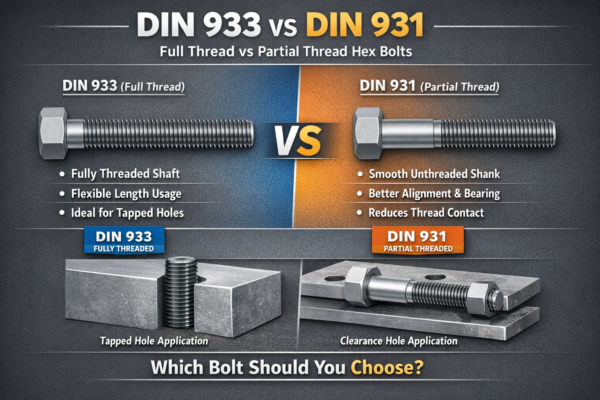
In simple terms, DIN 933 is a fully threaded hex head fastener, while DIN 931 is a partially threaded hex head bolt with an unthreaded shank. For buyers, distributors, and project teams, that difference matters far more than the standard number itself.
What Are DIN 933 and DIN 931?
DIN 933
DIN 933 refers to a hex head fastener with full thread along the body. It is commonly used when full-thread engagement is needed or when greater installation flexibility is preferred.
DIN 931
DIN 931 refers to a hex head fastener with a partially threaded body. Between the head and the threaded portion, there is a smooth, unthreaded shank. This design is often selected when the shank should pass through the clamped parts.
The Simplest Way to Remember the Difference
- DIN 933 = fully threaded
- DIN 931 = partially threaded with shank
DIN 933 vs DIN 931: What Is the Actual Difference?
1. Thread Length
This is the core difference. DIN 933 is threaded almost the entire length, while DIN 931 has a plain shank and a shorter threaded section. In real applications, this affects how the bolt sits inside the assembly and whether the thread enters the clamped area.
2. Joint Performance
In assemblies using nuts and clearance holes, DIN 931 can position the smooth shank inside the working section of the joint. That can reduce thread contact with the hole wall and improve bearing in some mechanical or structural applications. DIN 933, by contrast, offers more flexibility but may leave threads inside the shear plane if the length is not chosen carefully.
3. Installation Flexibility
DIN 933 is often easier to use when grip thickness varies between jobs. Because it is fully threaded, it adapts more easily to different clamped thicknesses. DIN 931 requires more accurate length selection, otherwise the shank may be too long or the thread may end up inside the wrong part of the joint.
4. Market Naming Confusion
Many buyers use “hex bolt” and “hex screw” interchangeably, but in practice suppliers may quote either DIN 933 or DIN 931 unless the standard is clearly specified. That is why standard number matters in RFQs and purchase orders.
When Should You Choose DIN 933?
DIN 933 is usually the better choice in the following situations:
- When you need full thread engagement
- When the fastener goes into a tapped hole
- When the clamped thickness varies from one application to another
- When you want a more general-purpose stock item
- When there is no specific need to keep the thread outside the working section of the joint
For distributors and general industrial buyers, DIN 933 is often easier to stock because it suits a wider range of routine applications without requiring detailed grip calculations.
When Should You Choose DIN 931?
DIN 931 is usually the better choice in these cases:
- When you want the smooth shank to sit inside the clamped parts
- When the assembly uses clearance holes plus nut fastening
- When alignment and bearing inside the hole matter
- When you want to reduce thread contact within the joint area
- When the application allows accurate bolt length selection
DIN 931 is commonly preferred in machinery frames, steel structures, brackets, flange connections, and other assemblies where the joint design benefits from an unthreaded grip section.
Is DIN 931 Stronger Than DIN 933?
Not automatically. This is one of the most common misunderstandings in fastener purchasing.
A partially threaded bolt is not “stronger” simply because it has a smooth shank. Real performance depends on the property class, material, diameter, grip length, joint design, and whether the working load acts across the threaded or unthreaded portion.
The more useful question is not “which one is stronger in general?” but “where do I need the thread to be in this assembly?”
Common Materials and Finishes
Both DIN 933 and DIN 931 are commonly available in carbon steel and stainless steel. Depending on the application, they may also be supplied with surface finishes such as plain, zinc plated, or hot-dip galvanized.
However, the standard number alone does not define the material or strength class. A purchase order that only says “DIN 931 bolt” or “DIN 933 bolt” is incomplete.
At Minimum, a Buyer Should Confirm:
- Diameter and length
- Material or grade
- Property class for carbon steel
- Finish or coating
- Thread type or pitch if non-standard
- Quantity and packaging requirements
DIN 933 and DIN 931 vs ISO Alternatives
In export business, buyers often see DIN 933 compared with ISO 4017 and DIN 931 compared with ISO 4014. In many cases, they are treated as corresponding standards, but that does not mean every dimension is automatically identical in every size.
If a customer drawing names an exact DIN standard, or if wrench clearance and mating dimensions are critical, do not approve substitution based only on a similar standard number. Always verify the actual dimensions before confirming equivalence.
How to Choose Between DIN 933 and DIN 931
Choose DIN 933 if:
- You need full thread flexibility
- The bolt goes into a tapped hole
- The grip thickness is not fixed
- You want easier stocking for general-purpose supply
- You do not need the shank to sit inside the working section of the joint
Choose DIN 931 if:
- You need the plain shank inside the joint
- The assembly uses a nut and clearance holes
- The joint benefits from better alignment and bearing
- You want to reduce thread contact inside the clamped parts
- You can calculate the correct length based on the actual grip thickness
A Practical Rule for Buyers
If the application is general and not tightly engineered, DIN 933 is often the safer default. If the assembly clearly depends on an unthreaded grip section, DIN 931 is usually the better choice.
Common Purchasing Mistakes
Ordering DIN 931 Without Checking Grip Length
This is the most common mistake. Buyers focus on diameter and overall length but forget to verify whether the shank and thread will sit in the correct positions inside the assembly.
Assuming DIN and ISO Are Always Interchangeable
Similar standards are not always identical in every detail. Dimensional differences can matter in real projects, especially when assemblies are already designed or manufactured.
Using “Hex Bolt” as a Generic Name
If the inquiry only says “hex bolt M16 x 80,” suppliers may quote full thread or partial thread depending on their interpretation. That can easily lead to the wrong product being ordered.
Ignoring Material and Strength Class
DIN 933 or DIN 931 only describes the type of fastener. It does not define whether the product is stainless steel, carbon steel, 8.8, 10.9, or hot-dip galvanized.
Assuming Partial Thread Is Always Better
DIN 931 is only better when the joint design actually benefits from the shank. Otherwise, it may simply make purchasing more complicated.
Procurement Tips Before You Place an Order
- Confirm whether the fastener uses a nut or goes into a tapped hole.
- Check the total grip thickness of the clamped parts.
- Understand whether the load is mainly tensile, shear, or mixed.
- Verify whether ISO substitution is acceptable if the drawing specifies DIN.
- Check the service environment before choosing material and coating.
These five checks prevent most ordering mistakes and help avoid expensive rework, especially in export and project-based procurement.
Key Takeaways
- DIN 933 is fully threaded, while DIN 931 is partially threaded with a shank.
- Choose DIN 933 for flexibility, tapped holes, and general stock applications.
- Choose DIN 931 when the assembly benefits from a smooth shank inside the joint.
- DIN 931 is not automatically stronger; the correct choice depends on the joint design.
- The biggest purchasing mistake is ordering DIN 931 without checking grip length.
FAQ
Is DIN 933 fully threaded?
Yes. DIN 933 is the fully threaded version of a hex head fastener.
Is DIN 931 partially threaded?
Yes. DIN 931 has a smooth, unthreaded shank between the head and the threaded portion.
Which is better for structural or mechanical assemblies?
In many structural or mechanical joints, DIN 931 is preferred when the plain shank should pass through the clamped parts. However, it only works properly if the selected bolt length matches the grip thickness.
Can DIN 933 replace DIN 931?
Sometimes, but not by default. If the application depends on the smooth shank for alignment, bearing, or joint behavior, DIN 933 may not be a suitable substitute.
What should I include in an RFQ?
At minimum, specify the standard, diameter, length, material, property class, finish, quantity, and whether substitution is allowed.
Conclusion
For most buyers, the real difference between DIN 933 and DIN 931 is not just the standard number. It is about where the thread sits in the assembly and how the fastener works in the joint.
DIN 933 is usually the better choice when you need full-thread flexibility, easier stocking, or direct use in tapped holes. DIN 931 is usually the better choice when the assembly needs an unthreaded shank inside the clamped parts.
If you are buying for resale or general industrial supply, DIN 933 is often the easier default. If you are buying against a drawing or for a mechanical or structural assembly, check the grip length carefully before choosing DIN 931. That single step prevents many avoidable ordering errors.