
 Русский
  English
  Español
  Tiếng Việt
  العربية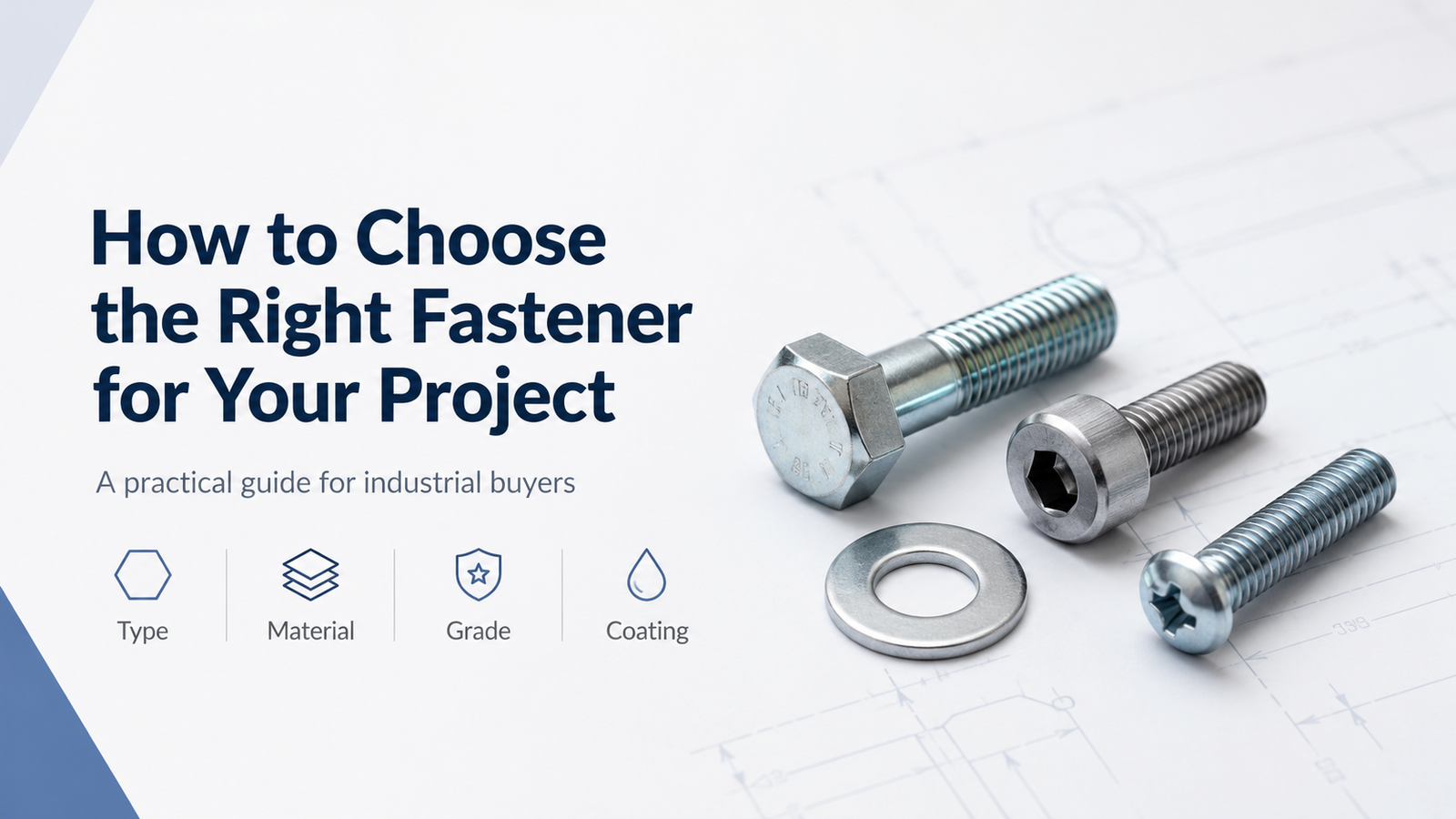
Введение
Choosing the right fastener is not only about matching a bolt or screw to a hole. For industrial projects, the wrong fastener can cause assembly delays, premature corrosion, loosening, thread failure, or even structural risk.
This guide helps buyers, distributors, contractors, and project engineers make a practical fastener selection. You will learn how to choose the right fastener by application, load, material, grade, thread type, surface treatment, environment, and purchasing requirements.
A simple answer is this: the right fastener is the one that matches the working load, installation method, material compatibility, environment, and project standard — not simply the cheapest or strongest option.
Основное содержание
What Does “Choosing the Right Fastener” Really Mean?
Choosing the right fastener means selecting a part that can safely and reliably connect components under real working conditions.
A complete fastener decision usually includes:
- Product type: bolt, screw, nut, washer, anchor, rivet, threaded rod, stud bolt
- Size: diameter, length, thread length, head type
- Thread: metric, UNC, UNF, coarse thread, fine thread
- Material: carbon steel, stainless steel, alloy steel, brass, aluminum, special alloys
- Strength grade: such as 4.8, 8.8, 10.9, 12.9, A2-70, A4-80
- Surface treatment: zinc plated, hot-dip galvanized, black oxide, Dacromet, zinc-aluminum coating, PTFE coating
- Standard: DIN, ISO, ASTM, ANSI, JIS, BS, EN, GB, or customer drawing
- Application environment: indoor, outdoor, marine, chemical, high temperature, vibration, heavy load
For general product browsing, you can review common industrial fasteners on the fastener products page.
Step 1: Start With the Application, Not the Fastener Name
Many sourcing mistakes happen because buyers start with a product name instead of the actual use case.
For example, “M12 bolt” is not enough information. An M12 bolt used for indoor equipment assembly is very different from an M12 bolt used on outdoor steel structures, solar mounting systems, railway equipment, or concrete anchoring.
Ask These Questions First
Before choosing a fastener, confirm:
- What parts need to be connected?
- Is the joint removable or permanent?
- Will the fastener carry load or only hold parts in position?
- Is the fastener installed into metal, wood, plastic, concrete, or masonry?
- Will the assembly face vibration, impact, moisture, chemicals, or temperature changes?
- Is there a project drawing or required standard?
Practical Example
For a machinery cover plate, a socket screw or machine screw may be enough.
For steel structure connection, a high-strength bolt and matching nut may be needed.
For fixing a bracket into concrete, a wedge anchor, sleeve anchor, or chemical anchor may be more suitable than a standard bolt.
Step 2: Choose the Right Fastener Type
Different fastener types are designed for different installation methods.
Болты
Bolts are commonly used with nuts or threaded holes. They are suitable for structural connections, machinery, brackets, flanges, equipment bases, and assemblies that may need future disassembly.
Common bolt types include hex bolts, socket head cap screws, flange bolts, carriage bolts, eye bolts, U-bolts, anchor bolts, and stud bolts. You can explore more options in the bolts category.
Use bolts when you need strong clamping force, clear specification control, and easier maintenance.
Шурупы
Screws are often driven directly into materials or pre-tapped holes. They are commonly used in sheet metal, machinery covers, electrical equipment, wood, plastic, and light assembly.
Self-tapping and self-drilling screws are useful when pre-threading is not convenient, but they should not be treated as replacements for load-bearing bolts unless the design allows it.
Nuts and Washers
Nuts must match the bolt thread and strength grade. Washers help distribute load, protect surfaces, and improve joint stability.
A washer may look simple, but it can prevent surface damage, improve load distribution, and reduce the risk of loosening in some assemblies.
Якоря
Anchors are used for concrete or masonry fixing. Selection depends on base material, hole depth, load direction, edge distance, and installation condition.
Do not select anchors only by diameter. Two anchors with the same diameter may perform very differently depending on expansion design, embedment depth, and base material quality.
Threaded Rods and Stud Bolts
Threaded rods and stud bolts are useful for flanges, pipe supports, equipment installation, hanging systems, and adjustable assemblies.
When ordering, confirm total length, thread pitch, material, grade, coating, and whether the rod is fully threaded or partially threaded.
Step 3: Match the Fastener Material to the Working Environment
Material selection affects strength, corrosion resistance, cost, weight, and service life.
Carbon Steel Fasteners
Carbon steel fasteners are cost-effective and widely used in construction, machinery, steel structures, and general industrial assembly.
They are suitable when:
- The environment is indoor or mildly corrosive
- High strength is required
- Cost control is important
- Surface treatment can provide enough protection
However, carbon steel usually needs coating if used outdoors or in humid environments.
Stainless Steel Fasteners
Stainless steel fasteners are selected when corrosion resistance is more important than low cost.
Common stainless steel options include A2 / 304 and A4 / 316. In general, A4 / 316 performs better in marine, chemical, and high-humidity environments than A2 / 304.
Choose stainless steel when:
- The fastener is exposed to moisture
- Appearance matters
- The environment contains mild chemicals
- Long-term corrosion resistance is more important than the lowest unit price
But stainless steel is not automatically stronger than carbon steel. Always check the property class, such as A2-70, A4-70, or A4-80.
Alloy Steel Fasteners
Alloy steel is commonly used for high-strength fasteners, especially grades such as 10.9 and 12.9.
Choose alloy steel when:
- The assembly carries high load
- Mechanical strength is the main concern
- The project requires high tensile strength
- The fastener is used in heavy equipment or machinery
For high-strength applications, you can also review the high strength fasteners category.
Brass, Aluminum, and Special Materials
Brass is often used in electrical and decorative applications. Aluminum is lightweight but not suitable for every high-load assembly. Titanium, nickel alloy, duplex stainless steel, and other special materials may be required for marine, chemical, high-temperature, or weight-sensitive applications.
For special materials or non-standard shapes, a customized fastener service is usually more reliable than forcing a standard part into the wrong application.
Step 4: Select the Correct Strength Grade
Strength grade is one of the most important parts of fastener selection.
For metric carbon steel and alloy steel bolts, common grades include 4.8, 8.8, 10.9, and 12.9.
General Selection Logic
| Класс Прочности | Typical Use | Buyer’s Note |
|---|---|---|
| 4.8 / 5.8 | Light-duty assembly, general fixing | Cost-effective but not for heavy structural loads |
| 8.8 | Common industrial and structural use | A practical choice for many machinery and construction projects |
| 10.9 | Higher-load machinery and structural applications | Requires proper matching nuts and washers |
| 12.9 | High-strength, heavy-duty applications | Not always suitable for corrosive or high-risk plating conditions |
Higher grade does not always mean better. A grade 12.9 bolt may provide high strength, but it can be less forgiving in applications where ductility, corrosion resistance, or fatigue behavior is more important.
For detailed bolt grade selection, the article Как выбрать правильный класс болта для вашего проекта can be used as a supporting reference.
Step 5: Choose the Right Surface Treatment
Surface treatment protects fasteners from corrosion, improves appearance, and may affect friction during installation.
Zinc Plating
Zinc plating is common for indoor and mild outdoor use. It is economical and suitable for general fasteners, but it may not be enough for long-term exposure to rain, salt spray, or chemical environments.
Choose zinc plating when:
- Cost control is important
- The environment is indoor or mildly humid
- Appearance and basic corrosion protection are enough
Hot-Dip Galvanizing
Hot-dip galvanizing creates a thicker zinc layer than ordinary zinc plating. It is often used for outdoor steel structures, construction, infrastructure, and utility projects.
Choose hot-dip galvanizing when:
- The fastener is used outdoors
- Long-term corrosion protection is needed
- The project involves steel structures or infrastructure
Buyer note: because hot-dip galvanized coating is thicker, thread fit should be confirmed. Matching nuts may need special consideration.
Zinc-Aluminum Coating
Zinc-aluminum coating is often selected for outdoor fasteners, solar mounting systems, automotive parts, and equipment exposed to harsh environments. It can provide better corrosion resistance than basic zinc plating while keeping cost more controlled than some stainless steel solutions.
For coating-related options, you can review various coated fasteners or the zinc-aluminum coating fastener page.
Black Oxide, Phosphate, Dacromet, and PTFE
Black oxide and phosphate are often used for appearance, lubrication, or mild protection. Dacromet and zinc-aluminum coatings are used when corrosion resistance is more important. PTFE coating may be selected for chemical resistance, lower friction, or specific industrial environments.
For outdoor projects, this guide on how to choose fastener coating for outdoor use can help buyers compare coating choices more clearly.
Step 6: Confirm Thread Type and Fit
Thread mismatch is one of the most common fastener purchasing errors.
You should confirm:
- Metric or inch thread
- Coarse or fine thread
- Thread pitch
- Full thread or partial thread
- Internal thread compatibility
- Coating thickness effect on thread fit
For example, M12 coarse thread and M12 fine thread are not interchangeable. A 1/2”-13 UNC fastener will not match a 1/2”-20 UNF nut.
Fine threads can provide better adjustment and may help in some vibration conditions, but they are easier to damage during rough installation. Coarse threads are easier to assemble and generally better for fast installation or rougher working conditions.
Step 7: Confirm the Standard Before Quotation
Fastener standards define dimensions, thread details, tolerance, mechanical properties, and inspection expectations.
Common standards include:
- ДИН
- ИСО
- АСТМ
- ANSI / ASME
- ДЖИС
- BS
- EN
- Великобритания
For example, “hex bolt M10 × 50” is not complete enough for many industrial orders. A better RFQ description would be:
DIN 933 hex bolt, M10 × 50, full thread, grade 8.8, zinc plated, quantity 20,000 pcs
This tells the supplier exactly what to quote.
If your project involves different standards, the guide on DIN and ISO fastener standards can help clarify specification differences.
Step 8: Consider Installation Conditions
Even a correct fastener can fail if installation conditions are ignored.
Check these points before final selection:
Access Space
If tools have limited access, socket head cap screws may be easier to install than hex bolts.
Vibration
For machinery, vehicles, pumps, motors, or rotating equipment, vibration can loosen fasteners. Consider lock nuts, serrated washers, thread-locking solutions, or proper preload control.
Base Material
A fastener used in soft aluminum, thin sheet metal, concrete, or hardwood needs different thread engagement and installation methods.
Torque Requirement
For critical assemblies, torque control matters. Over-tightening may strip threads or damage parts. Under-tightening may lead to loosening.
Maintenance Needs
If the assembly needs regular maintenance, choose removable fasteners and avoid permanent fastening methods unless the design requires them.
Step 9: Know When Standard Fasteners Are Not Enough
Standard fasteners are suitable for many projects, but they are not always the best solution.
Consider custom fasteners when:
- The drawing requires special dimensions
- Standard head type does not fit the installation space
- A special material is needed
- The environment is highly corrosive or high temperature
- The fastener needs special coating, marking, or packaging
- The assembly has unusual load or vibration conditions
- A sample must be matched for replacement or repair
For drawing-based, sample-based, or working-condition-based projects, visit the custom non-standard fasteners category or request support through customized fastener solutions.
Fastener Selection Matrix for Buyers
| Project Condition | Recommended Direction | What to Confirm |
|---|---|---|
| Indoor general assembly | Carbon steel zinc plated screws or bolts | Size, thread, head type, coating |
| Outdoor steel structure | Hot-dip galvanized or zinc-aluminum coated bolts | Standard, grade, coating thickness, matching nuts |
| Marine or coastal use | A4 / 316 stainless steel or special corrosion-resistant material | Chloride exposure, grade, surface finish |
| Heavy machinery | Grade 8.8, 10.9, or 12.9 alloy steel fasteners | Load, torque, fatigue, matching nuts |
| Concrete fixing | Wedge anchor, sleeve anchor, drop-in anchor, or chemical anchor | Base material, embedment depth, load direction |
| Chemical equipment | Stainless steel, PTFE-coated, or special alloy fasteners | Chemical type, temperature, corrosion risk |
| Custom equipment | Non-standard fasteners made to drawing or sample | Drawing, tolerance, material, coating, quantity |
Common Mistakes Buyers Should Avoid
Mistake 1: Choosing Only by Price
The cheapest fastener may cost more later if it rusts early, breaks during installation, or causes project delays.
A better approach is to compare total cost: product price, service life, replacement risk, installation efficiency, and project safety.
Mistake 2: Assuming Stainless Steel Is Always Best
Stainless steel is corrosion-resistant, but it is not always the strongest or cheapest option. For high-load mechanical assemblies, carbon steel or alloy steel with proper coating may be more suitable.
Mistake 3: Ignoring the Nut and Washer
A bolt does not work alone. Nut grade, washer type, thread fit, and contact surface all affect the joint.
For high-strength bolts, always confirm matching nuts and washers.
Mistake 4: Forgetting Coating Thickness
Hot-dip galvanizing and some special coatings can affect thread fit. If the coating is thick, matching nuts and thread tolerance should be checked before mass production.
Mistake 5: Using “Outdoor” as the Only Environment Description
Outdoor use can mean many things. A dry inland project is different from a coastal bridge, chemical plant, solar farm, or wastewater facility.
When requesting a quote, describe the actual environment as clearly as possible.
Practical RFQ Checklist
To get a faster and more accurate quotation, include the following details:
- Product type
- Стандарт
- Size
- Thread pitch
- Full thread or partial thread
- Материал
- Strength grade
- Обработка поверхности
- Quantity
- Приложение
- Working environment
- Drawing or sample photo
- Packaging requirement
- Destination country or port
- Required certificates or inspection reports
Например:
Hex bolt, DIN 933, M12 × 60, grade 8.8, zinc-aluminum coating, full thread, 50,000 pcs, outdoor solar mounting project, packed in cartons on pallets.
This type of inquiry is much easier to quote accurately than “need M12 bolts.”
If you already have a drawing, sample, or project specification, you can contact XZ Fastener for a quotation review.
Основные выводы
- The right fastener depends on application, load, environment, material, grade, thread, coating, and standard.
- Do not choose fasteners only by price or strength grade. A higher-grade fastener is not automatically better for every project.
- Surface treatment should match the real environment. Indoor, outdoor, marine, chemical, and high-humidity conditions require different protection.
- Thread pitch, nut grade, washer type, and coating thickness are often overlooked but can directly affect installation success.
- For non-standard equipment, harsh environments, or drawing-based projects, custom fasteners may reduce risk compared with forcing a standard part into the wrong application.
Часто задаваемые вопросы
1. How do I know which fastener is right for my project?
Start with the application. Confirm what materials need to be connected, whether the joint carries load, where it will be used, and whether it must resist vibration, corrosion, or high temperature. Then choose the product type, material, strength grade, coating, and standard.
2. Should I choose carbon steel or stainless steel fasteners?
Choose carbon steel when strength and cost control are important and the environment is not highly corrosive. Choose stainless steel when corrosion resistance is more important, especially in outdoor, humid, marine, or chemical environments.
3. Is a higher strength grade always better?
No. Higher strength can be useful for heavy loads, but it may not be suitable for every condition. Some applications need better corrosion resistance, ductility, fatigue performance, or coating compatibility instead of maximum tensile strength.
4. What coating is best for outdoor fasteners?
For mild outdoor use, zinc plating may be acceptable. For stronger outdoor protection, hot-dip galvanizing or zinc-aluminum coating is often considered. For marine or chemical environments, stainless steel or special coatings may be needed. The final choice depends on exposure level, project life, and budget.
5. What information should I send to a fastener supplier?
Send the product name, standard, size, thread pitch, material, grade, surface treatment, quantity, application, working environment, destination, and certificate requirements. For custom parts, include drawings or samples.
Заключение
Choosing the right fastener for your project is a practical engineering and purchasing decision. The best choice is not always the strongest, most expensive, or most corrosion-resistant fastener. It is the one that matches the real working condition.
For indoor general assembly, zinc-plated carbon steel fasteners may be enough. For outdoor structures, hot-dip galvanized or zinc-aluminum coated fasteners may provide better long-term protection. For marine, chemical, or high-humidity environments, stainless steel or special materials should be considered. For heavy machinery or structural connections, strength grade and matching nuts must be checked carefully.
Before placing an order, confirm the application, load, standard, material, thread, coating, and packaging. Clear specifications help suppliers quote accurately, reduce production mistakes, and avoid installation problems on site.
For standard fasteners, start from the full fastener products page. For special sizes, materials, coatings, or drawing-based parts, use the customized fastener service to review the best solution for your project.