
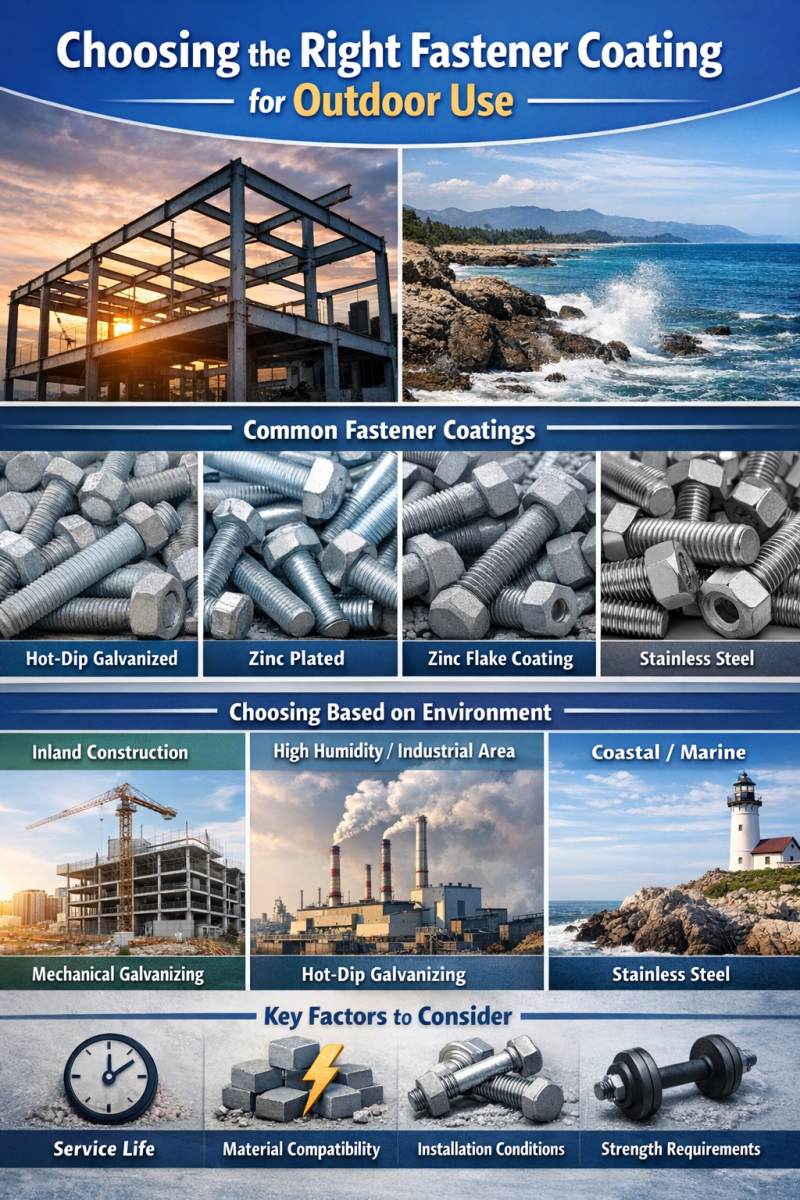
Introducción
Las estructuras exteriores enfrentan una exposición constante a la humedad, cambios de temperatura y contaminantes ambientales. Si se utiliza el recubrimiento de sujetador incorrecto, la corrosión puede aparecer en cuestión de meses, lo que provoca fallas estructurales, mantenimiento costoso o reemplazo prematuro.
Por lo tanto, para los gerentes de adquisiciones, contratistas e ingenieros, elegir el recubrimiento de sujetadores correcto no es solo una decisión material: es una decisión de durabilidad y costo del ciclo de vida.
Esta guía explica cómo elegir el revestimiento de sujetadores adecuado para uso en exteriores. Cubre los tipos de recubrimiento más comunes, cómo se desempeñan en diferentes entornos y cómo hacer una selección práctica según las condiciones del proyecto.
Contenido principal
Por qué es importante el revestimiento de sujetadores en ambientes exteriores
Los sujetadores desnudos acero al carbono se corroen rápidamente cuando se exponen al aire y la humedad. Los ambientes al aire libre aceleran este proceso a través de:
- Lluvia y humedad
- Fluctuaciones de temperatura
- exposición a los rayos ultravioleta
- Contaminación industrial
- Espuma de sal costera
- Exposición química
Sin una protección adecuada contra la corrosión, los sujetadores pueden:
- Pierde fuerza debido al óxido.
- Se vuelve difícil de quitar durante el mantenimiento.
- Causar manchas en los materiales circundantes.
- Conducir al fracaso conjunto
Los recubrimientos para sujetadores actúan como barrera protectora o capa de sacrificio para evitar que la corrosión ataque el metal base.
Recubrimientos de sujetadores comunes para aplicaciones en exteriores
La elección del recubrimiento adecuado depende de la exposición ambiental, los requisitos estructurales y la vida útil del proyecto.
1. Galvanizado en caliente (HDG)
La galvanización en caliente es uno de los recubrimientos más utilizados para sujetadores estructurales de exteriores.
como funciona
Los sujetadores se sumergen en zinc fundido, creando una gruesa capa metalúrgica de zinc adherida a la superficie de acero.
Ventajas
- Excelente resistencia a la corrosión
- Revestimiento grueso (normalmente de 40 a 80 μm)
- Larga vida útil en ambientes exteriores.
- Proporciona protección sacrificial si el revestimiento está dañado.
Aplicaciones típicas
- Estructuras de acero
- Puentes
- Sistemas de montaje solar
- Infraestructura vial
- Estructura de construcción
Limitaciones
- Acabado superficial más rugoso
- Puede afectar el ajuste de la rosca en sujetadores más pequeños
- No es ideal para ensamblajes con tolerancias estrictas
Para la mayoría de los proyectos estructurales al aire libre, los pernos galvanizados en caliente suelen ser la opción predeterminada.
2. Galvanizado (Electrogalvanizado)
El revestimiento de zinc se utiliza comúnmente para sujetadores industriales en general.
como funciona
Se galvaniza una fina capa de zinc sobre la superficie del sujetador.
Ventajas
- Acabado liso
- Bajo costo
- Adecuado para producción de gran volumen
Aplicaciones típicas
- Maquinaria interior
- Hardware liviano
- Ambientes controlados
Limitaciones para uso en exteriores
- Revestimiento fino (normalmente de 5 a 15 μm)
- Protección limitada contra la corrosión
- Corta vida útil en ambientes húmedos o mojados.
Para proyectos al aire libre, el revestimiento de zinc solo suele ser No es suficiente a menos que se combine con recubrimientos adicionales..
3. Galvanizado mecánico
La galvanización mecánica utiliza procesos de volteo para unir el polvo de zinc a los sujetadores.
Ventajas
- Recubrimiento uniforme
- Sin riesgo de fragilización por hidrógeno
- Bueno para sujetadores de alta resistencia
Aplicaciones típicas
- Pernos estructurales
- Hardware de construcción
- Equipo al aire libre
En comparación con la galvanoplastia, la galvanización mecánica proporciona mejor resistencia a la corrosión, aunque normalmente menos que el galvanizado en caliente.
4. Recubrimientos en escamas de zinc (Dacromet / Geomet)
Los recubrimientos en escamas de zinc se utilizan cada vez más en industrias donde se requiere resistencia a la corrosión y roscas precisas.
como funciona
Se aplica y cura una mezcla de escamas de zinc y aluminio para formar una barrera protectora.
Ventajas
- Alta resistencia a la corrosión
- Recubrimiento fino y uniforme
- Sin fragilización por hidrógeno
- Excelente para pernos de alta resistencia
Aplicaciones típicas
- Componentes automotrices
- Sistemas de energía eólica
- Estructuras de montaje solar
- Maquinaria exterior
Estos recubrimientos pueden lograr Resistencia a la niebla salina de más de 500 a 1000 horas, dependiendo de la especificación.
5. Sujetadores acero inoxidable
Aunque técnicamente no es un recubrimiento, acero inoxidable a menudo se considera cuando la resistencia a la corrosión es crítica.
Los grados comunes incluyen:
- A2 / 304 acero inoxidable – ambientes exteriores generales
- A4 / 316 acero inoxidable – entornos marinos o costeros
Ventajas
- Resistencia natural a la corrosión
- Sin riesgo de dañar el recubrimiento
- Aspecto limpio
Limitaciones
- Mayor costo
- Menor resistencia en comparación con algunos pernos acero aleado
- Riesgo de irritación durante la instalación.
Para ambientes costeros o químicos, acero inoxidable puede superar a los sujetadores recubiertos acero al carbono.
Cómo elegir el revestimiento adecuado según el entorno
El mejor recubrimiento depende en gran medida de dónde se utilizará el sujetador.
Ambiente exterior templado
Ejemplos:
- Construcción interior
- Edificios residenciales
- Equipos al aire libre con exposición limitada.
Opciones recomendadas:
- Galvanizado mecánico
- Galvanizado grueso con capa superior
- Galvanizado en caliente estándar
Áreas industriales o de alta humedad
Ejemplos:
- Fábricas
- Plantas químicas
- Entornos urbanos con contaminación
Opciones recomendadas:
- Galvanizado en caliente
- Sistemas de recubrimiento en escamas de zinc
- Sistemas de recubrimiento dúplex (zinc + acabado)
Ambientes costeros o marinos
La exposición a la sal acelera drásticamente la corrosión.
Opciones recomendadas:
- acero inoxidable A4 (316)
- Recubrimientos de escamas de zinc de alto rendimiento
- Galvanizado especializado de grado marino
Evite el uso de revestimiento de zinc estándar en estas condiciones.
Estructuras de energía solar y renovables
Los sistemas de montaje solar requieren una larga vida útil con un mantenimiento mínimo.
Opciones recomendadas:
- Pernos estructurales galvanizados en caliente
- Recubrimientos en escamas de zinc y aluminio
- acero inoxidable para áreas de alta exposición
Los sujetadores utilizados en instalaciones solares a menudo necesitan Más de 20 años de resistencia a la corrosión.
Factores que los compradores deben considerar antes de elegir un recubrimiento
1. Vida útil esperada
Haga las siguientes preguntas:
- ¿El proyecto está diseñado para 5, 10 o 25 años?
- ¿Se podrán reemplazar los sujetadores más adelante?
Los proyectos con una vida útil más larga suelen justificar revestimientos más resistentes.
2. Compatibilidad con el material base
El uso de sujetadores galvanizados con ciertos metales puede causar corrosión galvánica.
Ejemplos:
- Estructuras de aluminio
- Conjuntos acero inoxidable
La compatibilidad del material debe evaluarse durante el diseño.
3. Condiciones de instalación
Algunos recubrimientos afectan el rendimiento de la instalación.
Ejemplos:
- Los revestimientos gruesos pueden requerir hilos de gran tamaño
- acero inoxidable puede requerir lubricación para evitar irritaciones
Las especificaciones de torque de instalación deben coincidir con el sistema de recubrimiento.
4. Requisitos de fuerza
Los pernos de alta resistencia (por ejemplo, Grado 10.9 o ASTM A490) pueden tener restricciones de recubrimiento.
Los procesos de galvanoplastia pueden causar fragilización por hidrógeno, por lo que a menudo se prefiere la galvanización mecánica o los recubrimientos con escamas de zinc.
Errores comunes al seleccionar revestimientos de sujetadores para exteriores
Elegir basándose únicamente en el precio
Los recubrimientos de bajo costo pueden provocar una corrosión rápida, lo que requiere un mantenimiento costoso en el futuro.
Ignorar la exposición ambiental
Los sujetadores aptos para interiores a veces se instalan en exteriores debido a errores de compra.
Mezclar materiales incompatibles
La combinación de sujetadores acero inoxidable con componentes galvanizados puede acelerar la corrosión en ciertas condiciones.
No considerar el acceso de mantenimiento
Si es difícil acceder a los sujetadores después de la instalación, vale la pena el costo de una mayor protección contra la corrosión.
Consejos prácticos de adquisiciones
Al adquirir sujetadores para proyectos al aire libre:
- Confirmar recubrimiento tipo y espesor
- Solicitar datos de la prueba de niebla salina si corresponde
- Verifique el cumplimiento de estándares como ASTM, ISO o DIN
- Confirmar si tolerancias de rosca se ven afectados por el recubrimiento
- Garantizar la compatibilidad del revestimiento con los materiales del proyecto.
Para proyectos grandes, trabajar con un proveedor experimentado puede ayudar a evitar costosos errores de especificación.
Puede explorar los tipos de sujetadores disponibles en la
Página de todos los productos:
https://xzfastener.com/home/products/
Si su proyecto requiere recubrimientos específicos o especificaciones personalizadas, hay disponibles servicios de fabricación personalizados:
https://xzfastener.com/home/customized-service/
Conclusiones clave
- Los revestimientos de sujetadores son fundamentales para prevenir la corrosión en ambientes exteriores.
- La galvanización en caliente es una de las opciones más confiables para aplicaciones estructurales en exteriores.
- El zincado por sí solo no suele ofrecer suficiente protección en exteriores.
- Los entornos costeros y marinos suelen requerir acero inoxidable o recubrimientos de alto rendimiento.
- La selección correcta del recubrimiento depende de las condiciones de exposición, la vida útil y los requisitos de instalación.
Preguntas frecuentes
¿Cuál es el mejor revestimiento de sujetadores para uso en exteriores?
La galvanización en caliente se considera comúnmente uno de los recubrimientos más confiables para aplicaciones estructurales en exteriores porque proporciona una protección espesa de zinc y una larga vida útil.
¿Los sujetadores galvanizados son adecuados para ambientes exteriores?
El revestimiento de zinc estándar ofrece una resistencia a la corrosión limitada y generalmente no se recomienda para una exposición prolongada al aire libre a menos que se combine con revestimientos protectores adicionales.
¿Cuándo se deben utilizar los sujetadores acero inoxidable en exteriores?
Los sujetadores acero inoxidable son ideales para áreas costeras, ambientes marinos o aplicaciones donde la resistencia a la corrosión y la apariencia son importantes.
¿Los sujetadores recubiertos afectan la resistencia de los pernos?
Algunos procesos de recubrimiento, en particular la galvanoplastia, pueden introducir fragilidad por hidrógeno en pernos de alta resistencia. La galvanización mecánica o los recubrimientos con escamas de zinc suelen ser opciones más seguras para sujetadores de alta resistencia.
¿Cuánto duran los sujetadores galvanizados al aire libre?
La vida útil depende del medio ambiente, pero los sujetadores galvanizados en caliente a menudo pueden proporcionar 15 a 50 años de protección contra la corrosión en muchas condiciones al aire libre.
Conclusión
Seleccionar el recubrimiento de sujetadores adecuado para uso en exteriores requiere equilibrar la resistencia a la corrosión, el costo, los requisitos de resistencia y la exposición ambiental.
Para la mayoría de las aplicaciones estructurales al aire libre, Los sujetadores galvanizados en caliente ofrecen una solución confiable y rentable.. En entornos más hostiles, como zonas costeras o instalaciones químicas, acero inoxidable o recubrimientos avanzados de escamas de zinc pueden proporcionar una mejor protección a largo plazo.
La clave es adaptar el sistema de recubrimiento a las condiciones de servicio reales en lugar de elegir basándose únicamente en el precio.
Si necesita ayuda para seleccionar el recubrimiento adecuado para su proyecto, puede obtener más información sobre nuestra empresa y nuestras capacidades de fabricación aquí:
https://xzfastener.com/home/about-us/
O comuníquese con nuestro equipo directamente para analizar los requisitos del proyecto:
https://xzfastener.com/home/contact-us/
 English
  Español
  Français
  Español de México
  العربية
  Deutsch
  Русский
  Tiếng Việt
  Bahasa Indonesia
  Italiano
  简体中文
简体中文