
Introducción
Si compra pernos, tuercas, tornillos, arandelas, anclajes o varillas roscadas para un proyecto, ya sabe una cosa: un sujetador nunca es “solo una pieza pequeña”. Elegir el sujetador incorrecto puede provocar retrasos en la instalación, problemas de corrosión, fallas de resistencia o ensamblajes no coincidentes en el sitio.
Esta guía explica la definición básica, clasificación, materiales comunes, estándares, tratamientos superficiales y lógica de selección de sujetadores. Está escrito para equipos de adquisiciones, distribuidores, contratistas y compradores industriales que necesitan una comprensión clara y práctica antes de realizar un pedido.
Contenido principal
¿Qué es un sujetador?
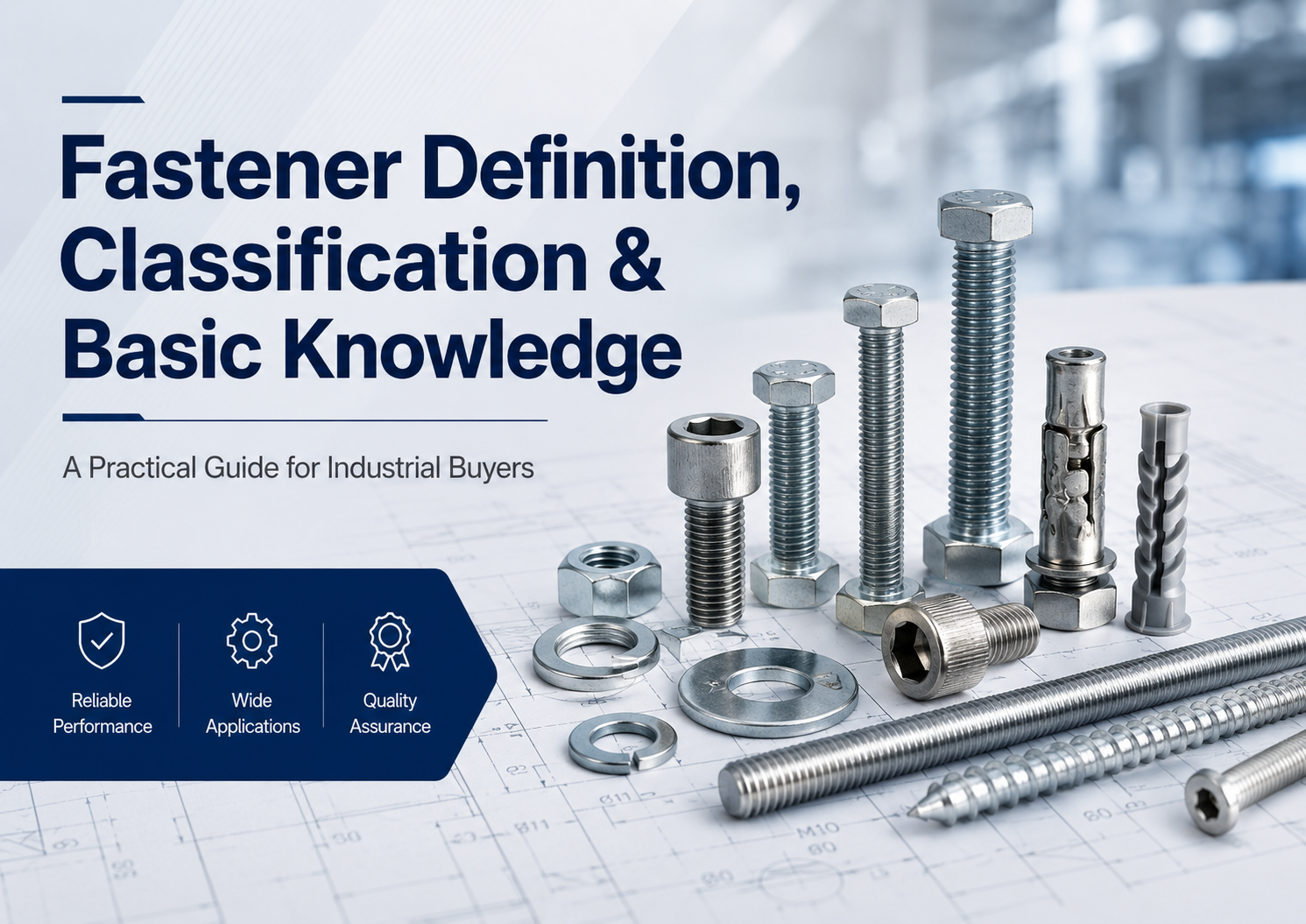
Un sujetador es un componente mecánico que se utiliza para conectar, fijar, asegurar o colocar dos o más piezas juntas. En aplicaciones industriales, los sujetadores se utilizan ampliamente en estructuras de acero, maquinaria, construcción, automoción, proyectos de energía, equipos eléctricos, muebles y muchos otros ensamblajes.
Los sujetadores comunes incluyen:
- Pernos
- Tornillos
- Tuercas
- Arandelas
- Pernos prisioneros
- varillas roscadas
- Anclas
- Pasadores
- Remaches
- Clips y anillos de retención
El objetivo principal de un sujetador es crear una unión confiable. Dependiendo del diseño, la articulación puede ser removible, semipermanente o permanente.
Por ejemplo, un perno hexagonal con tuerca normalmente se puede quitar y reemplazar. Un remache, una vez instalado, normalmente se considera una solución de sujeción permanente. Esta diferencia es importante cuando los compradores deben considerar el mantenimiento, la reparación, el reemplazo o el desmontaje futuro.
Funciones principales de los sujetadores
Los sujetadores se utilizan para algo más que simplemente "mantener juntas las piezas". En proyectos reales, suelen realizar una o más de las siguientes funciones.
1. Sujeción y conexión
Se utilizan pernos, tuercas y arandelas para sujetar los componentes. Esto es común en estructuras de acero, marcos de maquinaria, bridas, soportes y bases de equipos.
2. Posicionamiento
Los pasadores, clavijas y algunos tornillos especiales ayudan a colocar las piezas con precisión antes o durante el montaje.
3. Transferencia de carga
En aplicaciones estructurales, los pernos y anclajes pueden transferir cargas de tensión, corte o combinadas. Es por eso que se deben verificar cuidadosamente clase de resistencia, el enganche de la rosca y el método de instalación.
4. Antiaflojamiento
Se utilizan contratuercas, arandelas de resorte, tuercas de nailon, revestimientos de bloqueo de roscas y arandelas especiales cuando la vibración o el movimiento pueden aflojar el conjunto.
5. Fijación a Hormigón o Mampostería
Los anclajes, pernos de expansión, anclajes de cuña, anclajes de manga y anclajes químicos están diseñados para fijar equipos, rieles, soportes o estructuras a bases de concreto o mampostería.
Clasificaciones de sujetadores comunes
Los sujetadores se pueden clasificar de varias maneras. Para los compradores, la clasificación más útil es por tipo de producto, tipo de rosca, material, clase de resistencia, estándar y tratamiento superficial.
Clasificación por tipo de producto
Pernos
Los pernos se suelen utilizar con tuercas o agujeros roscados. Los tipos comunes incluyen pernos hexagonales, pernos de carro, pernos de brida, tornillos de cabeza hueca, cáncamos, pernos en U y pernos en T.
pernos hexagonales se utilizan comúnmente en maquinaria general, construcción y estructuras de acero. Los pernos de cabeza hueca se seleccionan a menudo cuando el espacio es limitado o se requiere una apariencia más limpia.
Puede buscar más tipos de sujetadores estándar en nuestro página de productos de sujetadores.
Tornillos
Los tornillos suelen estar diseñados para introducirse directamente en materiales o en orificios preroscados. Los tipos comunes incluyen tornillos para metales, tornillos autorroscantes, tornillos autoperforantes, tornillos para madera, tornillos para paneles de yeso y tornillos de fijación.
Un error común es tratar los tornillos y pernos como el mismo producto. En muchos casos de compra, la diferencia afecta el diseño de la rosca, el tipo de cabezal, el método de instalación y la aplicación.
Tuercas
Las tuercas son sujetadores con rosca interna que se usan junto con pernos, varillas roscadas o espárragos. Los tipos comunes incluyen tuercas hexagonales, tuercas con brida, tuercas de seguridad, tuercas ciegas, tuercas cuadradas y tuercas para soldar.
Para ensamblajes de alta resistencia, el grado de la tuerca debe coincidir con el grado del perno. Por ejemplo, utilizar una tuerca de baja calidad con un perno de alta resistencia puede debilitar toda la unión.
Arandelas
Las arandelas distribuyen la carga, protegen la superficie, ajustan el espacio o reducen el riesgo de aflojamiento. Los tipos comunes incluyen arandelas planas, arandelas elásticas, arandelas de guardabarros, arandelas cuadradas y arandelas estructurales.
Las arandelas a menudo se ignoran en la adquisición, pero pueden afectar la fuerza de sujeción, la protección de la superficie y la estabilidad de la instalación.
Pernos prisioneros y varillas roscadas
Los pernos prisioneros y varillas roscadas se usan ampliamente en bridas, tuberías, equipos pesados y construcción. Un espárrago roscado puede tener roscas en ambos extremos, mientras que un varilla roscada suele tener roscas en toda su longitud.
Para estos productos, los compradores deben confirmar el diámetro, el paso de la rosca, la longitud total, la longitud de la rosca, el material, el grado y el tratamiento de la superficie.
Anclas
Los anclajes se utilizan para fijar componentes en hormigón, ladrillo u otros materiales base. Los tipos comunes incluyen anclajes de cuña, anclajes de manga, anclajes de inserción, anclajes de expansión y anclajes químicos.
La selección del anclaje depende en gran medida del material base, los requisitos de carga, la profundidad del orificio, las condiciones de instalación y el entorno.
Clasificación por tipo de hilo
El hilo es uno de los detalles más importantes en la selección de sujetadores. Incluso si el diámetro parece correcto, es posible que el sujetador no encaje si el paso de rosca o el estándar de rosca son incorrectos.
Rosca métrica
Las roscas métricas se utilizan comúnmente en muchos mercados internacionales. Los tamaños generalmente se escriben como M6, M8, M10, M12, M16, etc. Por ejemplo, M12 × 1.75 significa un diámetro nominal 12 mm con un paso de rosca 1.75 mm.
Rosca UNC y UNF
UNC y UNF son sistemas de roscas en pulgadas comúnmente utilizados en sujetadores estándar estadounidenses. UNC significa Grueso Nacional Unificado, mientras que UNF significa Multa Nacional Unificado.
Las roscas UNC son generalmente más comunes para el montaje general. Las roscas UNF tienen un paso más fino y se pueden usar donde se requiere un enganche de rosca más fuerte o un ajuste más preciso.
rosca gruesa y rosca fina
Las roscas gruesas son más fáciles de instalar y más adecuadas para aplicaciones generales, especialmente cuando el entorno de trabajo puede incluir suciedad, espesor del revestimiento o un montaje más rápido.
Los hilos finos proporcionan un mejor ajuste y pueden ofrecer una mayor resistencia al aflojamiento en algunas condiciones, pero son más fáciles de dañar si se manipulan incorrectamente.
Clasificación por Material
La selección del material afecta la resistencia, la resistencia a la corrosión, la resistencia a la temperatura, el costo y la vida útil.
acero al carbono
acero al carbono es uno de los materiales de fijación más comunes. Es rentable y adecuado para aplicaciones estructurales y de maquinaria en general. Sin embargo, normalmente necesita un tratamiento superficial si se utiliza en ambientes húmedos o al aire libre.
Los grados de sujetadores acero al carbono comunes incluyen 4.8, 8.8, 10.9 y 12.9 en sistemas métricos.
acero inoxidable
Los sujetadores acero inoxidable se seleccionan cuando la resistencia a la corrosión es importante. Los grados comunes incluyen 304, 316, A2 y A4.
304 acero inoxidable es adecuado para muchos entornos interiores y exteriores en general. 316 acero inoxidable ofrece una mejor resistencia a la corrosión, especialmente en ambientes marinos, químicos o de alta humedad.
Sin embargo, acero inoxidable no es automáticamente más fuerte que acero al carbono. Los compradores deben verificar tanto el grado del material como la clase de propiedad mecánica.
acero aleado
acero aleado se utiliza a menudo para pernos de alta resistencia, tornillos con hexágono interior y aplicaciones de maquinaria exigentes. Los sujetadores de grado 10.9 y 12.9 se fabrican comúnmente a partir de acero aleado con tratamiento térmico.
Estos sujetadores proporcionan una alta resistencia a la tracción, pero se debe considerar el tratamiento de la superficie y el riesgo de fragilización por hidrógeno, especialmente después de la galvanoplastia.
Latón, Aluminio y Materiales Especiales
El latón se utiliza a menudo en aplicaciones eléctricas, decorativas o sensibles a la corrosión. Los sujetadores de aluminio son livianos pero no adecuados para todas las aplicaciones de carga elevada.
Es posible que se requieran materiales especiales para altas temperaturas, resistencia química o condiciones de ingeniería específicas. En tales casos, los compradores deben proporcionar dibujos, entorno de trabajo y estándares requeridos.
Para tamaños no estándar o materiales especiales, un servicio de sujetadores personalizado suele ser más fiable que intentar adaptar una pieza estándar inadecuada.
Clasificación por clase de resistencia
El sujetador clase de resistencia no es solo una etiqueta. Afecta directamente a la capacidad de carga y a la seguridad.
Grados de pernos métricos
Los grados métricos comunes incluyen 4.8, 8.8, 10.9 y 12.9.
- Grado 4.8: aplicaciones generales de baja resistencia
- Grado 8.8: uso industrial común de alta resistencia
- Grado 10.9: maquinaria y aplicaciones estructurales de mayor resistencia
- Grado 12.9: aplicaciones de alta resistencia, a menudo utilizadas para tornillos de cabeza hueca y conjuntos de maquinaria exigentes
Una calificación más alta no siempre significa mejor. Un perno de muy alta resistencia puede resultar inadecuado si la aplicación necesita ductilidad, resistencia a la corrosión o compatibilidad de recubrimiento especial.
acero inoxidable Clases de propiedad
Los sujetadores acero inoxidable pueden marcarse como A2-70, A4-70, A4-80 y grados similares. La letra indica el grupo acero inoxidable, mientras que el número se refiere a la clase de resistencia a la tracción.
Por ejemplo, A4-70 se usa comúnmente cuando se requiere una mejor resistencia a la corrosión en comparación con A2-70.
Clasificación por estándares
Los estándares de fijación definen dimensiones, tolerancias, detalles de rosca, propiedades mecánicas y, a veces, requisitos de prueba. Los estándares comunes incluyen:
- DIN
- ISO
- ASTM
- ANSI / ASME
- JIS
- BS
- EN
- GB
Por ejemplo, se puede suministrar un perno hexagonal según DIN 933, DIN 931, ISO 4017 o ISO 4014, según la longitud de la rosca y los requisitos dimensionales.
Un comprador no sólo debe escribir "perno hexagonal M12 × 50". Es mejor confirmar el estándar, el grado, el material, el tratamiento de la superficie y la cantidad. Sin estos detalles, diferentes proveedores pueden cotizar diferentes productos que parecen similares pero que no son completamente intercambiables.
Clasificación por Tratamiento Superficial
El tratamiento de la superficie protege el sujetador, mejora la apariencia y, en ocasiones, afecta la fricción durante la instalación.
Galvanizado
El revestimiento de zinc es común para aplicaciones en interiores o exteriores suaves. Es rentable y está disponible en zinc blanco, zinc blanco azul, zinc amarillo y otros acabados.
Galvanizado en caliente
La galvanización en caliente proporciona una capa de zinc más gruesa y se utiliza a menudo para estructuras de acero, construcción e infraestructura al aire libre. Sin embargo, los compradores deben considerar el ajuste de la rosca porque el recubrimiento es más grueso que la galvanoplastia.
Revestimiento de zinc y aluminio
El recubrimiento de zinc y aluminio se utiliza cuando los compradores necesitan una mejor resistencia a la corrosión que el recubrimiento de zinc ordinario y al mismo tiempo controlar los costos. A menudo se selecciona para sujetadores exteriores, piezas de automóviles, sistemas de montaje solar y entornos hostiles.
óxido negro y fosfato
óxido negro y los recubrimientos de fosfato se utilizan a menudo para mejorar la apariencia, la protección contra la corrosión ligera o la lubricación mejorada. Por lo general, no son la mejor opción para la resistencia a la corrosión exterior a largo plazo a menos que se combinen con aceite u otra protección.
PTFE y Recubrimientos Especiales
El recubrimiento PTFE se puede utilizar para resistencia química, baja fricción o entornos de trabajo especiales. Es común en algunas aplicaciones de tuberías, bridas y equipos industriales.
Cómo elegir el sujetador adecuado
Un proceso de selección práctico debe partir de la solicitud, no del precio.
Paso 1: Confirme la solicitud
Pregunte dónde se utilizará el sujetador. ¿Es para estructuras de acero, maquinaria, fijación de hormigón, piezas de vehículos, montaje solar, equipos eléctricos o muebles?
La aplicación determina el tipo de producto, la resistencia, el material y el recubrimiento.
Paso 2: Confirme el requisito de carga
¿El sujetador soportará tensión, cizallamiento, vibración, impacto o solo una fijación ligera? Para aplicaciones de carga, la calidad y el método de instalación son fundamentales.
Paso 3: Confirmar el entorno
Los entornos interiores, exteriores, marinos, químicos, de alta temperatura y alta humedad requieren diferentes materiales y revestimientos.
Un perno acero al carbono galvanizado puede funcionar bien en interiores, pero puede oxidarse rápidamente en ambientes costeros o químicos.
Paso 4: Confirme el estándar y las dimensiones
Confirme siempre el diámetro, la longitud, el paso de rosca, el tipo de cabeza, la longitud de la rosca, el estándar y la tolerancia, si es necesario.
Por ejemplo:
M12 × 50, DIN 933, Grado 8.8, zincado, rosca completa
Esto es mucho más claro que simplemente decir "perno M12".
Paso 5: Confirmar el tratamiento superficial y el embalaje
El tratamiento de la superficie afecta la resistencia a la corrosión, la apariencia y la vida útil. El embalaje afecta la eficiencia del envío, el almacenamiento y la instalación.
Para pedidos de exportación, los compradores también deben confirmar el peso de la caja, los requisitos de la plataforma, las etiquetas, las marcas y si es aceptable el embalaje mixto.
Lo que los compradores suelen pasar por alto
Paso de rosca
Muchos errores de compra ocurren porque no se confirma el paso del hilo. M10 rosca gruesa y M10 rosca fina no son intercambiables.
Grados coincidentes de pernos y tuercas
Es posible que un perno de alta calidad con una tuerca de baja calidad no funcione como se esperaba. El conjunto debe coincidir.
Espesor del revestimiento y ajuste de la rosca
La galvanización en caliente y algunos recubrimientos gruesos pueden afectar el enganche de la rosca. Es posible que se requiera roscado sobredimensionado o tuercas adecuadas.
Entorno de trabajo real
El “uso en exteriores” no es lo suficientemente específico. Un sujetador usado en una zona seca del interior y un sujetador usado cerca del mar pueden necesitar una protección diferente.
Requisitos de certificación e inspección
Algunos proyectos requieren certificados de materiales, informes de pruebas o estándares de inspección específicos. Estos deben confirmarse antes de la producción, no después del envío.
Para conocer más sobre nuestra empresa y experiencia en suministro de exportación, puede visitar nuestro Página sobre nosotros.
Malentendidos comunes sobre los sujetadores
Malentendido 1: acero inoxidable significa que no se oxidará para siempre
acero inoxidable tiene una mejor resistencia a la corrosión, pero aún puede corroerse bajo ciertas condiciones, especialmente en ambientes ricos en cloruro, ácidos o mal ventilados.
Malentendido 2: un clase de resistencia más alto siempre es mejor
Una mayor resistencia puede reducir la ductilidad y puede no ser adecuada para todas las aplicaciones. En algunos entornos, la resistencia a la corrosión y la tenacidad pueden ser más importantes que la resistencia máxima a la tracción.
Malentendido 3: Todos los recubrimientos de zinc son iguales
El electrocincado, el galvanizado en caliente, el revestimiento de zinc-aluminio y el galvanizado mecánico son procesos diferentes. Su espesor de recubrimiento, resistencia a la corrosión, costo y aplicaciones adecuadas no son los mismos.
Malentendido 4: Apariencia similar significa mismo estándar
Dos pernos pueden parecer casi idénticos pero tener diferentes dimensiones de cabeza, longitud de rosca, tolerancia o propiedades mecánicas.
Consejos prácticos sobre adquisiciones
Antes de enviar una consulta, prepare la mayor cantidad de información posible:
- Nombre del producto
- Estándar
- Tamaño
- Paso de rosca
- Materiales
- clase de resistencia
- Tratamiento superficial
- Cantidad
- Solicitud
- Dibujo o foto de muestra.
- Puerto de destino o dirección de entrega
- Certificado requerido o informe de inspección
Si no está seguro del estándar exacto, proporcione la solicitud y la fotografía. Un proveedor profesional puede ayudar a identificar la opción más adecuada.
Para sujetadores basados en proyectos o dibujos, comparta los dibujos con anticipación. Esto reduce los errores de cotización y evita retrasos durante la producción.
Si necesita ayuda para confirmar las especificaciones, puede Contáctenos con los detalles de su producto, dibujos o requisitos de aplicación.
Conclusiones clave
- Un sujetador es una pieza mecánica que se utiliza para conectar, fijar, posicionar o asegurar componentes, pero diferentes sujetadores sirven para propósitos muy diferentes.
- El tipo de producto, el material, clase de resistencia, el estándar, el tipo de rosca y el tratamiento de la superficie deben confirmarse antes de realizar el pedido.
- Una mayor resistencia no siempre significa mejor. La elección correcta depende de la carga, el entorno, el método de instalación y las necesidades de mantenimiento.
- El tratamiento de la superficie debe seleccionarse según las condiciones reales de trabajo, no sólo la apariencia o el precio.
- Para las adquisiciones industriales, unas especificaciones claras reducen los errores en las cotizaciones, los retrasos en la producción y los problemas de instalación.
Preguntas frecuentes
1. ¿Cuál es la diferencia entre un perno y un tornillo?
Por lo general, se usa un perno con una tuerca o un orificio roscado para sujetar las piezas. A menudo, un tornillo se introduce directamente en un material o en un orificio previamente roscado. En la compra real, la diferencia afecta el tipo de cabezal, el diseño de la rosca, el método de instalación y la aplicación.
2. ¿Cómo elijo entre los sujetadores acero al carbono y acero inoxidable?
Elija acero al carbono cuando la resistencia y el control de costos sean las principales preocupaciones y el ambiente no sea altamente corrosivo. Elija acero inoxidable cuando la resistencia a la corrosión sea más importante, especialmente en ambientes húmedos, exteriores, marinos o químicos.
3. ¿Qué información debo proporcionar al solicitar una cotización de sujetadores?
Debe proporcionar el tipo de producto, tamaño, estándar, material, grado, tratamiento de superficie, cantidad, aplicación, destino y cualquier requisito de certificado. Un dibujo o una fotografía son muy útiles para productos no estándar.
4. ¿El revestimiento de zinc es adecuado para sujetadores para exteriores?
El revestimiento de zinc se puede utilizar en ambientes exteriores templados, pero puede no ser suficiente para condiciones duras, marinas o de exposición prolongada. La galvanización en caliente, el recubrimiento de zinc-aluminio, acero inoxidable o recubrimientos especiales pueden ser más adecuados.
5. ¿Se pueden reemplazar los sujetadores estándar por sujetadores personalizados?
Sí, pero sólo cuando el diseño personalizado cumple con la resistencia, el ajuste, el material y las condiciones de funcionamiento requeridos. Los sujetadores personalizados deben producirse de acuerdo con dibujos o muestras y verificarse cuidadosamente antes de la producción en masa.
Conclusión
La selección de sujetadores no debe comenzar con “¿cuál es el más barato?” Debe comenzar con las condiciones de trabajo, los requisitos de carga, la compatibilidad del material, el método de instalación y el entorno de servicio.
Para un montaje interior sencillo, los sujetadores estándar acero al carbono con revestimiento de zinc pueden ser suficientes. Para estructuras exteriores, montaje solar, maquinaria o entornos con alta humedad, los compradores deben prestar más atención al revestimiento, el material y clase de resistencia. Para equipos especiales o proyectos no estándar, a menudo se necesitan dibujos y producción personalizada.
Un sujetador bien seleccionado ayuda a reducir los problemas de instalación, el riesgo de corrosión, los costos de mantenimiento y los retrasos en el proyecto. Si está preparando una nueva consulta, confirme primero los detalles básicos y luego solicite a su proveedor que le recomiende la solución más práctica y rentable.
 English
  Español
  Français
  Español de México
  العربية
  Deutsch
  Русский
  Tiếng Việt
  Bahasa Indonesia
  Italiano
  简体中文
简体中文