
Introducción
El óxido en los pernos estructurales no es sólo un problema de apariencia. En ambientes costeros y químicos, la corrosión puede reducir la sección transversal de los pernos, dañar las roscas, debilitar la precarga, manchar las estructuras de acero y dificultar el mantenimiento futuro. Para puentes, edificios de acero, equipos portuarios, soportes de tuberías, plantas químicas y marcos estructurales exteriores, un revestimiento de pernos incorrecto puede fallar mucho antes de lo esperado.
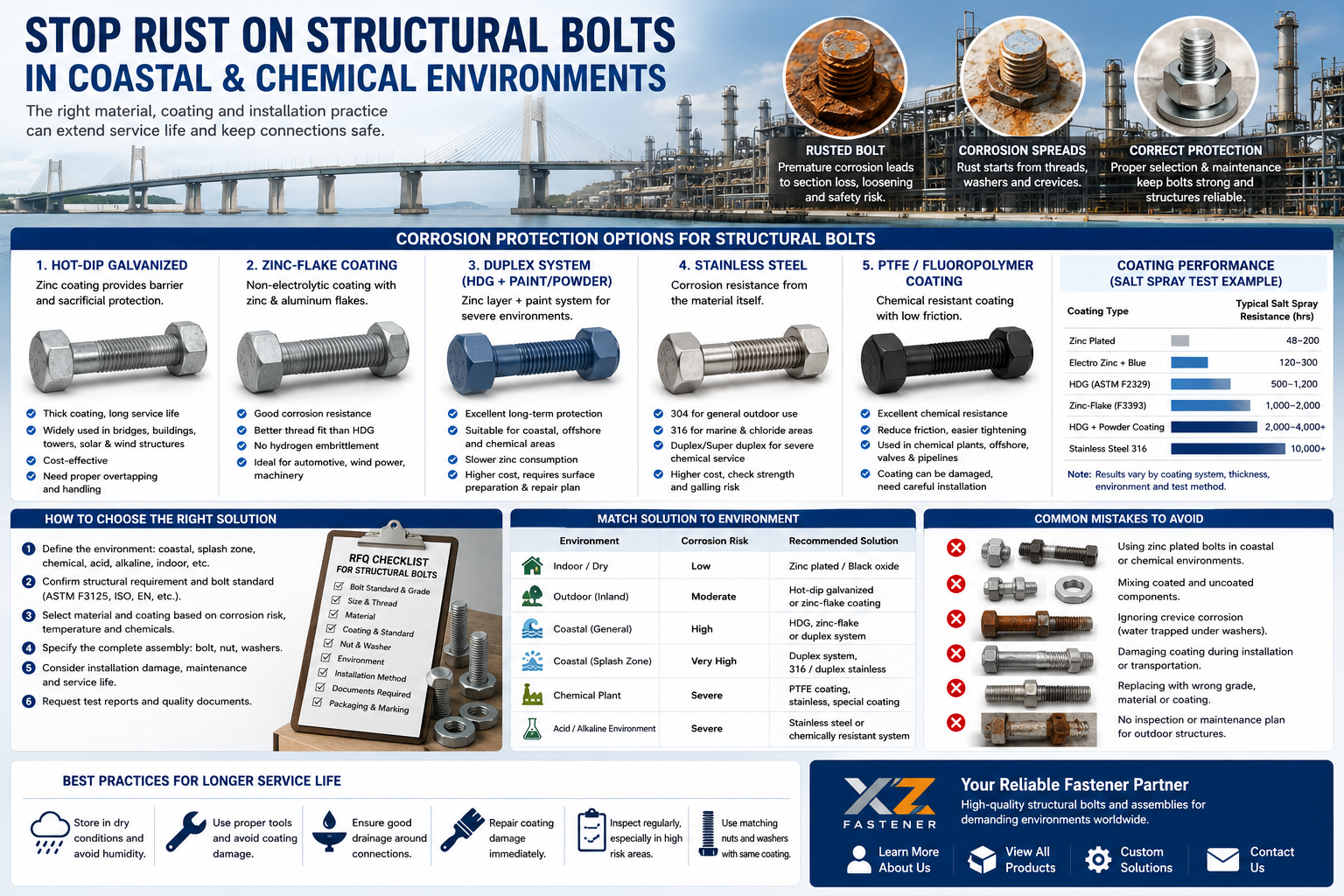
Esta guía explica cómo detener la oxidación en pernos estructurales seleccionando el material de perno, el sistema de recubrimiento, la combinación de arandela/tuerca y la estrategia de mantenimiento adecuados. Se centra en decisiones de compra reales: galvanizado en caliente frente a zincado frente a recubierto con escamas de zinc frente a acero inoxidable frente a sistemas de recubrimiento dúplexy cuándo cada opción tiene sentido.
Contenido principal
Por qué los pernos estructurales se oxidan más rápido en entornos costeros y químicos
Los pernos estructurales generalmente funcionan en uniones expuestas donde la humedad, el oxígeno, la sal, los contaminantes y los productos químicos pueden permanecer alrededor de la cabeza del perno, la tuerca, la arandela y el área de la rosca. Una vez que comienza la corrosión en estas zonas, puede ser más difícil de inspeccionar y limpiar que las superficies planas de acero.
Los ambientes costeros son agresivos principalmente debido a los cloruros en el aire, la niebla salina, la humedad y los largos ciclos húmedos y secos. ISO 9223 clasifica la corrosividad atmosférica e identifica las condiciones de temperatura y humedad, la contaminación por dióxido de azufre y la salinidad del aire como factores clave en la corrosión atmosférica.
Los entornos químicos son diferentes. La fuente de corrosión puede ser vapor ácido, solución de limpieza alcalina, polvo de fertilizante, compuestos de azufre, cloro, residuos de disolventes, gases de aguas residuales o productos químicos de proceso. Esto significa que es posible que una solución de “calidad marina” no funcione automáticamente en todas las plantas químicas.
Para los compradores, la primera regla es clara: No elija la protección contra la corrosión únicamente por el nombre del producto. Elígelo por entorno.
¿Qué se considera un perno estructural?
Un perno estructural está diseñado para conexiones estructurales de acero a acero, generalmente con un sistema pesado y de arandelas. En muchos proyectos internacionales, los pernos estructurales se especifican de acuerdo con ASTM, ISO, EN o los dibujos del proyecto.
ASTM F3125/F3125M cubre pernos y conjuntos estructurales de alta resistencia, incluidas dimensiones en pulgadas y métricas, con niveles mínimos de resistencia a la tracción, como 120 ksi, 144 ksi, 150 ksi, 830 MPa y 1040 MPa, según el grado y el estilo. El alcance ASTM también establece que estos pernos están destinados a conexiones estructurales cubiertas por las especificaciones del Consejo de Investigación sobre Conexiones Estructurales.
Los ejemplos comunes incluyen:
| Tipo de perno estructural común | Uso típico |
|---|---|
| ASTM F3125 Grado A325 | Conexiones generales de acero estructural de alta resistencia. |
| ASTM F3125 Grado A490 | Conexiones estructurales de mayor resistencia |
| Conjuntos de torsión F1852 / F2280 | Atornillado estructural con control de tensión |
| Conjuntos de pernos estructurales métricos 8.8 / 10.9 | Proyectos internacionales de acero estructural. |
| Pernos personalizados de alta resistencia | Proyectos que requieren material, revestimiento o dimensiones especiales. |
Para obtener sujetadores de alta resistencia estándar y personalizados, los compradores pueden revisar la Todos los productos página.
Por qué “zincado” no suele ser suficiente en exteriores
Muchos compradores solicitan “pernos estructurales zincado” porque la superficie parece limpia y el costo es bajo. Pero para entornos costeros o químicos, el electrocincado ordinario suele ser demasiado delgado para resistir la corrosión en exteriores a largo plazo.
El revestimiento de zinc es útil para:
- Estructuras de acero interiores
- Equipos de almacén seco
- Maquinaria ligera
- Protección temporal durante el almacenamiento o transporte
- Ambientes templados con baja humedad.
No suele ser la mejor opción para:
- Puertos
- Puentes
- Estructuras marinas
- Plantas químicas
- Torres de enfriamiento
- Soportes para tuberías al aire libre
- Instalaciones de aguas residuales
- Áreas de almacenamiento de fertilizantes o sal.
El problema no es que el zincado no tenga valor. El problema es que a menudo se selecciona para entornos donde el espesor del recubrimiento y la reserva de corrosión no son suficientes.
Principales opciones de protección contra la corrosión para pernos estructurales
1. Pernos estructurales galvanizados en caliente
La galvanización en caliente es una de las opciones más comunes para pernos estructurales para exteriores. Crea una capa de zinc que proporciona tanto protección de barrera como protección de sacrificio.
ASTM F2329/F2329M cubre los requisitos de recubrimiento de zinc por inmersión en caliente para pernos, tornillos, arandelas, tuercas y sujetadores roscados especiales acero al carbono y acero aleado. ISO 10684 especifica los requisitos de material, proceso, dimensiones y rendimiento para recubrimientos galvanizados en caliente en sujetadores de acero roscados desde M8 a M64 y clases de propiedad hasta 10.9 para pernos, tornillos y pernos. También señala que no se recomienda la galvanización en caliente para sujetadores roscados más pequeños que M8 o con un paso inferior a 1.25 mm.
Mejor para
- Puentes
- Estructuras de acero al aire libre
- Torres de transmisión
- Estructuras de montaje solar
- Estructuras de soporte de energía eólica
- Construcción costera general con exposición moderada.
- Plataformas industriales con exposición química no severa
Fortalezas
- Protección más gruesa que el revestimiento de zinc ordinario
- Buena relación costo-rendimiento para estructuras de acero al aire libre
- Adecuado para muchos conjuntos de pernos estructurales
- La protección de sacrificio de zinc ayuda a proteger las áreas de acero expuestas
- Ampliamente aceptado en proyectos de construcción e infraestructura.
Limitaciones
- Las roscas pueden requerir un sobreroscado o un margen adecuado porque el recubrimiento es grueso
- No es ideal para exposición a ácidos fuertes o químicos alcalinos fuertes.
- Puede producir óxido blanco durante un almacenamiento deficiente.
- La apariencia es menos brillante que el revestimiento de zinc.
- El revestimiento puede dañarse si los pernos se fuerzan, se modifican o se instalan incorrectamente.
Juicio experto
Los pernos galvanizados en caliente suelen ser la primera opción práctica para el acero estructural para exteriores. Pero en zonas costeras severas de salpicaduras, plataformas marinas o áreas de vapores químicos, la galvanización en caliente por sí sola puede no ser suficiente para una larga vida útil.
2. Pernos estructurales recubiertos con escamas de zinc
El recubrimiento con escamas de zinc, a menudo asociado con recubrimientos como los sistemas tipo Dacromet o Geomet, es un sistema de recubrimiento no electrolítico que utiliza escamas de zinc, a veces con escamas de aluminio. ASTM F3393 cubre la clasificación, el rendimiento y los requisitos básicos para recubrimientos de escamas de zinc aplicados no electrolíticamente en sujetadores roscados en pulgadas y métricos, con diámetros nominales mínimos de 0,250 pulgadas y 6 mm. La norma también especifica que estos sistemas de laminillas de zinc se suministran sin cromo hexavalente.
Mejor para
- Estructuras automotrices
- Sujeciones para energía eólica
- Hardware de montaje solar
- Maquinaria expuesta a la humedad.
- Elementos de fijación que requieren buena resistencia a la corrosión con ajuste de rosca controlado
- Aplicaciones en las que se debe reducir el riesgo de fragilización por hidrógeno mediante galvanoplastia
Fortalezas
- Buena resistencia a la corrosión con un espesor de recubrimiento relativamente delgado
- En muchos casos, mejor ajuste de la rosca que el galvanizado en caliente pesado
- El proceso no electrolítico reduce el problema de fragilidad por hidrógeno en comparación con la galvanoplastia
- A menudo es adecuado para sujetadores de alta resistencia cuando se especifica correctamente
Limitaciones
- El rendimiento del recubrimiento depende en gran medida del sistema, el espesor, la capa superior y el curado.
- No todos los recubrimientos de escamas de zinc son adecuados para todas las especificaciones estructurales
- La reparación en campo puede ser más difícil que el retoque de superficies galvanizadas
- Debe confirmarse con los requisitos del proyecto.
Juicio experto
Los recubrimientos con escamas de zinc son útiles cuando los compradores necesitan una mejor resistencia a la corrosión que el recubrimiento de zinc ordinario, pero no pueden aceptar hilos gruesos galvanizados en caliente. Para pernos de alta resistencia, es especialmente importante especificar el sistema de recubrimiento exacto y el rendimiento de prueba requerido en lugar de escribir solo "Dacromet".
3. Sistema dúplex: Galvanizado en caliente más pintura o recubrimiento en polvo
Un sistema dúplex combina galvanizado en caliente con pintura o recubrimiento en polvo. Esto se utiliza a menudo cuando una sola capa de zinc puede no proporcionar suficiente durabilidad en atmósferas costeras o industriales agresivas.
ISO 12944-9 cubre sistemas de pintura protectora y métodos de prueba de rendimiento de laboratorio para estructuras marinas y relacionadas expuestas a atmósfera marina, agua de mar o agua salobre, incluida la categoría de corrosividad CX y la categoría de inmersión Im4 como se define en ISO 12944-2. ISO 12944-5 también proporciona orientación para seleccionar sistemas de pintura protectora para estructuras de acero en diferentes entornos, excepto las categorías CX e Im4.
Mejor para
- Puentes costeros
- Estructuras portuarias
- Acerías relacionadas con el mar
- Estructuras de acero para plantas químicas
- Estructuras exteriores de larga duración
- Conexiones atornilladas expuestas donde es difícil repintar
Fortalezas
- Mejor protección a largo plazo que el recubrimiento solo en exposición agresiva
- La capa de pintura frena el consumo de zinc
- La capa de zinc protege el acero si la pintura se raya
- La combinación de colores y la inspección visual son más fáciles
Limitaciones
- Más caro que un solo recubrimiento
- Requiere una correcta preparación de la superficie.
- El espesor de la pintura puede afectar el ajuste del perno/tuerca si se aplica después del ensamblaje.
- Las áreas de empernado pueden necesitar procedimientos de instalación especiales.
- El plan de reparación de daños en el campo debe ser claro.
Juicio experto
Para entornos costeros severos, un sistema dúplex suele ser más realista que esperar que los pernos galvanizados estándar permanezcan libres de óxido durante décadas sin mantenimiento. La clave no es sólo la selección del recubrimiento, sino también cómo se manejan los pernos, tuercas, arandelas y áreas de retoque durante la instalación.
4. Pernos estructurales acero inoxidable
acero inoxidable resiste la oxidación porque el cromo forma una película pasiva en la superficie. Para entornos costeros y químicos, a menudo se considera acero inoxidable cuando los recubrimientos acero al carbono no son suficientes.
Las opciones comunes de acero inoxidable incluyen:
| Grado inoxidable | Dirección de uso común |
|---|---|
| 304 / A2 | Uso general en exteriores y ligeramente corrosivo. |
| 316 / A4 | Ambientes costeros, clorados, adyacentes al mar y húmedos |
| Inoxidable dúplex | Mayor resistencia y mejor resistencia a la corrosión por tensión de cloruro que los grados austeníticos estándar en algunas aplicaciones. |
| Acero inoxidable súper dúplex | Ambientes severos con cloro y químicos, sujetos a aprobación de ingeniería. |
Mejor para
- Estructuras costeras con requisitos de larga vida útil
- Conjuntos marinos adyacentes
- Equipo químico
- Plantas de alimentos y aguas residuales.
- Aplicaciones donde el daño al recubrimiento es inaceptable
- Conjuntos más pequeños donde el costo de mantenimiento a largo plazo importa más que el costo de los sujetadores
Fortalezas
- La resistencia a la corrosión proviene del propio material, no sólo del revestimiento de la superficie.
- No hay capa de zinc para consumir.
- buena apariencia
- Útil donde la reparación del revestimiento es difícil
- El acero inoxidable 316 funciona mejor que el 304 en ambientes con cloruro.
Limitaciones
- Mayor costo
- Es posible que clase de resistencia no coincida con los pernos estructurales estándar de alta resistencia acero al carbono
- Riesgo de irritación durante la instalación
- No todos los pernos de acero inoxidable son sustitutos aprobados de los pernos estructurales.
- El agrietamiento por corrosión bajo tensión de cloruro puede ser una preocupación en algunas condiciones de cloruro de alta tensión y alta temperatura.
Juicio experto
acero inoxidable no es automáticamente un reemplazo directo de los pernos estructurales ASTM F3125 A325 o A490. Si la unión es estructural y soporta carga, el ingeniero debe confirmar la resistencia, la ductilidad, el método de precarga, la compatibilidad de las tuercas, la dureza de las arandelas y el cumplimiento de las normas.
5. PTFE o pernos recubiertos de fluoropolímero
PTFE y los recubrimientos de fluoropolímero se utilizan a menudo en plantas químicas, equipos marinos, válvulas, bridas y conexiones de tuberías. Proporcionan resistencia a la corrosión, resistencia química y menor fricción.
Mejor para
- Equipos de proceso químico
- Bridas y soportes para tuberías.
- Plantas petroquímicas
- Asambleas costa afuera
- Sujetadores expuestos a salpicaduras o vapores químicos
- Aplicaciones que necesitan fricción controlada durante el apriete
Fortalezas
- Buena resistencia química dependiendo del sistema de recubrimiento.
- La reducción de la fricción puede ayudar en la instalación
- El recubrimiento codificado por colores puede simplificar la identificación
- Útil para pernos que requieren extracción frecuente
Limitaciones
- El revestimiento puede dañarse durante la instalación.
- La relación par-tensión cambia porque la fricción es menor
- No todos los recubrimientos PTFE son adecuados para juntas estructurales de deslizamiento crítico
- Requiere manipulación, embalaje e inspección cuidadosos.
Juicio experto
Los pernos recubiertos con PTFE son útiles en entornos químicos, pero los compradores no deben ignorar el control de torsión. Una fricción más baja puede aumentar la tensión del perno con el mismo torque, por lo que los procedimientos de instalación deben coincidir con el sistema de recubrimiento.
Cómo elegir la solución antioxidante adecuada
Paso 1: identificar el entorno de corrosión
Antes de elegir un revestimiento para pernos estructurales, defina claramente la exposición.
| Medio ambiente | Principal riesgo de corrosión | Mejor dirección de selección |
|---|---|---|
| Estructura interior de acero seco. | Baja humedad | zincado o simple con aceite, según requerimiento |
| Interior al aire libre | Lluvia y humedad | Recubrimiento galvanizado en caliente o con escamas de zinc |
| Zona costera pero no de chapoteo. | Cloruro del aire y la humedad. | Recubrimiento HDG, con escamas de zinc o dúplex |
| Zona de chapoteo costera | Ciclos de pulverización de sal y secado húmedo. | Recubrimiento dúplex, acero inoxidable 316, acero inoxidable dúplex o sistema de ingeniería |
| Estante de tuberías al aire libre para plantas químicas | Vapor químico + humedad | Revestimiento PTFE, escamas de zinc, inoxidable o revestimiento especial |
| Ambiente ácido | Ataque ácido al zinc y al acero. | Revestimiento de acero inoxidable, aleación o resistente a productos químicos. |
| Lavado alcalino | Riesgo de degradación del recubrimiento | Confirme la compatibilidad química antes de la selección. |
| Alta mar/marino severo | Corrosividad CX, sal, viento, humedad. | Sistema dúplex, acero inoxidable o revestimiento específico del proyecto |
La misma etiqueta "costera" puede significar cosas diferentes. No es lo mismo un perno a 5 km de la costa bajo un techo que un perno en un muelle expuesto a la niebla salina.
Paso 2: decida si el perno es verdaderamente estructural
Esto es importante porque la protección contra la corrosión no se puede seleccionar independientemente del rendimiento mecánico.
Preguntar:
- ¿El perno soporta carga estructural?
- ¿Es una junta estructural precargada?
- ¿Es un deslizamiento crítico?
- ¿Está cubierto por ASTM F3125, EN 14399, ISO 898 o el dibujo del proyecto?
- ¿Se permite el reemplazo por acero inoxidable?
- ¿Las tuercas y arandelas forman parte de un conjunto aprobado?
- ¿Se requieren pruebas de capacidad rotacional?
Si el perno es parte de una conexión estructural de acero crítica, no lo sustituya con revestimiento o material sin aprobación.
Paso 3: haga coincidir el perno, la tuerca y la arandela como un sistema
El óxido suele comenzar cuando se utilizan piezas que no coinciden. Un perno galvanizado en caliente con una tuerca plana no es un conjunto resistente a la corrosión. Un perno de acero inoxidable con una arandela acero al carbono puede crear un punto débil de corrosión. Un perno revestido con una arandela sin revestir puede oxidarse alrededor de la superficie del cojinete.
Para ambientes costeros y químicos, especificar el conjunto completo:
- Material y grado del perno
- Grado y acabado de tuerca
- Estándar y acabado de la lavadora.
- Estándar de recubrimiento
- Requisito de lubricación
- Método de embalaje
- Requisito del certificado de prueba
Un RFQ mejor es:
ASTM F3125 Conjunto de perno estructural hexagonal pesado grado A325, galvanizado en caliente según ASTM F2329/F2329M, con arandela pesada galvanizada tuerca hexagonal y F436 a juego
no simplemente:
Pernos estructurales galvanizados
Paso 4: Elija el espesor y el estándar del recubrimiento, no solo el nombre del recubrimiento
"Galvanizado" puede significar diferentes cosas en diferentes mercados. Puede referirse a electrocincado, galvanizado mecánico o galvanizado en caliente. Estos no son iguales para la exposición costera.
| Nombre del revestimiento en RFQ | Posible significado | Riesgo |
|---|---|---|
| zincado | Zinc galvanizado | Por lo general, es demasiado liviano para un uso severo en exteriores. |
| Galvanizado | ambiguo | El proveedor podrá cotizar electro zinc o HDG. |
| HDG | Galvanizado en caliente | Mejor, pero se debe especificar el estándar. |
| Dacromet / Geomet | Revestimiento de escamas de zinc | Necesita grado de recubrimiento y requisitos de rendimiento |
| PTFE recubierto | Recubrimiento de fluoropolímero | Necesita datos sobre espesor, adherencia, resistencia química y fricción. |
El lenguaje de compra más seguro es nombrar el estándar y el requisito de desempeño.
Paso 5: Considere el riesgo de fragilidad por hidrógeno
Los sujetadores de alta resistencia son más sensibles a la fragilización por hidrógeno que los sujetadores de baja resistencia. Los procesos de galvanoplastia pueden introducir hidrógeno si no se controlan adecuadamente.
Para pernos estructurales de alta resistencia, los compradores deben tener cuidado con los recubrimientos galvanizados. Los recubrimientos de escamas de zinc no electrolíticos y el galvanizado en caliente pueden ser más apropiados cuando lo permitan las especificaciones, pero la decisión final debe seguir el grado del perno y el estándar del proyecto.
Esta es una de las razones por las que el recubrimiento de sujetadores de alta resistencia no debe cambiarse sólo por su apariencia.
Paso 6: Verifique los daños de la instalación
Incluso el mejor revestimiento falla prematuramente si la instalación lo daña.
Los puntos de daño comunes incluyen:
- Contacto del casquillo de la llave de impacto en la cabeza del perno
- Recubrimiento raspador de rotación de tuerca
- Daño en la superficie del cojinete de la lavadora
- Hilo irritante
- Escariado después del recubrimiento
- Cortar o pulir cerca de los orificios de los pernos
- Pintura de retoque omitida después de la instalación.
- Elementos de sujeción revestidos arrastrados por el suelo antes del montaje
Para pernos estructurales revestidos, el embalaje y el manejo de la instalación son parte de la protección contra la corrosión.
Matriz de selección práctica
| Condición del proyecto | Protección de perno recomendada | Razón |
|---|---|---|
| Estructura de acero interior | zincado o óxido negro con aceite | Bajo riesgo de corrosión |
| Estructura interior al aire libre | Galvanizado en caliente | Costo práctico y durabilidad. |
| Montaje solar cerca de la costa | HDG, escamas de zinc o acero inoxidable 316 dependiendo de la exposición | Riesgo de cloruro y humedad. |
| Estructura del almacén portuario | Plan de retoque HDG+, o sistema dúplex | Preocupación por el aire salado y el mantenimiento |
| Muelle/zona de chapoteo | Recubrimiento dúplex, 316/acero inoxidable dúplex o sistema aprobado por el proyecto | Exposición directa al cloruro |
| Estante de tuberías para plantas químicas | PTFE, escamas de zinc, inoxidable o revestimiento especial | Vapor químico y humedad. |
| Exposición a sustancias químicas ácidas | Aleación de acero inoxidable o níquel después de comprobar la compatibilidad. | El zinc puede ser atacado por ácidos. |
| Junta de deslizamiento crítico de alta resistencia | Siga exactamente las especificaciones estructurales | El recubrimiento afecta la fricción y la precarga. |
| Sitio de mantenimiento restringido | Sistema inoxidable o dúplex | Menor riesgo de mantenimiento a largo plazo |
Errores comunes que causan oxidación en los pernos estructurales
Error 1: elegir revestimiento de zinc para estructuras costeras
El revestimiento de zinc puede parecer limpio en el momento de la entrega, pero normalmente no es suficiente para la exposición marina o química. Para estructuras costeras al aire libre, se debe considerar la galvanización en caliente, el recubrimiento con escamas de zinc, los sistemas dúplex o los materiales inoxidables.
Error 2: especificar "galvanizado" sin estándar
La palabra "galvanizado" es demasiado vaga. Especifique siempre si está galvanizado en caliente, electro zincado, galvanizado mecánico o recubierto de zinc en escamas.
Error 3: mezclar componentes revestidos y no revestidos
Un perno galvanizado con una tuerca o arandela plana aún se oxidará en el componente desprotegido. Especifique el perno, la tuerca y la arandela juntos.
Error 4: Reemplazar pernos estructurales acero al carbono con acero inoxidable sin revisión de ingeniería
acero inoxidable puede resistir mejor la corrosión, pero es posible que no cumpla con los mismos requisitos mecánicos que un perno estructural de alta resistencia. Nunca sustituya material en una junta estructural que soporte carga sin aprobación.
Error 5: ignorar la corrosión por grietas
El óxido a menudo comienza debajo de las arandelas, entre las placas conectadas o alrededor de las raíces de las roscas donde queda atrapada la humedad. El diseño debe permitir el drenaje y evitar bolsas de agua.
Error 6: Olvidar el retoque y el mantenimiento
Los revestimientos pueden rayarse durante el envío, la instalación o el ajuste. Para proyectos al aire libre, el plan de mantenimiento debe incluir inspección y métodos de retoque aprobados.
Error 7: elegir únicamente según las horas de niebla salina
Las pruebas de niebla salina pueden comparar recubrimientos, pero no representan perfectamente los entornos químicos o costeros reales. La exposición de campo incluye rayos UV, ciclos húmedo-seco, contaminantes, temperatura, daños mecánicos y condiciones de drenaje.
Qué deben especificar los compradores en un RFQ
Para ambientes costeros o químicos, un RFQ completo debe incluir:
| Artículo | Qué especificar |
|---|---|
| Estándar de perno | ASTM F3125, EN 14399, ISO, DIN, dibujo del proyecto |
| Grado | A325, A490, 8.8, 10.9, etc. |
| Tamaño | Diámetro, longitud, longitud del hilo. |
| Asamblea | Perno + tuerca + arandela |
| Recubrimiento | HDG, escamas de zinc, PTFE, dúplex, inoxidable, etc. |
| Estándar de recubrimiento | ASTM F2329/F2329M, ISO 10684, ASTM F3393, especificaciones del proyecto |
| Medio ambiente | Costa, zona de salpicadura, vapor químico, ácido, alcalino, aguas residuales |
| Instalación | Método de torsión, tipo rodamiento, precargado, de deslizamiento crítico |
| Documentos | MTC, informe de espesor del recubrimiento, informe de inspección, CO, prueba de terceros si es necesario |
| Embalaje | Envases a prueba de humedad, etiquetado, trazabilidad de lotes. |
| Necesidades personalizadas | Material especial, espesor de revestimiento, margen de hilo, marcado |
Para entornos inusuales, materiales personalizados, revestimientos especiales o pernos basados en dibujos, utilice el Servicio personalizado página para proporcionar condiciones de trabajo, dibujos, muestras o requisitos de recubrimiento.
Consejos de mantenimiento para reducir el óxido después de la instalación
Incluso la selección correcta de pernos requiere buenas prácticas en el lugar.
1. Guarde los pernos secos antes de la instalación
No deje pernos galvanizados o revestidos en bolsas mojadas, cajas de cartón abiertas o agua estancada. El óxido blanco en los recubrimientos de zinc a menudo proviene de un almacenamiento deficiente antes de la instalación.
2. Evite dañar el revestimiento durante el ajuste
Utilice enchufes y herramientas de instalación adecuados. No utilice casquillos dañados que raspen la capa de las cabezas de los pernos y las tuercas.
3. Mantenga el drenaje alrededor de las uniones atornilladas
El agua atrapada alrededor de las arandelas y los espacios de las placas acelera la corrosión. El diseño de la estructura debe evitar las bolsas de agua siempre que sea posible.
4. Inspeccione primero las áreas de alto riesgo
Revise las áreas inferiores, las zonas de salpicaduras, las juntas sombreadas, las áreas de vapores químicos y las conexiones cercanas a los puntos de drenaje.
5. Repare los daños del revestimiento a tiempo
Las pequeñas áreas dañadas deben repararse antes de que se propague la corrosión. Utilice materiales de reparación aprobados según el sistema de recubrimiento del proyecto.
6. No mezcle sujetadores de reemplazo aleatorios
Durante el mantenimiento, los pernos de repuesto deben coincidir con las especificaciones originales de grado, revestimiento, tuerca y arandela.
Para cotización del proyecto o confirmación técnica, los compradores pueden enviar requisitos a través del Contáctenos página. Para comprender la capacidad del proveedor y la experiencia de exportación, visite Quiénes somos.
Conclusiones clave
- La prevención de la oxidación comienza con la clasificación del entorno. El cloruro costero, el vapor químico, las zonas de salpicaduras y la humedad interior requieren diferentes estrategias de protección de pernos.
- Los pernos zincado generalmente no son suficientes para uso estructural químico o costero. Se debe evaluar galvanización en caliente, recubrimientos con escamas de zinc, sistemas dúplex, acero inoxidable o recubrimientos especiales.
- Los pernos estructurales galvanizados en caliente son una solución práctica para exteriores, pero no una respuesta universal. La exposición marina o química severa puede requerir un recubrimiento dúplex, acero inoxidable o protección específica del proyecto.
- El perno, la tuerca y la arandela deben especificarse como un conjunto resistente a la corrosión. Un solo componente sin recubrir puede convertirse en el primer punto de oxidación.
- No sustituya acero inoxidable por pernos estructurales acero al carbono sin la aprobación de ingeniería. La resistencia a la corrosión no significa automáticamente un rendimiento estructural equivalente.
Preguntas frecuentes
1. ¿Cuál es el mejor recubrimiento para detener la oxidación de pernos estructurales cerca del océano?
Para estructuras exteriores costeras en general, la galvanización en caliente suele ser un punto de partida práctico. Para zonas de niebla salina severa, zonas de salpicaduras o infraestructura de larga duración, es posible que se necesite un sistema dúplex, 316 acero inoxidable, acero inoxidable dúplex o un sistema de revestimiento aprobado por el proyecto. La elección final depende del nivel de exposición, los requisitos estructurales, el presupuesto y el acceso para mantenimiento.
2. ¿Son los pernos zincado adecuados para entornos costeros?
Por lo general, no es para uso estructural a largo plazo. El revestimiento de zinc generalmente es mejor para ambientes interiores o templados. Los entornos costeros requieren una protección más fuerte, como galvanización en caliente, recubrimiento con escamas de zinc, recubrimiento dúplex o acero inoxidable.
3. ¿Pueden los pernos acero inoxidable reemplazar los pernos estructurales galvanizados?
No automáticamente. acero inoxidable tiene una mejor resistencia a la corrosión en muchos entornos, pero es posible que no coincida con la resistencia, la ductilidad, el comportamiento de precarga o los requisitos estándar de los pernos estructurales acero al carbono. Cualquier sustitución en una junta estructural debe ser aprobada por el ingeniero o la especificación del proyecto.
4. ¿Por qué los pernos galvanizados todavía se oxidan?
Los pernos galvanizados pueden oxidarse si el recubrimiento de zinc se daña, se consume, se almacena mal, se expone a cloruros o productos químicos severos o se combina con tuercas y arandelas sin recubrimiento. El óxido también puede comenzar en las grietas donde el agua y la sal quedan atrapadas.
5. ¿Qué debo incluir en un perno estructural RFQ para proyectos costeros o químicos?
Incluya requisitos de estándar de perno, grado, tamaño, tuercas y arandelas, estándar de recubrimiento, detalles ambientales, método de instalación, documentos de inspección y requisitos de embalaje. Evite términos vagos como “pernos antioxidantes” o “pernos galvanizados” sin un estándar.
Conclusión
Detener el óxido en pernos estructurales en entornos costeros y químicos requiere algo más que elegir un revestimiento brillante. La solución correcta depende de la exposición real: aire salado, zona de salpicaduras, humedad, vapor químico, ácido, medios alcalinos, temperatura, drenaje y acceso de mantenimiento.
Para el acero estructural normal para exteriores, los pernos galvanizados en caliente suelen ser una opción sólida y económica. Para un control más estricto de la rosca y un alto rendimiento contra la corrosión, los recubrimientos con escamas de zinc pueden ser adecuados cuando lo permitan las especificaciones. Para exposiciones costeras o industriales severas, los sistemas dúplex o acero inoxidable pueden brindar una mejor protección a largo plazo. Para plantas químicas, es posible que se requiera PTFE o recubrimientos especiales, pero se deben controlar el torque y el daño del recubrimiento.
El enfoque de compra más confiable es especificar el perno, la tuerca, la arandela, el material, el estándar de recubrimiento, el entorno y los documentos de inspección como un sistema completo. Cuando el riesgo de corrosión es alto o la estructura es crítica para la seguridad, no elija sólo por el precio. Primero confirme las condiciones de trabajo y luego seleccione el método de protección que coincida tanto con la resistencia a la corrosión como con el rendimiento estructural.
 English
  Español
  Français
  Español de México
  العربية
  Deutsch
  Русский
  Tiếng Việt
  Bahasa Indonesia
  Italiano
  简体中文
简体中文