
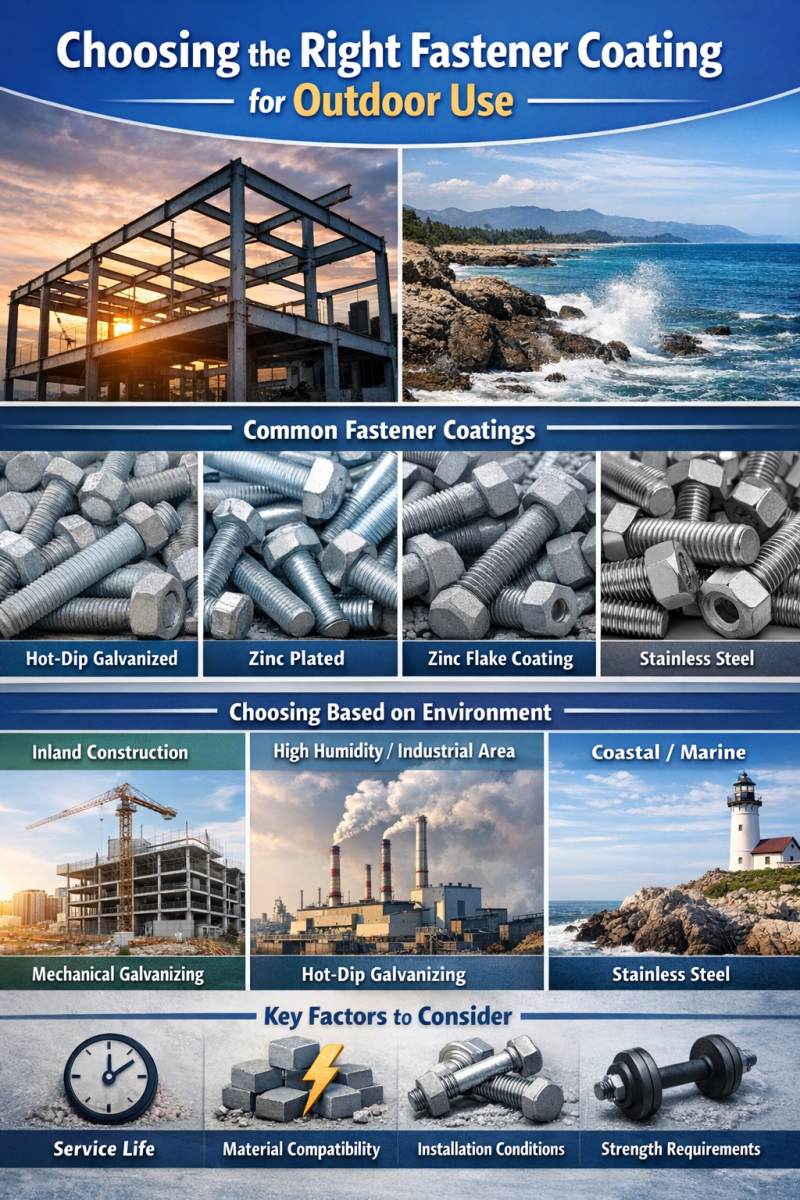
Introduction
Outdoor structures face constant exposure to moisture, temperature changes, and environmental contaminants. If the wrong fastener coating is used, corrosion can appear within months, leading to structural failures, costly maintenance, or premature replacement.
For procurement managers, contractors, and engineers, choosing the correct fastener coating is therefore not just a material decision—it is a durability and lifecycle cost decision.
This guide explains how to choose the right fastener coating for outdoor use. It covers the most common coating types, how they perform in different environments, and how to make a practical selection based on project conditions.
Contenu principal
Why Fastener Coating Matters in Outdoor Environments
Bare carbon steel fasteners corrode quickly when exposed to air and moisture. Outdoor environments accelerate this process through:
- Pluie et humidité
- Temperature fluctuations
- Exposition aux UV
- Industrial pollution
- Brouillard salin côtier
- Exposition chimique
Without adequate corrosion protection, fasteners can:
- Lose strength due to rust
- Become difficult to remove during maintenance
- Cause staining on surrounding materials
- Lead to joint failure
Fastener coatings act as a protective barrier ou sacrificial layer to prevent corrosion from attacking the base metal.
Common Fastener Coatings for Outdoor Applications
Choosing the right coating depends on environmental exposure, structural requirements, and project lifespan.
1. Hot-Dip Galvanizing (HDG)
Hot-dip galvanizing is one of the most widely used coatings for outdoor structural fasteners.
How it works
Fasteners are immersed in molten zinc, creating a thick metallurgical zinc layer bonded to the steel surface.
Avantages
- Excellent corrosion resistance
- Thick coating (typically 40–80 μm)
- Long service life in outdoor environments
- Provides sacrificial protection if coating is damaged
Typical applications
- Structures en acier
- Ponts
- Systèmes de montage solaire
- Highway infrastructure
- Construction framing
Limites
- Rougher surface finish
- May affect thread fit on smaller fasteners
- Not ideal for tight-tolerance assemblies
For most structural outdoor projects, hot-dip galvanized bolts are often the default choice.
2. Zinc Plating (Electro-Galvanizing)
Zinc plating is commonly used for general industrial fasteners.
How it works
A thin layer of zinc is electroplated onto the fastener surface.
Avantages
- Smooth finish
- Low cost
- Suitable for high-volume production
Typical applications
- Machines d'intérieur
- Light-duty hardware
- Controlled environments
Limitations for outdoor use
- Thin coating (typically 5–15 μm)
- Protection limitée contre la corrosion
- Short lifespan in humid or wet environments
For outdoor projects, zinc plating alone is usually not sufficient unless combined with additional coatings.
3. Mechanical Galvanizing
Mechanical galvanizing uses tumbling processes to bond zinc powder onto fasteners.
Avantages
- Uniform coating
- No hydrogen embrittlement risk
- Good for high-strength fasteners
Typical applications
- Boulons structurels
- Quincaillerie de construction
- Équipement extérieur
Compared with electroplating, mechanical galvanizing provides better corrosion resistance, though typically less than hot-dip galvanizing.
4. Zinc Flake Coatings (Dacromet / Geomet)
Zinc flake coatings are increasingly used in industries where both corrosion resistance and precise threads are required.
How it works
A mixture of zinc and aluminum flakes is applied and cured to form a protective barrier.
Avantages
- Haute résistance à la corrosion
- Thin, uniform coating
- No hydrogen embrittlement
- Excellent for high-strength bolts
Typical applications
- Composants automobiles
- Systèmes d'énergie éolienne
- Structures de montage solaire
- Machines d'extérieur
These coatings can achieve 500–1000+ hours salt spray resistance, depending on specification.
5. Stainless Steel Fasteners
Although not technically a coating, stainless steel is often considered when corrosion resistance is critical.
Common grades include:
- A2 / 304 stainless steel – general outdoor environments
- A4 / 316 stainless steel – marine or coastal environments
Avantages
- Natural corrosion resistance
- No coating damage risk
- Clean appearance
Limites
- Coût plus élevé
- Lower strength compared to some alloy steel bolts
- Risk of galling during installation
For coastal or chemical environments, stainless steel may outperform coated carbon steel fasteners.
How to Choose the Right Coating Based on Environment
The best coating depends heavily on where the fastener will be used.
Mild Outdoor Environment
Exemples :
- Inland construction
- Residential buildings
- Outdoor equipment with limited exposure
Recommended options:
- Galvanisation mécanique
- Thick zinc plating with topcoat
- Standard hot-dip galvanizing
High Humidity or Industrial Areas
Exemples :
- Factories
- Usines chimiques
- Urban environments with pollution
Recommended options:
- Galvanisation à chaud
- Zinc flake coating systems
- Duplex coating systems (zinc + topcoat)
Coastal or Marine Environments
Salt exposure dramatically accelerates corrosion.
Recommended options:
- Stainless steel A4 (316)
- High-performance zinc flake coatings
- Specialized marine-grade galvanizing
Avoid using standard zinc plating in these conditions.
Solar and Renewable Energy Structures
Solar mounting systems require long service life with minimal maintenance.
Recommended options:
- Hot-dip galvanized structural bolts
- Zinc-aluminum flake coatings
- Stainless steel for high exposure areas
Fasteners used in solar installations often need 20+ years of corrosion resistance.
Factors Buyers Should Consider Before Choosing a Coating
1. Expected Service Life
Ask the following questions:
- Is the project designed for 5, 10, or 25 years?
- Will fasteners be replaceable later?
Longer lifespan projects usually justify stronger coatings.
2. Compatibility With Base Material
Using galvanized fasteners with certain metals may cause corrosion galvanique.
Exemples :
- Aluminum structures
- Stainless steel assemblies
Material compatibility must be evaluated during design.
3. Installation Conditions
Some coatings affect installation performance.
Exemples :
- Thick coatings may require oversize threads
- Stainless steel may require lubrication to prevent galling
Installation torque specifications should match the coating system.
4. Strength Requirements
High-strength bolts (e.g., Grade 10.9 or ASTM A490) may have coating restrictions.
Electroplating processes can cause hydrogen embrittlement, which is why mechanical galvanizing or zinc flake coatings are often preferred.
Common Mistakes When Selecting Outdoor Fastener Coatings
Choosing Based on Price Alone
Low-cost coatings may result in fast corrosion, requiring expensive maintenance later.
Ignoring Environmental Exposure
Indoor-rated fasteners sometimes get installed outdoors due to purchasing errors.
Mixing Incompatible Materials
Combining stainless steel fasteners with galvanized components may accelerate corrosion in certain conditions.
Not Considering Maintenance Access
If fasteners are difficult to access after installation, higher corrosion protection is worth the cost.
Practical Procurement Tips
When sourcing fasteners for outdoor projects:
- Confirm coating type and thickness
- Request salt spray test data if applicable
- Verify compliance with standards such as ASTM, ISO, or DIN
- Confirm whether thread tolerances are affected by coating
- Ensure coating compatibility with project materials
For large projects, working with an experienced supplier can help prevent costly specification errors.
You can explore available fastener types on the
All Products page:
https://xzfastener.com/home/products/
If your project requires specific coatings or custom specifications, custom manufacturing services are available:
https://xzfastener.com/home/customized-service/
Points clés à retenir
- Fastener coatings are critical for preventing corrosion in outdoor environments.
- Hot-dip galvanizing is one of the most reliable choices for structural outdoor applications.
- Zinc plating alone usually does not provide sufficient protection outdoors.
- Coastal and marine environments often require stainless steel or high-performance coatings.
- Correct coating selection depends on exposure conditions, service life, and installation requirements.
FAQ
What is the best fastener coating for outdoor use?
Hot-dip galvanizing is commonly considered one of the most reliable coatings for outdoor structural applications because it provides thick zinc protection and long service life.
Are zinc-plated fasteners suitable for outdoor environments?
Standard zinc plating offers limited corrosion resistance and is generally not recommended for long-term outdoor exposure unless combined with additional protective coatings.
When should stainless steel fasteners be used outdoors?
Stainless steel fasteners are ideal for coastal areas, marine environments, or applications where corrosion resistance and appearance are both important.
Do coated fasteners affect bolt strength?
Some coating processes, particularly electroplating, can introduce hydrogen embrittlement in high-strength bolts. Mechanical galvanizing or zinc flake coatings are often safer options for high-strength fasteners.
How long do galvanized fasteners last outdoors?
The lifespan depends on the environment, but hot-dip galvanized fasteners can often provide 15–50 years of corrosion protection in many outdoor conditions.
Conclusion
Selecting the right fastener coating for outdoor use requires balancing corrosion resistance, cost, strength requirements, and environmental exposure.
For most structural outdoor applications, hot-dip galvanized fasteners offer a reliable and cost-effective solution. In harsher environments such as coastal areas or chemical facilities, stainless steel or advanced zinc flake coatings may provide better long-term protection.
The key is to match the coating system to the actual service conditions rather than choosing based on price alone.
If you need help selecting the appropriate coating for your project, you can learn more about our company and manufacturing capabilities here:
https://xzfastener.com/home/about-us/
Or contact our team directly to discuss project requirements:
https://xzfastener.com/home/contact-us/
 English
  Español
  Français
  Español de México
  العربية
  Deutsch
  Русский
  Tiếng Việt
  Bahasa Indonesia
  Italiano
  简体中文
简体中文