
Pendahuluan
When a standard bolt, screw, nut, washer, pin, anchor, or threaded part cannot fit your project, a custom fastener prototype is often the fastest way to verify the design before mass production.
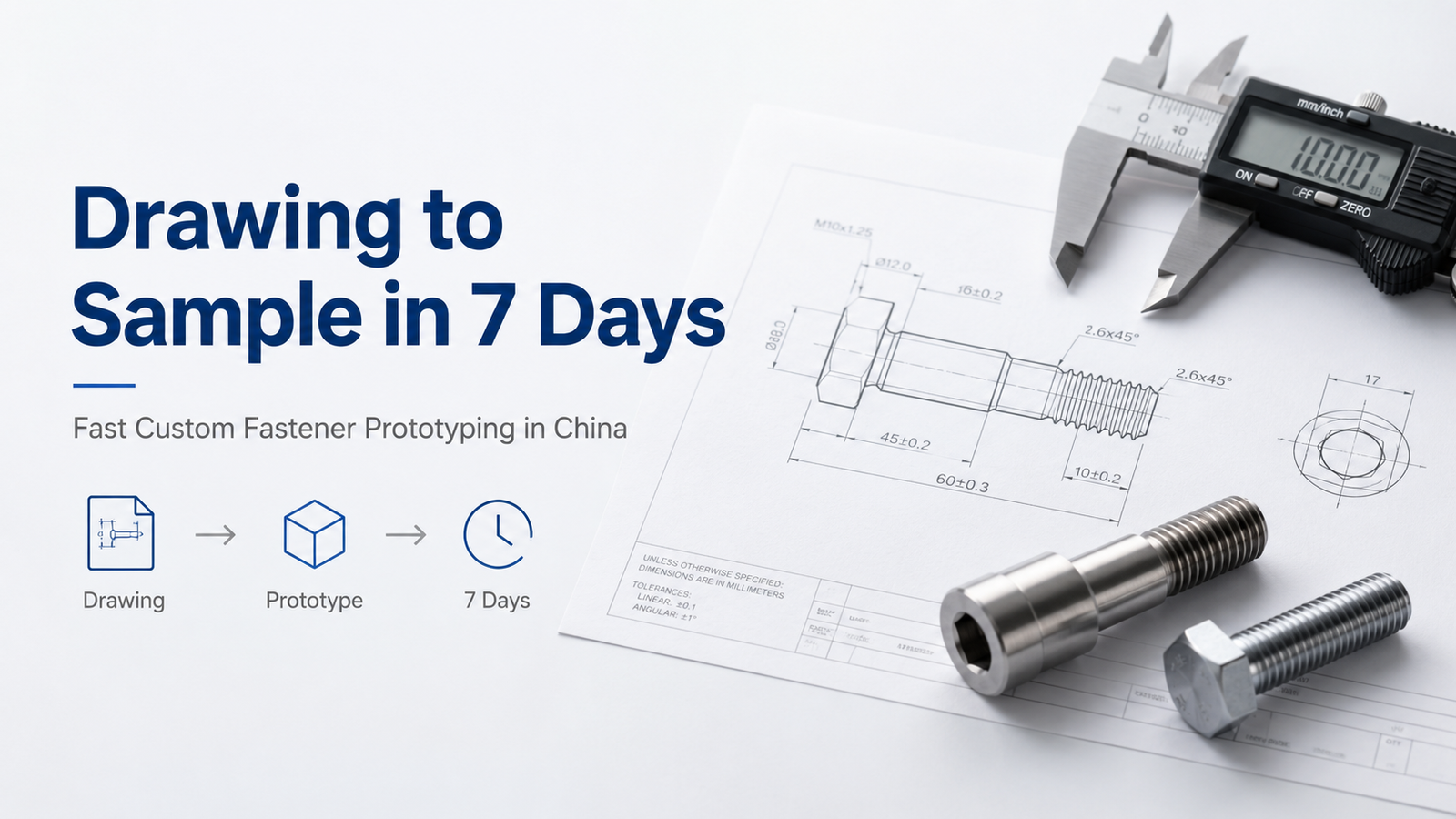
This article explains how custom fastener prototyping in China works, what “drawing to sample in 7 days” really means, which products are suitable for fast sampling, what information buyers should prepare, and how to reduce risks before placing a bulk order.
A practical answer first: 7-day custom fastener samples are possible when the drawing is clear, material is available, tooling is simple, and the first sample only needs dimensional verification or basic functional testing. For complex materials, special heat treatment, tight tolerances, or advanced coatings, the sample schedule may need more time.
Konten Utama
What Is Custom Fastener Prototyping?
Custom fastener prototyping means producing a small number of sample parts based on a drawing, physical sample, 3D model, or application requirement before mass production.
It is commonly used when standard fasteners do not meet one or more project requirements, such as:
- Non-standard length or diameter
- Bentuk kepala khusus
- Panjang benang khusus
- Fine thread or special thread
- Bahan khusus
- Higher strength grade
- Corrosion-resistant coating
- Custom logo marking
- Special washer, pin, sleeve, shaft, or threaded component
- Replacement parts for old equipment
For buyers, the prototype is not just a “sample for appearance.” It is a way to check whether the part can be manufactured, installed, assembled, and inspected correctly before investing in full production.
XZ Fastener supports custom fastener production based on drawings, samples, and technical requirements, including special size, thread, material, coating, and packaging. You can review related options on the custom non-standard fasteners page.
What Does “Drawing to Sample in 7 Days” Really Mean?
“Drawing to sample in 7 days” usually refers to the time needed to produce initial prototype samples after the technical details, material, quantity, and quotation are confirmed.
It does not always mean every custom fastener can be finished in exactly 7 days. A realistic schedule depends on the complexity of the part.
A 7-Day Sample Is More Realistic When:
- The drawing is complete and accurate
- Material is in stock or easy to source
- The product can be made by machining, turning, milling, thread rolling, or simple cold forming
- No complex mold is required
- The coating is simple, such as plain finish, zinc plating, or black oxide
- The sample quantity is small
- The buyer only needs dimensional checking first
- No third-party testing is required before shipment
A 7-Day Sample May Not Be Enough When:
- A new mold or complex tooling is required
- Material is special, such as 2205 duplex stainless steel, titanium alloy, Hastelloy, or high-temperature alloy
- Heat treatment and mechanical testing are required
- The part needs tight tolerance or precision grinding
- The coating needs long testing, such as salt spray verification
- The sample must pass project approval before shipment
- The product requires multiple assembly parts
This is why buyers should treat 7 days as a fast prototyping target, not a blind guarantee. A responsible supplier should confirm the lead time after reviewing the drawing, material, process, and inspection requirements.
XZ Fastener’s customized service page describes a 5-step quick customization process from requirement submission to mass production, with sample making listed as fast prototyping in 3–7 days. You can submit project details through the customized fastener service page.
Why Buyers Need Fast Custom Fastener Samples
Fast samples are valuable because they reduce uncertainty before bulk production.
For procurement teams, a sample helps answer practical questions:
- Does the part match the drawing?
- Can the thread fit the mating component?
- Is the head shape suitable for the tool?
- Is the length correct after assembly?
- Is the material suitable for the environment?
- Does the coating affect thread engagement?
- Can the supplier control dimensions consistently?
- Is the part ready for mass production?
For contractors and project engineers, fast sampling is often used when a project is delayed because the original fastener is missing, discontinued, damaged, or unsuitable for actual installation.
For distributors, fast custom samples help confirm whether a non-standard product has repeat order potential before committing to inventory.
Drawing-Based vs Sample-Based Custom Fasteners
Custom fasteners can start from either a technical drawing or a physical sample. Each method has advantages and limitations.
Drawing-Based Customization
Drawing-based production is usually more accurate. It gives the supplier clear data, such as dimensions, tolerance, material, grade, surface treatment, and thread details.
It is better for:
- New product development
- Engineering projects
- suku cadang OEM
- Pengencang berkekuatan tinggi
- Critical assemblies
- Parts with tolerance requirements
- Repeat orders
A good drawing should include diameter, length, head size, thread pitch, thread length, tolerance, material, grade, coating, hardness or mechanical requirements, and quantity.
Sample-Based Customization
Sample-based customization is useful when the buyer does not have the original drawing. The supplier measures the physical part and creates a manufacturing plan.
It is better for:
- Suku cadang pengganti
- Old equipment maintenance
- Discontinued fasteners
- Local market matching
- Repair projects
- Fast identification of unknown parts
However, sample-based production has one risk: the old sample may already be worn, corroded, stretched, or damaged. If the sample is not in original condition, the supplier may need additional confirmation before production.
Best Option: Drawing + Sample
The most reliable method is to provide both drawing and sample. The drawing confirms the design intent, while the sample helps verify real shape, surface condition, tool fit, and assembly details.
What Types of Custom Fasteners Can Be Prototyped?
Custom prototyping can cover many industrial fastener types.
Contoh umum meliputi:
- Baut khusus
- Special screws
- Non-standard nuts
- Special washers
- Batang berulir
- Baut tiang
- pin
- Shafts
- Sleeves
- paku keling
- Jangkar
- Stepped screws
- Special head bolts
- Custom threaded components
XZ Fastener’s product range includes bolts, nuts, washers, screws, rivets, anchors, threaded rods, stud bolts, and custom non-standard fasteners. Buyers can also browse standard categories first on the halaman produk pengikat to check whether an existing product can solve the problem before requesting a custom part.
For bolt-related projects, the kategori baut is useful because many custom requests are modified from standard hex bolts, socket head cap screws, flange bolts, carriage bolts, eye bolts, U-bolts, stud bolts, or anchor bolts.
Materials Commonly Used for Custom Fastener Samples
Material selection should match the load, environment, cost target, and production method.
Baja Karbon
Carbon steel is suitable for many general-purpose custom fasteners. It is cost-effective and can be supplied in different strength grades. It usually needs surface treatment when used outdoors or in humid environments.
Baja Paduan
Alloy steel is used for high-strength bolts, studs, machinery fasteners, and heavy-duty components. Grades such as 8.8, 10.9, and 12.9 are common in industrial applications.
If the part needs higher load capacity, review related products under pengencang kekuatan tinggi.
Baja Tahan Karat
Stainless steel is suitable for projects where corrosion resistance matters. A2 / 304 is often used for general corrosion resistance, while A4 / 316 is more suitable for marine, chemical, and high-humidity conditions.
Bahan Khusus
Special projects may require 316L, 2205 duplex stainless steel, titanium alloy, Hastelloy, high-temperature alloy, brass, aluminum, nylon, or engineering plastics.
XZ Fastener lists carbon steel, stainless steel, alloy steel, brass, aluminum, and special materials as available options depending on application.
Surface Treatment: Do Not Leave It Until the End
Many buyers focus on the drawing and forget the coating. This can cause problems later.
Surface treatment affects:
- Ketahanan korosi
- Penampilan
- Benangnya pas
- Gesekan
- Perilaku torsi
- Service life
- Project approval
Common surface treatments include:
- Hasil akhir yang polos
- Pelapisan seng
- Galvanisasi hot-dip
- Oksida hitam
- Dacromet
- Lapisan seng-aluminium
- Lapisan PTFE
- Lapisan fosfat
XZ Fastener lists zinc plated, hot-dip galvanized, black oxide, Dacromet, zinc-aluminum coating, PTFE coating, phosphate coating, and plain finish among available finish options. For projects where coating is important, buyers can compare options on the various coated fasteners page.
Practical Coating Advice
Use zinc plating for indoor or mild environments.
Use hot-dip galvanizing or zinc-aluminum coating for outdoor steel structures or infrastructure.
Use stainless steel, PTFE coating, or special coatings for marine, chemical, or high-corrosion environments.
Avoid choosing coating by appearance only. The real working environment matters more.
A Practical 7-Day Custom Fastener Prototyping Process
A well-organized process helps buyers save time and avoid repeated revisions.
Day 1: Submit Drawing, Sample, or Requirement
The buyer sends the drawing, sample photo, 3D model, or working condition.
Useful file formats include:
- gambar PDF
- CAD file
- STEP / STP file
- Sample photos with dimensions
- Assembly photos
- Material or standard requirements
- Quantity and destination
Day 1–2: Engineering Review
The supplier checks whether the part can be produced as designed.
This review should confirm:
- Manufacturing process
- Material availability
- Jenis benang
- Tolerance feasibility
- Kompatibilitas pelapisan
- Persyaratan perlakuan panas
- Metode inspeksi
- Estimated sample lead time
- Estimated mass production cost
This step is important because a drawing may be technically correct but difficult or expensive to manufacture.
Day 2–3: Quotation and Production Plan
The supplier provides price, lead time, sample quantity, tooling cost if needed, and inspection plan.
For urgent projects, buyers should confirm:
- Whether the quoted lead time starts after payment or drawing approval
- Whether the sample includes coating
- Whether testing reports are included
- Whether shipping time is counted separately
- Whether sample approval affects mass production lead time
Day 3–6: Sample Production
Depending on the part, the supplier may use machining, turning, milling, cold heading, hot forging, thread rolling, heat treatment, or surface treatment.
For simple parts, machining may be fastest.
For mass-production parts, a sample may need to consider future tooling and repeatability.
Day 6–7: Inspection and Sample Shipment
Before shipment, samples should be checked for key dimensions, thread accuracy, surface condition, material confirmation, and visual defects.
For high-strength or project fasteners, additional checks may include hardness testing, tensile testing, coating inspection, and material certificate review.
XZ Fastener describes quality control including raw material inspection, dimensional inspection, thread inspection, mechanical testing, hardness testing, and surface coating inspection before shipment.
What Buyers Should Prepare Before Requesting a Sample
A clear inquiry can reduce days of back-and-forth communication.
Send these details if possible:
| Informasi | Mengapa Itu Penting |
|---|---|
| Nama produk | Helps identify the basic fastener type |
| Gambar atau contoh foto | Reduces misunderstanding |
| Size and tolerance | Affects manufacturing process and cost |
| Jenis dan nada benang | Mencegah ketidakcocokan perakitan |
| Bahan | Affects strength, corrosion resistance, and cost |
| Grade or hardness | Important for load-bearing applications |
| Perawatan permukaan | Mempengaruhi ketahanan korosi dan kesesuaian benang |
| Kuantitas | Sample and mass production costs are different |
| Aplikasi | Helps supplier judge whether the design is suitable |
| Lingkungan kerja | Determines material and coating choice |
| Persyaratan pengujian | Affects lead time and cost |
| Tujuan | Needed for shipping estimate |
A strong inquiry example:
Custom shoulder bolt, according to attached drawing, material 40Cr, heat treated, black oxide, M12 × 1.75 thread, tolerance ±0.05 mm on shoulder diameter, 10 pcs samples first, 5,000 pcs estimated mass production, used for machinery assembly.
A weak inquiry example:
Need custom bolt, please quote.
The second inquiry forces the supplier to ask many questions before doing anything useful.
What Is Suitable for Fast Prototyping?
Fast prototyping is suitable when the buyer needs to verify fit, dimensions, assembly, and basic function quickly.
Good candidates include:
- Custom-length bolts
- Special thread lengths
- Machined threaded parts
- Custom pins
- Special washers
- Small-batch studs
- Simple non-standard screws
- Sleeves or spacers
- Replacement fasteners
- Modified standard parts
What Is Not Suitable for Rushed Sampling?
Some fasteners should not be rushed because the risk is too high.
Be careful with:
- Safety-critical structural bolts
- High-strength grade 10.9 or 12.9 bolts requiring full mechanical verification
- Fasteners for lifting equipment
- Pressure vessel or flange bolting
- Aerospace or automotive safety parts
- Parts requiring new cold heading molds
- Parts requiring long salt spray testing
- Special alloy parts with limited material availability
- Fasteners requiring third-party inspection before approval
For these projects, fast communication is useful, but production and testing should follow the required technical process.
Common Mistakes in Custom Fastener Prototyping
Mistake 1: Sending Only a Photo Without Dimensions
A photo can help identify shape, but it cannot replace dimensions. Always provide at least key measurements.
Kesalahan 2: Mengabaikan Pitch Thread
Thread pitch mismatch is one of the most common reasons custom samples fail during assembly.
Mistake 3: Choosing Material Only by Price
A cheaper material may not meet strength, corrosion, or temperature requirements. The application should guide material selection.
Mistake 4: Confirming Coating After the Sample Is Made
Coating can change the final size, appearance, friction, and thread fit. It should be confirmed before sample production.
Mistake 5: Treating the Prototype as Mass Production Approval
A first sample proves the design direction. Before mass production, buyers should still confirm inspection standards, tolerance, packaging, labeling, and batch quality control.
How to Choose a Custom Fastener Supplier in China
A suitable supplier should do more than quote a low price.
Look for these capabilities:
- Can review drawings technically
- Understands materials, grades, thread standards, and coatings
- Supports both standard and non-standard fasteners
- Can provide prototype and mass production
- Can explain manufacturing limitations clearly
- Provides dimensional inspection
- Can support material and performance testing when required
- Communicates lead time and cost clearly
- Understands export packaging and documentation
XZ Fastener’s customized service page states that customization can be based on working conditions, materials, strength, and dimensions, with engineer support for one-on-one design. The company also describes itself as a fastener manufacturing group integrating production, R&D, supply chain management, and global sales. You can learn more from the About XZ Fastener page.
When Should You Move From Sample to Mass Production?
Do not rush into bulk production just because the first sample looks correct.
Before approval, check:
- Dimensions match the drawing
- Thread fits the mating part
- Material is confirmed
- Surface treatment is acceptable
- Strength grade or hardness meets requirement
- Coating does not affect installation
- Sample works in the real assembly
- Packaging method is suitable
- Inspection criteria are agreed
- Lead time for mass production is confirmed
For repeat or project orders, it is better to keep one approved sample as the “golden sample” for future comparison.
Poin Penting
- Fast custom fastener prototyping is useful when standard fasteners cannot meet size, thread, material, coating, or application requirements.
- A 7-day sample is realistic for simple or well-defined custom parts, but complex materials, molds, heat treatment, tight tolerances, or testing can extend the timeline.
- The best inquiry includes drawings, samples, material, grade, coating, thread, quantity, application, and working environment.
- Coating, thread pitch, tolerance, and material choice should be confirmed before sample production, not after.
- A prototype verifies design and fit, but mass production still requires clear inspection standards and batch quality control.
FAQ
1. Can custom fastener samples really be made in 7 days?
Yes, some custom fastener samples can be made in 3–7 days when the drawing is clear, material is available, the process is simple, and no complex testing or tooling is required. For special materials, heat treatment, tight tolerance, or advanced coating, the lead time may be longer.
2. What files should I send for custom fastener prototyping?
Send a PDF drawing, CAD file, STEP file, sample photos, dimensions, material, grade, coating, thread pitch, quantity, and application details. If you do not have a drawing, send a physical sample or clear photos with key measurements.
3. Is drawing-based customization better than sample-based customization?
Drawing-based customization is usually more accurate because it defines dimensions, tolerances, material, and technical requirements. Sample-based customization is useful for replacement parts, but the sample may be worn or damaged. The best option is to provide both drawing and sample.
4. Can surface treatment be added after the sample is approved?
It can, but it is better to confirm coating before sample production. Coating may affect thread fit, thickness, corrosion resistance, appearance, and torque behavior. If the final product needs coating, the sample should reflect the final condition as closely as possible.
5. What is the difference between a prototype sample and a production sample?
A prototype sample checks design, fit, and basic manufacturability. A production sample is closer to mass production conditions and is used to confirm batch process, inspection criteria, surface treatment, packaging, and final approval.
Kesimpulan
Fast custom fastener prototyping helps buyers turn drawings, samples, or project requirements into real parts before committing to mass production. For urgent projects, a 7-day sample can save valuable time, but it works best when the buyer provides clear technical information and the part does not require complex tooling or long testing.
Choose fast prototyping when you need to verify fit, thread, dimensions, or assembly quickly. Slow down when the part is safety-critical, high-strength, made from special materials, or requires strict certification.
The most practical approach is simple: send a clear drawing or sample, define the working environment, confirm material and coating early, inspect the first sample carefully, and only then move to mass production.
For standard and custom industrial fasteners, start from the halaman produk pengikat. For drawing-based or sample-based custom parts, submit your requirements through the layanan pengikat yang disesuaikan atau hubungi XZ Fastener for a project review.
 English
  Español
  Français
  Español de México
  العربية
  Deutsch
  Русский
  Tiếng Việt
  Bahasa Indonesia
  Italiano
  简体中文
简体中文