
Introduzione
When selecting fasteners for an industrial project, one of the most common questions buyers face is whether to choose carbon steel fasteners or stainless steel fasteners.
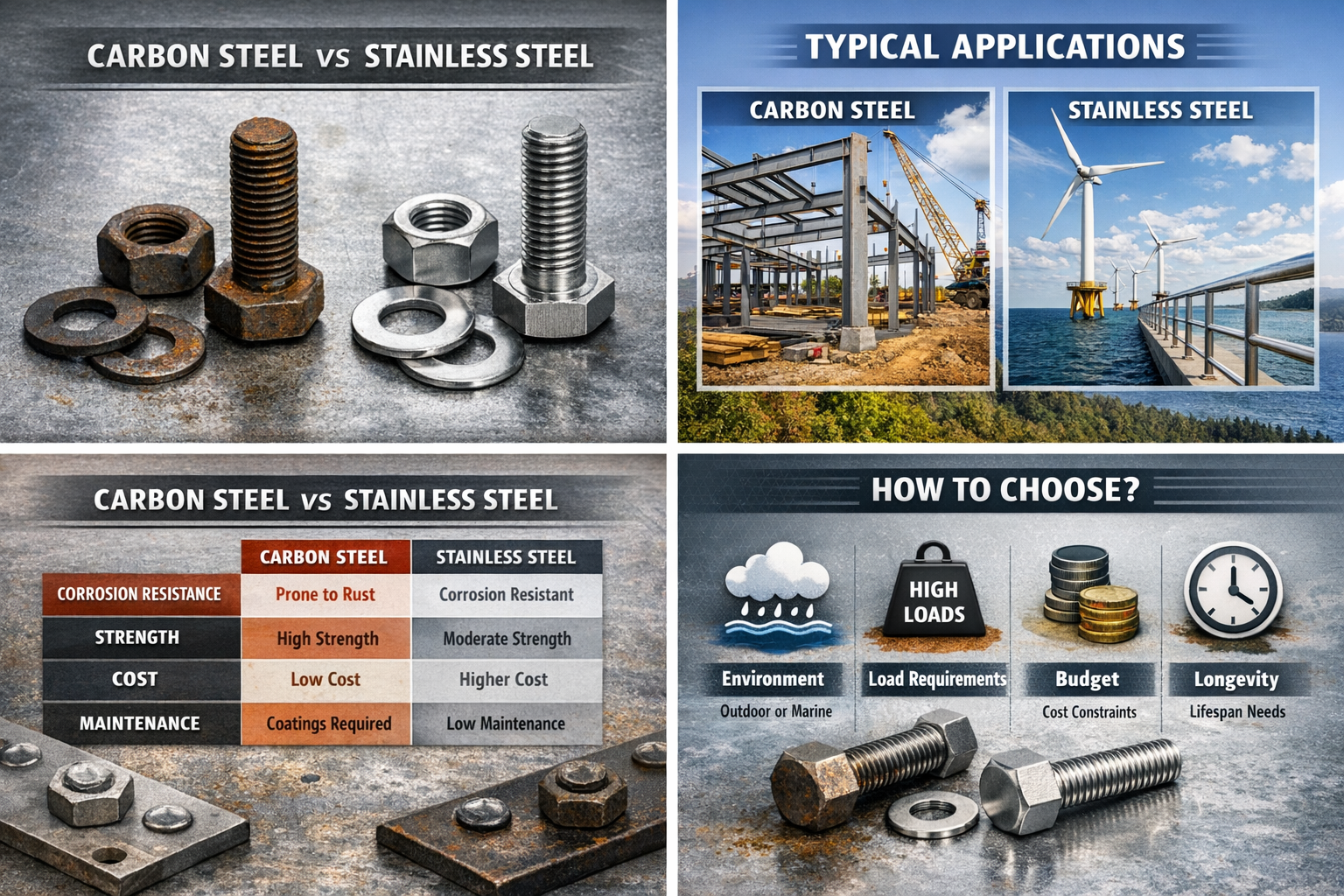
At first glance, the choice may seem straightforward: stainless steel resists corrosion, while carbon steel is stronger and cheaper. However, the real decision is rarely that simple. Factors such as environmental exposure, load requirements, maintenance expectations, and total lifecycle cost all influence which material performs better.
This guide explains the real differences between carbon steel and stainless steel fasteners, when each material performs best, and how procurement teams and engineers can make the right choice for their applications.
Cosa sono gli elementi di fissaggio in acciaio al carbonio?
Carbon steel fasteners are made primarily from iron and carbon, with carbon content typically ranging from 0.05% to around 0.60% depending on the required strength.
They are widely used because they offer:
- Elevata resistenza dopo il trattamento termico
- Good machinability
- Wide availability across bolt and screw standards
- Lower cost compared to alloyed materials
Most industrial bolts used in construction and machinery are carbon steel.
Common Carbon Steel Fastener Grades
Typical standards include:
- Grade 2 / Grade 5 / Grade 8 (SAE system)
- Class 4.8 / 8.8 / 10.9 / 12.9 (ISO metric system)
Higher grades usually indicate higher tensile strength due to heat treatment.
Surface Coatings Are Usually Required
Unlike stainless steel, carbon steel naturally corrodes when exposed to moisture or chemicals. To improve corrosion resistance, fasteners are often coated, such as:
- Zincatura
- Zincatura a caldo
- Zincatura meccanica
- Ossido nero
- Dacromet or Geomet coatings
Without these coatings, carbon steel fasteners can rust quickly in outdoor environments.
What Are Stainless Steel Fasteners?
Stainless steel fasteners are made from iron alloys containing chromium (typically ≥10.5%). The chromium forms a thin passive oxide layer that protects the metal from corrosion.
This self-protecting layer is the key difference from carbon steel.
Common Stainless Steel Fastener Grades
The most widely used grades include:
A2 Stainless Steel (304)
- Buona resistenza generale alla corrosione
- Suitable for indoor and outdoor environments
A4 Stainless Steel (316)
- Contains molybdenum
- Better resistance to saltwater and chemical corrosion
These grades are commonly labeled as:
- A2-70
- A4-70
- A4-80
The number indicates the minimum tensile strength class.
Carbon Steel vs Stainless Steel Fasteners: Key Differences
1. Corrosion Resistance
This is usually the primary decision factor.
Elementi di fissaggio in acciaio inossidabile
- Naturally resistant to rust
- Adatto per outdoor, marine, and humid environments
- Do not require coating
Elementi di fissaggio in acciaio al carbonio
- Corrode easily without coatings
- Protective coatings can delay rust but may eventually wear
Esempio:
- Indoor machinery → carbon steel is usually sufficient
- Coastal solar installations → stainless steel is typically preferred
2. Strength and Load Capacity
Carbon steel fasteners often offer higher strength grades.
Ad esempio:
- Class 12.9 socket bolts are typically acciaio al carbonio
- Stainless steel fasteners rarely exceed A4-80 strength levels
Ciò significa:
High-load structural applications often require carbon steel fasteners.
Typical examples:
- Collegamenti strutturali in acciaio
- Macchinari pesanti
- Assemblaggi automobilistici
3. Cost Considerations
Stainless steel fasteners are significantly more expensive.
Reasons include:
- Alloying elements like chromium and nickel
- Higher raw material cost
- More complex production processes
In many markets:
- Stainless fasteners may cost 2–4× more than carbon steel
For large-volume projects, the material choice can significantly affect the total budget.
4. Maintenance and Lifecycle Cost
Although stainless steel is more expensive upfront, it can reduce long-term maintenance.
Example scenarios:
Carbon steel with zinc plating:
- May require replacement after several years outdoors
Acciaio inossidabile:
- Can last decades in similar environments
For infrastructure or solar installations, lifecycle cost may favor stainless steel.
5. Appearance
Stainless steel fasteners maintain a clean metallic finish and resist staining.
Carbon steel fasteners with coatings may:
- Discolor over time
- Show rust staining
Because of this, stainless steel is often chosen for:
- Architectural structures
- Visible installations
- Food processing equipment
When Carbon Steel Fasteners Are the Better Choice
Carbon steel fasteners are usually the right option when:
High Strength Is Required
Applications like structural steel or heavy equipment often require Grade 10.9 or 12.9 bolts.
The Environment Is Controlled
Indoor machinery, equipment housings, and factory installations typically have minimal corrosion exposure.
Cost Is a Major Factor
Large projects involving tens of thousands of bolts often choose carbon steel to control budgets.
Coatings Can Provide Sufficient Protection
Hot-dip galvanized bolts are widely used in construction and infrastructure.
If you’re sourcing bolts for heavy structural use, you can explore available options on the pagina dei prodotti:
https://xzfastener.com/home/products/
When Stainless Steel Fasteners Are the Better Choice
Stainless steel becomes the better option when corrosion risk outweighs cost concerns.
Typical cases include:
Outdoor Installations
Rain exposure accelerates corrosion on carbon steel.
Esempi:
- Sistemi di montaggio solare
- Outdoor railings
- Signage structures
Marine or Coastal Environments
Saltwater dramatically increases corrosion rates.
A4 (316) stainless steel is often preferred here.
Food Processing and Hygiene-Sensitive Applications
Stainless steel fasteners are easier to clean and resist contamination.
Long-Term Infrastructure
Projects where maintenance access is difficult benefit from corrosion-resistant materials.
Factors Buyers Should Evaluate Before Choosing
Before purchasing fasteners, buyers should evaluate several key conditions.
1. Environmental Exposure
Chiedi:
- Will the fasteners be exposed to rain?
- Is the installation near the ocean?
- Are chemicals or cleaning agents present?
Environmental conditions often determine material selection.
2. Required Strength Grade
Confirm the load and structural requirements.
Using stainless steel where high-strength carbon steel is required can create safety risks.
3. Compatibility With Other Materials
Mixing different metals can cause corrosione galvanica.
Esempio:
Stainless steel bolts used with aluminum structures may accelerate corrosion under certain conditions.
4. Coating vs Material Choice
Sometimes a coated carbon steel fastener can provide sufficient corrosion resistance at lower cost.
Example coatings include:
- Zincatura a caldo
- Dacromet
- Zinc-nickel plating
If you’re unsure which coating works best, you can discuss your project requirements with the engineering team via the pagina dei contatti:
https://xzfastener.com/home/contact-us/
Common Mistakes Buyers Make
Assuming Stainless Steel Is Always Stronger
In reality, many high-strength fasteners are carbon steel, not stainless steel.
Ignoring Environmental Conditions
Using standard zinc-plated carbon steel outdoors often leads to premature rusting.
Choosing Based Only on Price
A cheaper fastener may lead to maintenance or replacement costs later.
Overlooking Custom Requirements
Some projects require:
- Rivestimenti speciali
- Non-standard dimensions
- Project-specific grades
In these cases, custom fastener manufacturing may be the best solution:
https://xzfastener.com/home/customized-service/
Punti chiave
- Carbon steel fasteners provide higher strength and lower cost, making them ideal for structural and heavy-load applications.
- Stainless steel fasteners offer superior corrosion resistance, especially in outdoor or marine environments.
- The right choice depends on environment, load requirements, maintenance expectations, and project budget.
- Coatings can improve corrosion resistance for carbon steel but may not match stainless steel in harsh environments.
- Evaluating lifecycle cost often leads to better material decisions than comparing purchase price alone.
FAQ
Are stainless steel fasteners stronger than carbon steel fasteners?
Not necessarily. High-strength fasteners such as Grade 10.9 or 12.9 bolts are typically carbon steel and can exceed the strength of most stainless steel fasteners.
Do carbon steel fasteners always rust?
Yes, carbon steel can rust if unprotected. However, coatings such as zinc plating or galvanizing can significantly delay corrosion.
When should I use A4 (316) stainless steel fasteners?
A4 stainless steel is recommended for marine environments, coastal installations, and chemical exposure, where corrosion resistance is critical.
Can stainless steel fasteners replace galvanized bolts?
Sometimes, but not always. Stainless steel provides better corrosion resistance, but galvanized carbon steel may still be preferred for structural strength or cost reasons.
Where can I source industrial fasteners or request custom specifications?
You can learn more about the manufacturer and available capabilities here:
https://xzfastener.com/home/about-us/
Conclusione
Scegliere tra carbon steel and stainless steel fasteners is not simply a matter of price or corrosion resistance. The correct material depends on the environment, required strength, expected lifespan, and overall project cost considerations.
Carbon steel fasteners remain the standard choice for high-strength structural applications and cost-sensitive projects, especially when protective coatings are sufficient. Stainless steel fasteners, on the other hand, provide long-term reliability in corrosive environments, making them the better option for outdoor, marine, and hygienic applications.
For buyers and project engineers, the most reliable approach is to evaluate the operating environment and mechanical requirements first, then choose the material that balances durability, safety, and cost.
 English
  Español
  Français
  Español de México
  العربية
  Deutsch
  Русский
  Tiếng Việt
  Bahasa Indonesia
  Italiano
  简体中文
简体中文