
What Is a Concrete Anchor and What Does It Do?
A concrete anchor is a fastening device used to attach structural or non-structural components to concrete. Unlike standard bolts that rely on threads alone, anchors are designed to transfer load into the concrete through expansion, bonding, or mechanical interlock.
Common examples of anchored components include:
- Structural steel columns
- 机械基地
- Guardrails and safety barriers
- HVAC equipment
- Cable trays and pipe supports
- 太阳能安装结构
Concrete anchors must resist several types of forces:
- Tension load – pulling force trying to pull the anchor out
- 剪切载荷 – sideways force acting across the anchor
- 组合荷载 – tension and shear acting simultaneously
- 动态负载 – vibration or repeated movement
Because concrete is strong in compression but relatively weak in tension, anchor design focuses on distributing these forces safely into the base material.
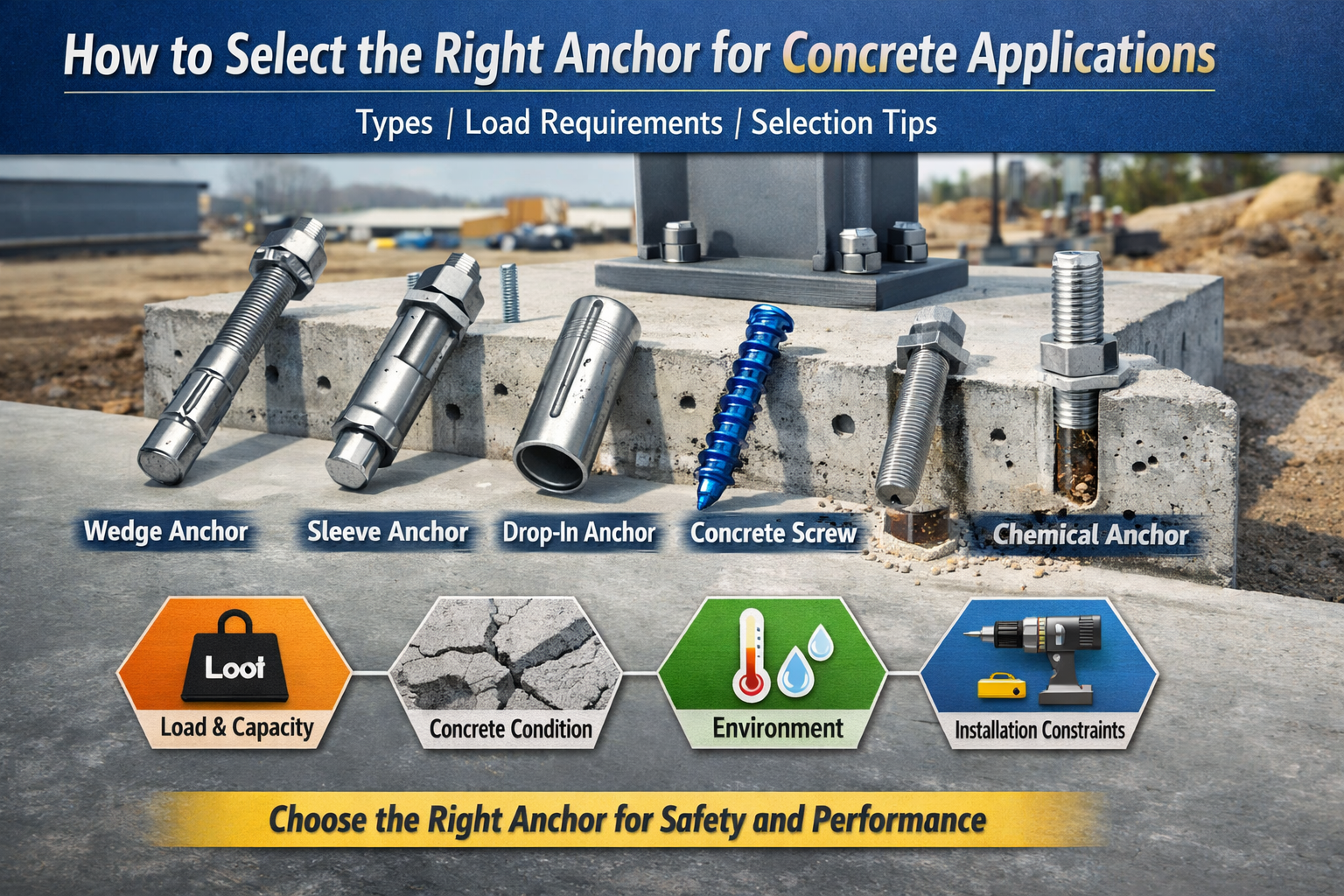
Common Types of Concrete 锚
Understanding anchor types is the first step in selecting the correct one.
1. Wedge Anchors
Wedge anchors are one of the most widely used mechanical anchors for solid concrete.
How they work:
A wedge clip expands against the concrete when the nut is tightened, creating strong friction and mechanical locking.
Typical applications
- 钢结构连接
- 设备安装
- Heavy-duty mounting
优点
- High load capacity
- Reliable in solid concrete
- Simple installation
局限性
- Not suitable for cracked or weak concrete unless specifically rated
- Cannot be reused after removal
2. Sleeve Anchors
Sleeve anchors use a sleeve that expands along the length of the anchor when tightened.
Typical applications
- Medium-duty fixtures
- 扶手
- 电气设备
- 轻工机械
优点
- Can work in several base materials (concrete, brick, block)
- 安装方便
局限性
- Lower load capacity compared with wedge anchors
3. Drop-In Anchors
Drop-in anchors are internally threaded anchors installed flush with the concrete surface.
Typical applications
- Suspended piping
- 暖通空调装置
- Threaded rod mounting
优点
- Flush installation
- Clean appearance
- Ideal for overhead installations
局限性
- Requires a setting tool
- Works only in solid concrete
4. Concrete Screw Anchors
Concrete screws cut threads directly into the concrete during installation.
Typical applications
- Temporary installations
- 设备支架
- Lightweight structural components
优点
- 快速安装
- Removable and reusable in some cases
- No expansion stress on concrete
局限性
- Moderate load capacity
- Hole quality is critical
5. Chemical (Adhesive) Anchors
Chemical anchors rely on epoxy or resin to bond threaded rods or rebar into drilled holes.
Typical applications
- Heavy structural loads
- Seismic zones
- Post-installed rebar connections
优点
- Extremely high load capacity
- Works well in cracked concrete
- Flexible embedment depth
局限性
- Installation requires proper curing time
- Sensitive to hole cleaning and temperature
Key Factors When Selecting a Concrete Anchor
Choosing the right anchor involves more than selecting a diameter. The following factors determine whether the anchor will perform safely.
1. Load Requirements
Start by determining the actual load applied to the anchor.
关键问题包括:
- Is the load tension, shear, 或 combined?
- Is the load static 或 dynamic?
- What is the safety factor required by the project?
Heavy structural loads typically require:
- wedge anchors
- chemical anchors
- heavy-duty mechanical anchors
Lighter installations may use:
- sleeve anchors
- concrete screws
2. Concrete Strength and Condition
Concrete anchors perform differently depending on the base material.
Important variables include:
- 混凝土抗压强度
- Cracked vs. non-cracked concrete
- 边距
- Spacing between anchors
例如:
- Mechanical anchors near edges may cause concrete cracking.
- Chemical anchors often perform better when anchors must be installed close to edges.
3. Installation Environment
Environmental conditions affect long-term anchor reliability.
Consider:
- Indoor vs outdoor installation
- 受潮
- 化学暴露
- Marine or coastal environments
- Temperature fluctuations
For corrosive environments, stainless steel anchors (such as A4 stainless) are often required.
4. Installation Constraints
Real-world installation conditions often influence anchor choice more than load capacity.
Key considerations include:
- Available drilling depth
- Overhead installation
- Limited installation space
- Need for removable anchors
- Installation speed on large projects
例如:
- Concrete screws are often used when fast installation is required.
- Drop-in anchors are ideal for overhead threaded rod systems.
5. Certification and Standards
In many structural projects, anchors must comply with recognized standards.
常见的参考资料包括:
- ICC approvals (North America)
- ETA approvals (Europe)
- Seismic ratings
- Fire resistance ratings
Always verify that the anchor type is approved for the intended structural use.
Common Mistakes When Choosing Concrete Anchors
Even experienced installers sometimes overlook critical details.
Ignoring Edge Distance
Installing anchors too close to the edge of concrete can cause cracking or pull-out failure.
Choosing Based Only on Diameter
Two anchors of the same diameter can have very different load capacities depending on design.
Poor Hole Preparation
Dust or debris left in drilled holes significantly reduces the performance of chemical anchors.
Using Carbon Steel in Corrosive Environments
Corrosion is one of the most common long-term causes of anchor failure.
Practical Selection Example
Consider a typical industrial installation:
Scenario: Mounting a heavy steel equipment base to a reinforced concrete floor.
Key requirements:
- High tension and shear loads
- Permanent installation
- Indoor environment
Suitable options may include:
- Wedge anchors for fast mechanical installation
- Chemical anchors if higher load capacity or closer edge spacing is required
This type of evaluation helps narrow down anchor choices logically instead of selecting blindly.
要点
- Concrete anchors transfer loads into concrete through expansion, mechanical interlock, or chemical bonding.
- The most common types include wedge anchors, sleeve anchors, drop-in anchors, concrete screws, and chemical anchors.
- Anchor selection should be based on load type, concrete condition, environment, and installation constraints.
- Chemical anchors generally provide the highest load capacity and flexibility in challenging installations.
- Incorrect anchor selection often results from ignoring edge distance, installation conditions, or corrosion risks.
常问问题
What is the strongest type of anchor for concrete?
Chemical anchors typically provide the highest load capacity because they bond directly to the concrete and allow deeper embedment.
Can wedge anchors be used in cracked concrete?
Some wedge anchors are rated for cracked concrete, but not all. Always check manufacturer specifications and certification.
Are concrete screw anchors reusable?
In many cases, yes. Concrete screws can be removed and sometimes reinstalled, making them useful for temporary installations.
What is the difference between wedge anchors and sleeve anchors?
Wedge anchors are designed for higher load capacity in solid concrete, while sleeve anchors are more versatile but generally support lower loads.
How deep should a concrete anchor be installed?
Embedment depth depends on the anchor type and load requirements. Manufacturers provide recommended embedment depths based on tested load capacities.
结论
Selecting the right anchor for concrete applications requires understanding both the mechanical behavior of anchors and the conditions of the installation site. The correct choice depends on several interacting factors: load requirements, concrete strength, edge spacing, environmental exposure, and installation constraints.
For heavy structural loads, wedge anchors or chemical anchors are typically the most reliable options. For medium-duty installations or mixed base materials, sleeve anchors often provide a practical solution. When installation speed or removability is important, concrete screw anchors may be the better choice.
Before finalizing a purchase, always verify load ratings, corrosion resistance, and certification requirements. Taking the time to evaluate these factors early in the project can prevent costly installation failures and ensure long-term structural reliability.
 English
  Español
  Français
  Español de México
  العربية
  Deutsch
  Русский
  Tiếng Việt
  Bahasa Indonesia
  Italiano
  简体中文
简体中文