
简介
Washers are small parts, but they often decide whether a bolted joint stays stable, protects the mating surface, or fails because of preload loss, vibration, corrosion, or wrong hardness matching.
For industrial buyers, the key question is not simply “Do I need a washer?” The real question is: which washer type should be used under this bolt or nut — flat washer, spring washer, lock washer, tooth washer, conical washer, or a custom washer?
This guide explains washer types, flat washer uses, spring washer limitations, lock washer selection, material choices, hardness matching, and common purchasing mistakes. It is written for buyers, contractors, distributors, and engineers who need to select washers for real industrial applications rather than only compare part names.
主要内容
What Is a Washer and Why Does It Matter?
A washer is a plate-shaped fastener component placed under a bolt head, screw head, or nut. Its job may look simple, but in a bolted joint it can affect several things:
- Contact pressure under the bolt head or nut
- 表面保护
- Hole coverage
- Preload stability
- Resistance to embedding
- Corrosion compatibility
- Anti-loosening performance
- Electrical contact or insulation
- Sealing or spacing
A common mistake is treating washers as “cheap accessories.” In practice, a washer should be selected together with the bolt, nut, base material, tightening method, and working environment.
For example, a soft washer under a high-strength bolt may deform after tightening. A tooth lock washer may damage a painted surface. A split spring washer may be specified out of habit even when it is not suitable for severe vibration. These are not theoretical problems; they show up as loose assemblies, coating damage, rust marks, uneven clamping, and warranty claims.
XZ Fastener lists industrial washers as a dedicated product category, including flat washers, spring washers, lock washers, fender washers, tooth washers, square washers, conical washers, sealing washers, and custom washers. The available options include carbon steel, stainless steel, brass, aluminum, nylon, rubber, and special materials. You can review washer categories here: Industrial Washers.
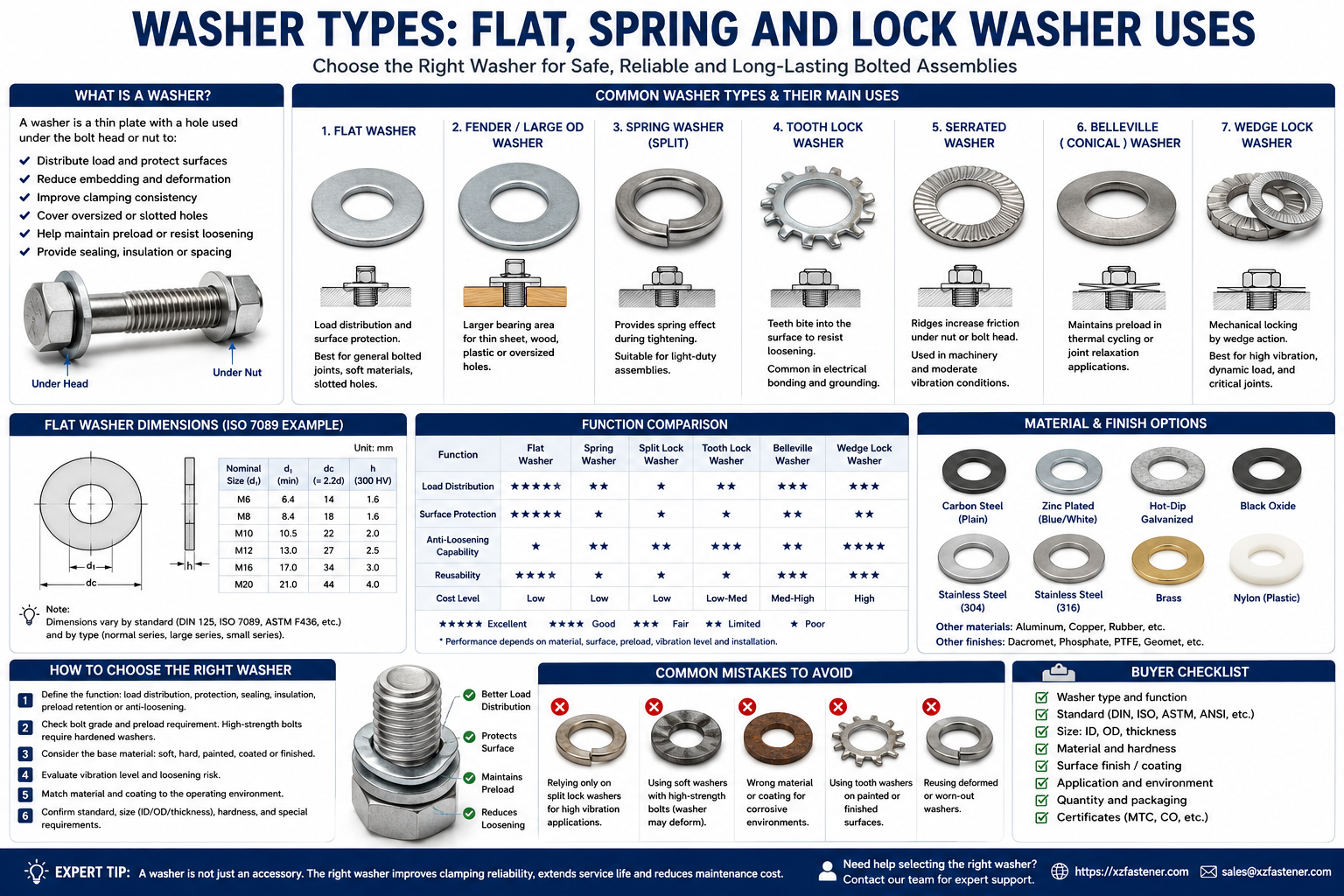
Main Washer Types at a Glance
| 垫圈类型 | 主要功能 | 典型用途 | Key Risk If Misused |
|---|---|---|---|
| 平垫圈 | 载荷分布和表面保护 | General bolted joints, soft materials, slotted holes | Does not lock the joint by itself |
| Fender / Large OD Washer | 更大的承载面积 | Thin sheet, wood, plastic, oversized holes | Too large OD may interfere with assembly space |
| 弹簧垫圈 | Provides spring effect during tightening | Light-duty assemblies, older designs, non-critical use | Often overestimated as an anti-vibration solution |
| 分体锁紧垫圈 | Traditional low-cost locking washer | General hardware, non-critical joints | Poor choice for serious vibration locking |
| Tooth Lock Washer | Bites into surface | Electrical bonding, grounding, small screws | Damages coating or mating surface |
| Serrated Washer | Increases friction by serrations | Flange bolts, machinery, moderate vibration | Can mark soft or decorative surfaces |
| Belleville / Conical Washer | Maintains load with spring deflection | Thermal cycling, preload retention, limited space | Needs correct load-deflection design |
| Wedge Lock Washer | Mechanical locking by wedge effect | High vibration, dynamic load, heavy machinery | Higher cost; surface marking may occur |
The first selection rule is simple: choose the washer by function, not by habit.
Flat Washers: Uses, Strengths and Selection Logic
What Is a Flat Washer?
A flat washer, also called a plain washer, is the most commonly used washer type. It has a flat circular shape with a central hole.
Its main purpose is not to stop loosening. A flat washer mainly provides a stable bearing surface between the fastener and the connected part.
Main Uses of Flat Washers
1. Distributing Load
When a bolt or nut is tightened directly against a soft or thin material, the contact pressure may be too concentrated. A flat washer spreads the load over a larger area.
This is useful for:
- Aluminum parts
- 塑料部件
- Wood assemblies
- 薄金属板
- Painted surfaces
- 长孔
- Oversized clearance holes
If the washer is too small, the bolt head or nut may still bite into the surface. If the washer is too soft, it may deform and reduce preload.
2. Protecting the Mating Surface
Flat washers reduce direct friction between the nut or bolt head and the connected part. This helps protect:
- Painted surfaces
- 镀锌表面
- Stainless steel equipment
- Aluminum frames
- Machinery mounting plates
- Decorative metal parts
This matters when the assembly will be removed and reinstalled, or when visible surface damage is unacceptable.
3. Supporting Oversized or Slotted Holes
Flat washers are often used where holes are larger than the bolt diameter. For slotted holes or soft materials, a larger outside diameter washer is often better than a standard OD washer.
例如:
| Hole Condition | Better Washer Choice |
|---|---|
| Normal clearance hole | 标准平垫圈 |
| Large clearance hole | 大外径垫圈 |
| 长孔 | Large OD or structural washer |
| 薄金属板 | Fender washer or large OD washer |
| High-strength joint | 硬化垫圈 |
Flat Washer Standards and Hardness
Common flat washer standards include DIN 125, DIN 9021, ISO 7089, ISO 7090, ISO 7091, ASTM F436, and ASTM F844. XZ Fastener’s washer supply page lists these as common washer standards and also shows hardness options such as HV100, HV140, HV200, HV300, 45H, and 300HV.
The important point for buyers is not only the standard number. It is also the hardness.
一个实用的规则:
| Bolt / Screw Strength | Washer Selection Direction |
|---|---|
| Low-strength general bolt | Standard carbon steel or stainless flat washer |
| 8.8级螺栓 | Normal washer may be acceptable depending on design |
| Class 10.9 or high-preload joint | Consider 300HV or hardened washer |
| Structural bolt assembly | Follow project standard, such as ASTM F436 or drawing requirement |
| 软质基材 | Use larger OD washer, but still check washer hardness |
ISO 7089 includes 200 HV and 300 HV plain washer hardness classes, and its scope links washer hardness suitability to different bolt property classes. In simple purchasing language: do not put a soft washer under a high-strength bolt unless the drawing allows it.
When to Choose Flat Washers
Choose flat washers when the goal is:
- 负载分布
- 表面保护
- Stable bearing surface
- Hole coverage
- Reducing embedding
- Matching bolts and nuts in normal assemblies
Do not choose a flat washer if your only goal is vibration locking. A flat washer improves bearing contact, but it does not stop thread rotation by itself.
Spring Washers: What They Can and Cannot Do
What Is a Spring Washer?
A spring washer is designed to provide elastic force. In many markets, the term “spring washer” is used to describe split spring washers, but it can also include wave washers and Belleville washers.
Common spring washer types include:
| 类型 | 形状 | 主要用途 |
|---|---|---|
| Split Spring Washer | Cut ring with helical form | Traditional low-cost tension support |
| Wave Washer | Wavy profile | Light preload or axial play compensation |
| Belleville Washer | Conical disc | Preload retention, thermal expansion compensation |
Practical Uses of Spring Washers
Spring washers may still be useful in:
- 轻型组件
- Non-critical equipment
- Low-cost hardware
- Applications following old drawings
- Light vibration where engineering risk is low
- Assemblies where a small spring effect is useful
- Situations where the customer specification requires them
However, a spring washer should not be selected automatically whenever the buyer says “anti-loosening.”
The Important Limitation: Split Spring Washers Are Often Overrated
This is where many general articles avoid making a clear judgment. From a fastener selection point of view, the traditional split spring washer is often misunderstood.
NASA’s Fastener Design Manual explains that a typical helical spring lock washer acts as a spring during tightening, but is normally flat once the bolt is fully torqued; at that point it is equivalent to a solid flat washer and its locking ability is described as nonexistent.
This does not mean every spring washer is useless in every assembly. It means buyers should not rely on a split spring washer as the only locking method for serious vibration, shock load, safety-critical equipment, or high-preload bolted joints.
When Spring Washers Make Sense
Use spring washers when:
- The application is not critical
- The design already specifies them
- The load is light to medium
- Vibration is low
- Cost control matters
- The washer is mainly used as a traditional hardware component
Avoid using split spring washers as the only locking method when:
- The equipment vibrates heavily
- The joint is safety-critical
- The fastener is high-strength and fully torqued
- The surface is hard and the washer cannot bite
- The joint will be inspected for long-term preload reliability
Lock Washers: Not All “Lock” Washers Work the Same Way
What Is a Lock Washer?
A lock washer is a washer intended to reduce loosening. But the word “lock” can be misleading because different lock washers work in different ways.
ASME B18.21.1 covers inch-series helical spring-lock washers, tooth-lock washers, and plain washers, and it specifically notes that “lock” is a historical product term and does not imply permanent locking in every application.
This is a useful warning for buyers: do not assume a washer locks the joint just because the product name includes “lock.”
分体锁紧垫圈
A split lock washer is the most common low-cost lock washer. It is often used in general hardware kits and older machinery designs.
适合于
- General non-critical assemblies
- Light-duty equipment
- Low-cost maintenance
- Existing drawings that specify split washers
- Applications where failure risk is low
Not Suitable For
- High-vibration machinery
- Safety-critical joints
- Heavy dynamic loads
- 精密设备
- High-preload structural bolting
专家判断
Use split lock washers when the specification requires them or when the assembly is low-risk. Do not sell or select them as a serious vibration-locking solution without explaining the limitation.
Tooth Lock Washer
A tooth lock washer has internal or external teeth. The teeth bite into the bolt head, nut, and mating surface.
适合于
- Electrical grounding
- Bonding applications
- 小螺丝
- 薄金属板
- 轻型组件
- Applications where surface damage is acceptable
Not Suitable For
- Painted surfaces
- Decorative stainless steel
- Aluminum surfaces where marks are unacceptable
- Corrosion-sensitive surfaces
- High-strength fatigue-sensitive parts
NASA’s manual notes that tooth lock washers provide some locking action, but they damage mating surfaces; the scratches may increase crack formation risk in highly stressed parts and increase corrosion susceptibility.
专家判断
Tooth washers are useful when biting into the surface is part of the function, such as grounding. They are a bad choice when the surface finish must remain intact.
锯齿锁紧垫圈
A serrated washer has ridges that increase friction under the nut or bolt head.
适合于
- 法兰螺栓
- 机械罩
- Bracket assemblies
- 适度振动
- Applications where surface marks are acceptable
Not Suitable For
- Painted surfaces
- Soft aluminum
- Sealing faces
- Finished visible parts
- Frequently removed assemblies
专家判断
A serrated washer can improve friction, but it still depends on surface hardness, tightening torque, coating, and whether the joint loses preload. It is better than choosing a split washer blindly, but not equal to an engineered vibration-locking solution.
Belleville Washer / Conical Washer
A Belleville washer is a conical spring washer. It is not mainly a “lock washer” in the traditional sense. Its value is in maintaining load when the joint experiences relaxation, thermal expansion, or limited space.
NASA’s manual describes Belleville washers as conical washers used more for maintaining uniform tension load than for locking; unless serrated, they have no significant locking capability.
适合于
- 热循环
- High-temperature assemblies
- 法兰接头
- Battery connections
- Equipment with joint relaxation
- Space-limited preload design
- Assemblies needing controlled spring deflection
Not Suitable For
- Random replacement of flat washers
- Assemblies without load-deflection calculation
- Applications where the washer is flattened beyond its working range
专家判断
Belleville washers are not “better spring washers.” They should be selected by load, deflection, stack arrangement, material, and working temperature.
Wedge Lock Washer
A wedge lock washer uses a pair of washers with cams and serrations. It resists loosening through wedge action rather than relying only on friction.
适合于
- 震动大
- Rail equipment
- Mining machinery
- Wind power equipment
- 工程机械
- Heavy vehicles
- Dynamic load assemblies
Not Suitable For
- Low-cost general hardware
- Decorative surfaces
- Very small assemblies with space limits
- Applications where surface indentation is not allowed
专家判断
If the customer’s main complaint is “bolts keep loosening under vibration,” a wedge lock washer, prevailing torque nut, threadlocker, double nut, safety wire, or redesign may be a better answer than simply adding a spring washer.
Flat Washer vs Spring Washer vs Lock Washer: Practical Comparison
| 选择点 | 平垫圈 | 弹簧垫圈 | Lock Washer |
|---|---|---|---|
| 主要功能 | 负载分布 | Elastic spring effect | 防松动支撑 |
| Best Used For | 一般螺栓连接 | Light preload support | Loosening-prone joints |
| Surface Protection | 好 | 有限公司 | Often poor if biting type |
| Vibration Resistance | 否 | 有限公司 | Depends heavily on type |
| 可重复使用性 | Usually good | Limited after deformation | Depends on design |
| 成本 | 低 | 低 | Low to high |
| Best Buyer Question | “Do I need bearing support?” | “Do I need spring deflection?” | “What kind of loosening risk do I have?” |
A professional selection should not ask only “flat or spring?” It should ask: What problem is the washer solving?
Washer Material Selection
Carbon Steel Washers
Carbon steel washers are economical and widely used in general construction, machinery, and equipment assembly.
Common Finishes
- 平原
- 镀锌
- 黑色氧化
- 热镀锌
- 磷酸盐
- 达克罗
- 锌铝涂层
最适合
- 室内设备
- 通用机械
- 钢结构
- 建筑五金
- Cost-sensitive projects
注意
Carbon steel washers need suitable coating when used outdoors or in humid environments. Plain steel washers are not suitable for long-term corrosion exposure.
Stainless Steel Washers
Stainless steel washers are used where corrosion resistance matters.
通用等级
- 304 不锈钢
- 316 不锈钢
- A2 stainless steel
- A4不锈钢
最适合
- 户外装备
- Food machinery
- 化工设备
- 沿海环境
- Stainless steel bolt and nut assemblies
专家判断
Use 304 for general corrosion resistance. Use 316 when chloride, seawater, or stronger corrosion risk is present. For stainless assemblies, consider galling risk and avoid unnecessary serrated biting surfaces unless required.
Hardened Washers
Hardened washers are used with high-strength bolts where ordinary soft washers may deform.
最适合
- Class 10.9 / 12.9 bolt assemblies
- 重型机械
- 结构连接
- 高预载接头
- Bolted joints needing stable bearing support
专家判断
If the bolt is high-strength but the washer is soft, the washer becomes the weak point. The joint may lose preload even if the bolt itself is correct.
Brass, Copper, Nylon, Rubber and Plastic Washers
These washers are chosen for special functions, not high-strength clamping.
| 材质 | 主要用途 |
|---|---|
| 黄铜 | Electrical, decorative, corrosion-resistant light-duty use |
| Copper | Conductivity, sealing, soft bearing surface |
| 尼龙 | Insulation, spacing, non-metal contact |
| 橡胶 | Sealing, vibration damping, waterproof support |
| Engineering Plastic | Lightweight, insulation, corrosion separation |
Do not use these materials in structural bolting unless the drawing clearly requires them.
如何选择合适的垫圈
Step 1: Define the Real Function
Ask what the washer must do:
| 要求 | 推荐方向 |
|---|---|
| Spread load | 平垫圈 |
| Protect surface | 平垫圈 |
| Cover large hole | Fender or large OD washer |
| Match high-strength bolt | 硬化垫圈 |
| Resist mild loosening | Serrated or tooth washer, if surface damage is allowed |
| Resist serious vibration | Wedge lock washer or engineered locking method |
| Maintain preload under thermal cycling | Belleville washer |
| Provide sealing | Bonded sealing washer or rubber washer |
| Provide insulation | Nylon or plastic washer |
| Custom thickness or OD | 定制垫圈 |
Step 2: Match Washer Hardness with Bolt Grade
This is one of the most overlooked details in washer purchasing.
A simple judgment table:
| Bolt Grade / Class | 垫圈风险 | 更好的选择 |
|---|---|---|
| 4.8 / 5.8 级 | 低预载 | Standard washer usually acceptable |
| 8.8 级 | Medium preload | Check washer hardness and base material |
| 10.9 级 | Higher preload | 300HV or hardened washer recommended |
| 12.9 级 | Very high preload | Hardened washer or specified washer required |
| Stainless A2/A4 | Corrosion focus | Stainless washer, check strength and galling risk |
| Structural bolt | Safety-critical | Follow project standard exactly |
XZ Fastener’s washer page lists washer hardness options including HV100, HV140, HV200, HV300, 45H, and 300HV, which is important when matching washers to different bolt grades and project requirements.
Step 3: Match Coating with Environment
Do not choose washers only by price. Coating should match the actual working environment.
| 环境 | Washer Finish Direction |
|---|---|
| Dry indoor | 普通、黑色氧化、镀锌 |
| General outdoor | Hot-dip galvanized, Dacromet, zinc-aluminum coating |
| Coastal / marine | Stainless steel 316 or suitable anti-corrosion coating |
| 化工设备 | Stainless steel, duplex stainless, or special alloy |
| High-temperature area | Avoid coatings with unsuitable temperature limits |
| Electrical grounding | Tooth washer may be used where surface bite is required |
NASA’s Fastener Design Manual also warns that plating or coating can become a limiting factor in fastener service temperature and corrosion performance.
Step 4: Consider Surface Damage
Some washers protect the surface. Others intentionally damage it to create grip.
| 垫圈类型 | Surface Effect |
|---|---|
| 平垫圈 | Protects surface |
| 大外径垫圈 | Protects and spreads load |
| Tooth washer | Bites into surface |
| Serrated washer | Marks surface |
| Wedge lock washer | Serrations may mark surface |
| Belleville washer | Depends on smooth or serrated type |
If the part is painted, polished, passivated, anodized, or decorative, do not use a tooth or serrated washer without approval.
Step 5: Confirm Whether Standard Washer Is Enough
Standard washers are suitable for many applications. But custom washers are needed when the project requires:
- Special outside diameter
- Special inside diameter
- Special thickness
- Non-standard shape
- Special hardness
- 特殊涂层
- 特殊材质
- 承载面积大
- 电气绝缘
- Sealing function
- Drawing-based tolerance
For drawing-based or working-condition-based washer projects, use the 定制紧固件服务. The custom service page lists options such as special materials, corrosion-resistant fasteners, special surface treatments, custom dimensions, and production based on drawings, samples, or working conditions.
Practical Selection by Application
| 应用 | Recommended Washer Choice | 原因 |
|---|---|---|
| 通用机械 | Zinc plated flat washer | Load distribution and low cost |
| High-strength bolt joint | Hardened flat washer | Prevent washer deformation |
| 钢结构 | Hardened or structural washer | Stable preload and bearing support |
| Soft aluminum part | Large OD flat washer | Reduce surface indentation |
| Slotted bracket hole | 大外径垫圈 | Cover slot and improve bearing area |
| Electrical grounding | Internal or external tooth washer | Teeth bite through coating for contact |
| Decorative stainless assembly | Stainless flat washer | Protect surface and corrosion resistance |
| 户外施工 | HDG or stainless washer | 更好的耐腐蚀性 |
| 震动大 | Wedge lock washer or lock nut system | More reliable anti-loosening method |
| 热循环 | Belleville washer | Helps maintain tension |
| Waterproof assembly | Bonded sealing washer | Sealing under screw or bolt head |
买家应避免的常见错误
Mistake 1: Ordering Only “M10 Washer”
“M10 washer” is not a complete specification. It does not define type, standard, hardness, material, finish, OD, thickness, or function.
Better examples:
- M10 Flat Washer, ISO 7089, 300HV, Zinc Plated
- M12 Spring Washer, DIN 127, Carbon Steel, Black Oxide
- 1/2″ Hardened Flat Washer, ASTM F436, Hot-Dip Galvanized
- M8 External Tooth Lock Washer, Stainless Steel 304
- Custom Large OD Washer, 316 Stainless Steel, Drawing Required
Mistake 2: Using Spring Washers for Every Anti-Loosening Requirement
This is one of the most common procurement habits. Spring washers are cheap and familiar, but they are not a universal vibration solution.
If the application involves high vibration, use a proper locking method rather than simply adding a split washer.
Mistake 3: Ignoring Washer Hardness
A washer that looks correct may still be wrong if it is too soft. Under high bolt preload, a soft washer can embed, flatten, or deform.
This causes:
- Reduced preload
- Loose joint
- Uneven clamping
- Retightening problems
- Possible fatigue risk
Mistake 4: Mixing Coatings Incorrectly
A zinc plated bolt with a plain washer in outdoor use may rust at the washer first. A stainless bolt with a carbon steel washer may create corrosion problems in wet environments.
Washer material and coating should match the bolt, nut, and service environment.
Mistake 5: Using Tooth Washers on Finished Surfaces
Tooth washers work by biting. If the customer does not want coating damage, tooth washers are the wrong choice.
Mistake 6: Treating Washers as Reusable Forever
Some washers can be reused if undamaged. Others should not be reused after deformation, biting, or heavy preload.
Do not reuse:
- Cracked washers
- Flattened spring washers
- Deformed hardened washers
- Tooth washers with damaged teeth
- Corroded washers
- Washers from critical bolted joints without approval
RFQ Checklist for Washer Purchasing
在请求报价之前,请准备以下内容:
| 项目 | 需要确认什么 |
|---|---|
| 垫圈类型 | Flat, spring, lock, tooth, serrated, Belleville, sealing |
| 标准型 | DIN, ISO, ASTM, ANSI, JIS, BS, GB, or drawing |
| 尺寸 | M6, M8, M10, 1/4″, 3/8″, 1/2″, etc. |
| 内径 | Standard or custom |
| 外径 | Normal, small, large, oversized |
| 厚度 | Standard or custom |
| 材质 | Carbon steel, stainless steel, brass, nylon, rubber, etc. |
| 硬度 | HV100, HV200, HV300, 45H, hardened, etc. |
| 表面处理 | Zinc plated, HDG, black oxide, Dacromet, plain, PTFE |
| Matching fastener | Bolt, nut, screw, threaded rod, anchor |
| 应用 | Machinery, construction, electrical, outdoor, marine, vibration |
| 证书 | MTC, inspection report, CO, EN 10204 3.1 if required |
XZ Fastener’s main product page states that it supplies bolts, nuts, washers, screws, rivets, anchors, threaded rods, and custom fasteners in DIN / ISO / ASTM / ANSI / EN standards, with materials and coatings including carbon steel, stainless steel, alloy steel, zinc plating, hot-dip galvanizing, black oxide, Dacromet, PTFE, and phosphate. You can browse the full product range here: 所有产品.
For project orders, send the washer type, standard, size, material, hardness, finish, quantity, and application environment through the 联系我们 页。
要点
- Flat washers are mainly for load distribution and surface protection, not locking. Use them when the joint needs a stable bearing surface or when the base material is soft, thin, slotted, or painted.
- Spring washers are often overused. A split spring washer may be acceptable in light-duty assemblies, but it should not be treated as a reliable anti-vibration solution for critical joints.
- Lock washers must be selected by locking mechanism. Split, tooth, serrated, Belleville, and wedge lock washers do not work the same way.
- Washer hardness must match bolt strength. High-strength bolts often require hardened washers to prevent embedding and preload loss.
- 材料和涂层应与环境相匹配。 Outdoor, marine, chemical, and electrical applications require different washer choices.
常问问题
1. What is the difference between a flat washer and a spring washer?
A flat washer spreads load and protects the surface. A spring washer provides limited elastic force during tightening. A flat washer is usually better for bearing support, while a spring washer is used in some light-duty or traditional anti-loosening designs.
2. Do lock washers really prevent bolts from loosening?
It depends on the type. Split lock washers have limited locking ability in many fully torqued joints. Tooth washers can provide some locking by biting into the surface, but they damage the surface. For high vibration, wedge lock washers, lock nuts, threadlocker, safety wire, or engineered locking methods are usually more reliable.
3. When should I use a hardened washer?
Use a hardened washer when the bolt preload is high, especially with high-strength bolts such as Class 10.9, Class 12.9, or structural bolt assemblies. A soft washer may deform and reduce clamping force.
4. Are stainless steel washers better than zinc plated washers?
Not always. Stainless steel washers are better for corrosion resistance, especially outdoors, marine areas, or chemical environments. Zinc plated washers are more economical for indoor or mild environments. The best choice depends on exposure, cost, and matching fastener material.
5. Can I use a tooth lock washer on painted surfaces?
Only if surface damage is acceptable. Tooth lock washers work by biting into the surface. They can damage paint, plating, anodizing, or stainless finishes. For painted or decorative surfaces, consider a flat washer with another locking method.
结论
Washer selection should start from the joint problem you need to solve. If the problem is load distribution, choose a flat washer. If the problem is soft material or oversized holes, choose a large OD flat washer. If the problem is high preload, choose a hardened washer. If the problem is thermal expansion or joint relaxation, consider a Belleville washer. If the problem is vibration loosening, do not automatically choose a split spring washer; evaluate tooth, serrated, wedge lock, lock nut, threadlocker, or another engineered locking solution.
For industrial purchasing, the safest washer specification includes type, standard, size, material, hardness, surface finish, and application environment. A washer is not just an accessory. It is part of the complete fastening system, and the wrong washer can make the right bolt perform poorly.
For standard and custom washer sourcing, review Industrial Washers, browse 所有产品, or submit special dimensions and working conditions through 定制紧固件服务.
 English
  Español
  Français
  Español de México
  العربية
  Deutsch
  Русский
  Tiếng Việt
  Bahasa Indonesia
  Italiano
  简体中文
简体中文